



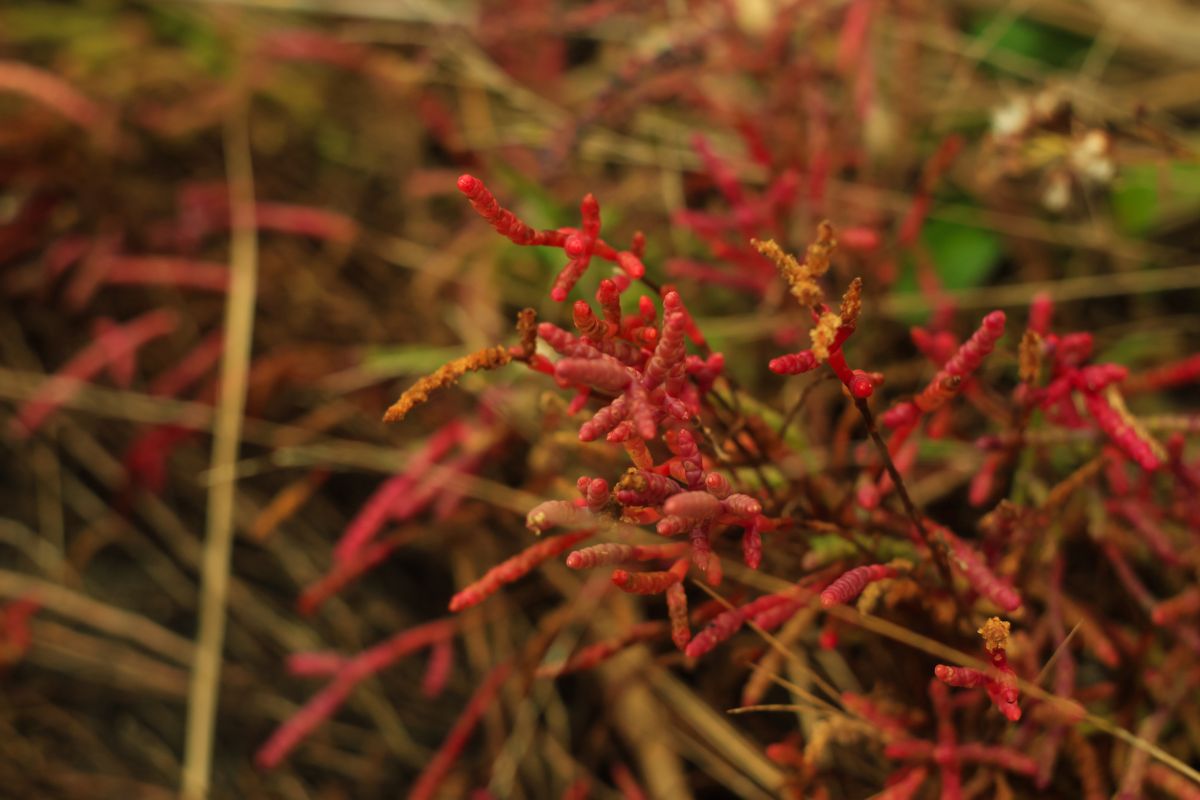
For years, a farmer in Gujarat’s Kutch region struggled with a problem that affects thousands of hectares across India’s coastal belt. Rising soil salinity had gradually reduced the productivity of his land, making conventional crop cultivation increasingly difficult.
Many neighbouring farmers viewed such land as unsuitable for profitable agriculture.
Instead of abandoning cultivation, he began exploring crops naturally adapted to saline environments. His search eventually led him to salicornia, a salt-tolerant plant commonly found in coastal ecosystems and known internationally as a high-value specialty crop.
What started as a small experiment has grown into a successful enterprise that supplies niche food markets while demonstrating a new possibility for salt-affected agriculture.
The venture is attracting attention from farmers facing similar challenges.
Salinity remains one of the biggest constraints affecting coastal agriculture. Excess salt in soil reduces water uptake by plants and limits the productivity of many conventional crops. Farmers often experience declining yields and shrinking profits as salinity levels increase.
The Gujarat farmer faced exactly this situation.
Repeated attempts to cultivate traditional crops produced disappointing results. Rather than continuing the same approach, he decided to identify species that could thrive under local conditions.
This shift in thinking became the turning point.
The challenge was no longer how to remove salinity.
It was how to farm with it.
Discovering a Salt-Loving Crop
Salicornia belongs to a group of plants known as halophytes, which naturally grow in saline environments. Unlike most crops, it can tolerate conditions that would severely affect conventional agriculture. Internationally, salicornia is used in gourmet cuisine, health foods, and specialty agricultural products. The farmer began with a small trial plot to understand cultivation practices and market demand.
The results were encouraging.
The crop adapted well to local conditions and produced harvests from land previously considered marginal. This success encouraged expansion into larger production areas.
The experiment became a business opportunity.
One factor behind the enterprise’s growth was the existence of specialised markets. Restaurants, food retailers, and health-conscious consumers increasingly seek unique products with distinct nutritional and culinary characteristics. Salicornia fits this demand because of its unusual flavour and coastal identity.
The farmer focused on quality and direct market development rather than bulk commodity sales.
This approach allowed him to access premium buyers willing to pay higher prices than traditional agricultural markets.
Market positioning proved as important as cultivation.
The crop’s uniqueness became a commercial advantage.
Turning a Limitation Into an Asset
Most agricultural success stories focus on fertile land and favourable growing conditions. This enterprise followed a different path. The farmer’s biggest challenge became his strongest advantage. While salinity reduced the viability of conventional crops, it created ideal conditions for a plant specifically adapted to such environments.
Researchers studying climate-resilient agriculture often highlight the importance of matching crops to local ecosystems.
The salicornia enterprise demonstrates this principle in practice.
Adaptation became the foundation of profitability.
Climate change and sea-level rise are increasing salinity problems in many coastal regions. Agricultural scientists are therefore paying greater attention to crops capable of thriving under these conditions. Salicornia is among several species being evaluated for future farming systems.
The Gujarat farmer’s experience is attracting interest because it provides a practical example of commercial production under challenging conditions. While the crop will not replace mainstream agriculture, it offers an additional option for affected regions.
New opportunities are emerging from difficult environments.
A Different Vision of Farming
The success of the enterprise reflects a broader lesson about agricultural innovation.
Progress does not always come from growing more of the same crops. Sometimes it comes from identifying entirely different possibilities suited to changing conditions.
By cultivating salicornia, the farmer transformed a perceived disadvantage into a profitable business. Land once considered problematic now generates income through a crop specifically adapted to its environment.
As coastal agriculture faces increasing climate pressures, similar approaches may become more important.
In Gujarat’s salt-affected landscapes, one farmer has shown that the future of farming may sometimes lie in crops that welcome conditions others cannot tolerate.
Contact us: If farmers want to share information or experiences related to farming with us, then they can do this by calling us on the phone number 9599273766 or by writing an email to kisanofindia.mail@gmail.com or by sending your recording. Through Kisan of India, we will convey your message to the people, because we believe that if the farmers are advanced then the country is happy.