



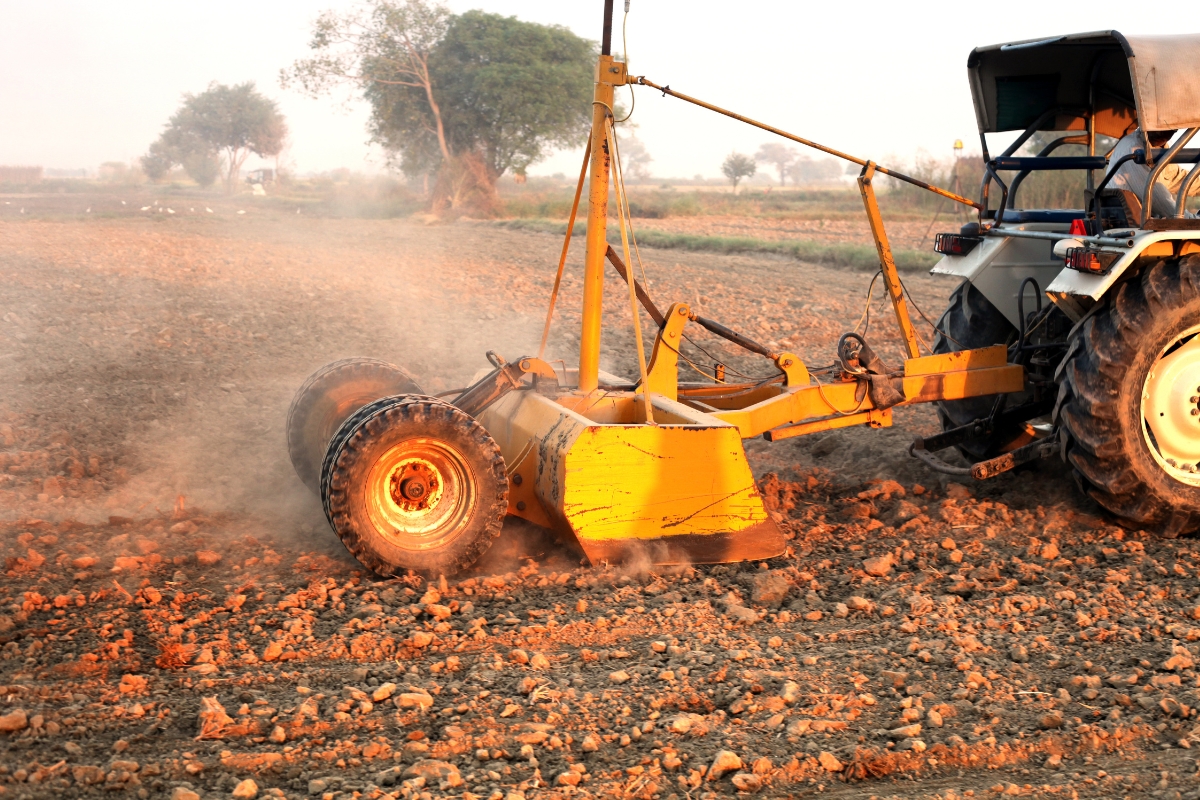
Uneven farm fields may appear to be a minor problem, but they can significantly affect agricultural productivity. Fields with depressions and elevated patches often receive unequal amounts of water during irrigation. Some areas become waterlogged while others remain dry, resulting in uneven crop growth and inefficient use of resources.
To address this challenge, farmers across India are increasingly adopting laser land levellers. These machines use laser-guided technology to create uniformly level fields, improving irrigation efficiency and crop establishment. Agricultural scientists consider laser levelling one of the most effective farm mechanisation tools for improving water management in irrigated agriculture.
Researchers have found that properly levelled fields can reduce irrigation water requirements while improving crop performance and farm profitability.
Traditional land preparation methods often leave fields with small variations in height. During irrigation, water naturally accumulates in lower areas while higher portions receive less moisture.
This uneven distribution leads to inefficient water use and inconsistent crop growth. Farmers may apply additional irrigation to compensate, increasing both water consumption and pumping costs.
Water management experts note that field levelling is one of the simplest ways to improve irrigation performance without changing cropping patterns.
Laser Technology Improves Accuracy
Laser land levellers use a laser transmitter, receiver, control box, and scraper unit attached to a tractor. The system continuously measures field elevation and automatically adjusts the scraper blade to achieve the desired level.
Unlike conventional levelling methods that depend largely on operator judgement, laser-guided systems provide much greater precision. Fields can be levelled accurately across large areas, ensuring uniform water distribution during irrigation.
Agricultural engineers report that precision levelling often delivers immediate improvements in field performance.
One of the most important benefits of laser levelling is improved irrigation efficiency. When fields are level, water spreads evenly across the entire surface, reducing losses caused by runoff and excessive ponding.
Farmers can achieve adequate soil moisture using less water, which is particularly important in regions facing groundwater depletion and increasing irrigation costs.
Researchers studying water conservation consistently identify laser levelling as a highly effective technology for improving resource use efficiency.
Uniform irrigation contributes directly to healthier crop growth. Seeds germinate more evenly, plant populations become more consistent, and nutrient availability improves across the field.
Many studies have reported yield improvements in crops such as wheat, rice, maize, and sugarcane following laser levelling. The benefits arise because crops experience more uniform growing conditions throughout the season.
Agronomists note that improved field conditions often lead to better crop performance even without major changes in other management practices.
Fuel and Labour Costs Decline
Efficient water application reduces the number of irrigation cycles required during the season. Farmers spend less time managing water and operate pumps for fewer hours, reducing fuel and electricity costs.
The improved field surface also supports smoother movement of farm machinery during sowing, spraying, and harvesting operations. This further improves operational efficiency and reduces labour requirements.
Agricultural economists point out that savings from water, energy, and labour often contribute significantly to the economic benefits of laser levelling.
India’s agricultural sector faces growing pressure to use water more efficiently. Groundwater depletion, rising energy costs, and climate variability are making resource conservation a priority across many farming regions.
Laser land levelling supports these goals by improving irrigation efficiency without requiring major changes in cropping systems. Farmers continue growing the same crops while using available resources more effectively.
Researchers believe precision land preparation technologies will play an increasingly important role in sustainable agricultural development.
Precision Begins Before the Crop Is Planted
Many agricultural technologies focus on crop management after sowing. Laser land levelling demonstrates that important improvements can begin even before seeds enter the field.
By creating a uniform land surface, farmers improve irrigation, reduce waste, and provide crops with more consistent growing conditions. The technology delivers benefits that continue throughout the production cycle.
As agriculture seeks higher productivity with fewer resources, laser land levellers are proving that precision farming often starts from the ground up.
Also Read: Punarnava Jal – The world’s first organic fertilizer! Know how it is beneficial for farmers?
Contact us – If farmers want to share any valuable information or experiences related to farming, they can connect with us via phone or whatsapp at 9599273766 or you can write to us at “kisanofindia.mail@gmail.com”. Through Kisan of India, we will convey your message to the people, because we believe that if the farmers are advanced then the country is happy.
You can connect with Kisan of India on Facebook, Twitter, and Whatsapp and Subscribe to our YouTube channel.