



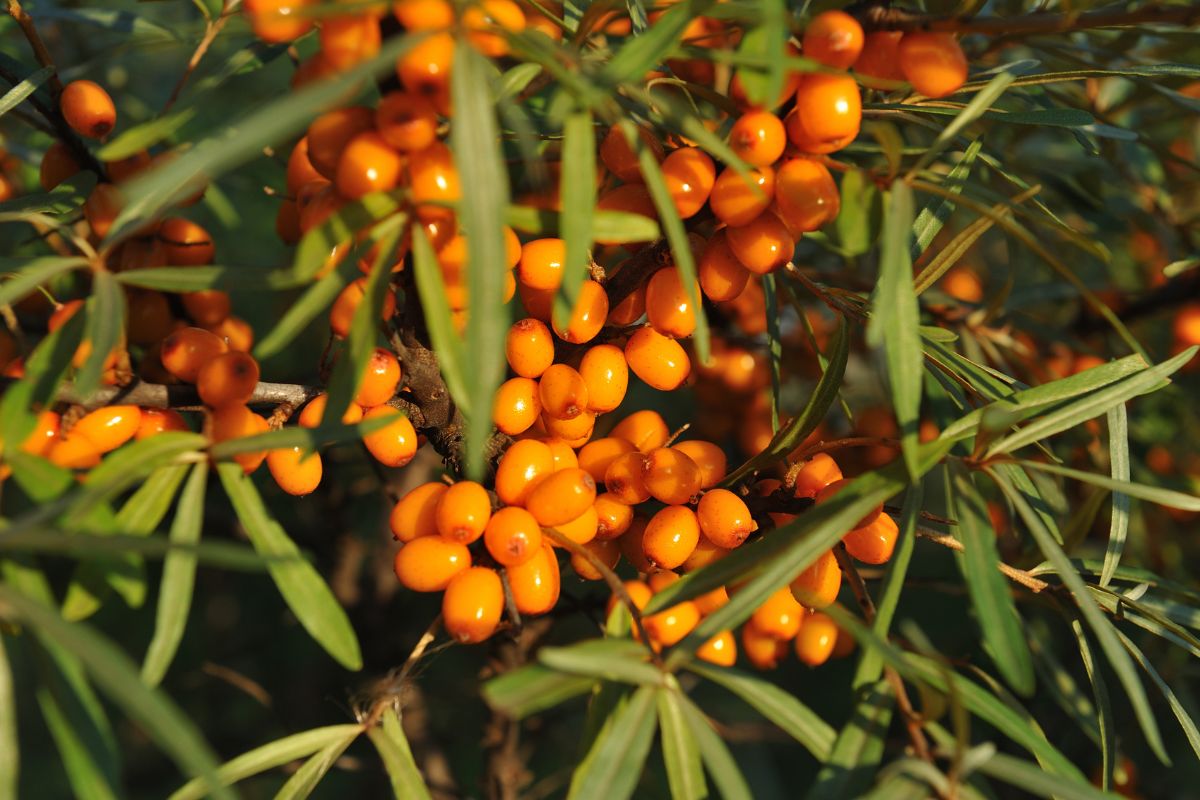
Ladakh’s sea buckthorn sector could get a major research and development boost after the Union Agriculture Ministry formed a high-level committee to assess a proposal for a dedicated National Sanjeevani Research Centre in Nubra Valley.
The Indian Council of Agricultural Research constituted the committee on August 21. Its members visited Ladakh on August 24 to meet officials and local stakeholders and assess the potential for the proposed centre.
Why Nubra is being considered
Nubra Valley is among Ladakh’s major sea buckthorn-producing areas. The naturally occurring Himalayan plant has potential across food, nutraceutical, pharmaceutical and other processing industries. The plant is already used to make products such as pulp, juices, jams, herbal drinks, oils and other value-added products. Local businesses have also started building enterprises around the berry and its processed products.
The proposed research centre is intended to strengthen this value chain. The committee will examine the existing sea buckthorn genetic resources, natural distribution, cultivation, production, utilisation and ongoing research in Ladakh.
The committee will examine several models for the centre. These include a standalone national research centre, a regional station of an existing ICAR institute or a multi-agency network.
The possible partners include ICAR, the Ladakh administration, DRDO, CSIR, AYUSH and industry. The committee will also identify research gaps and assess options for propagation, production, processing and commercialisation.
This matters because sea buckthorn is not simply a wild berry that can be harvested and sold. Expanding its commercial use requires better planting material, cultivation methods, harvesting systems and post-harvest handling.
Research could also help address the difficulties involved in scaling up production.
Farmers could gain from organised production
The committee has specifically been asked to examine the potential for farmer clusters, nurseries, cooperatives and public-private partnerships around sea buckthorn.
These systems could help move the crop from scattered natural growth towards more organised production and marketing.
That shift could create opportunities for farmers and local communities to participate in different parts of the value chain. They could supply berries to processors or become involved in nursery production, primary processing and other activities.
A recent report from Ladakh shows that demand for sea buckthorn products is already growing, while the supply of berries remains a constraint. One local entrepreneur told ThePrint that companies were seeking much larger quantities than producers could currently supply.
Sea buckthorn is also important from an ecological perspective.
Its roots can help stabilise fragile soils, while the plant can grow in the cold, arid conditions of the Himalayan region. Research on the plant has documented its ecological and commercial importance in India’s cold desert regions.
This gives the proposed research centre a wider role than simply increasing berry production.
Research could look at cultivation, conservation, processing and new products while also considering the ecological conditions in which the plant grows.
For Ladakh, maintaining that balance will matter as commercial demand increases.
Report due within 45 days
The committee has been asked to prepare a feasibility report and detailed project report within 45 days of its constitution.
It will also prepare broad estimates for infrastructure, equipment, staff and recurring costs. A five-year action plan with measurable targets and timelines is also part of its mandate.
This means the research centre is still at the proposal and assessment stage. The government has not yet announced that a fully operational national centre will be established.
The committee’s recommendations will determine the next step.
For Ladakh’s farmers and local businesses, the proposal could provide a stronger research base for a crop that already has an emerging market.
The bigger opportunity will be to connect research with nurseries, farmers, processors and buyers so that the benefits of sea buckthorn reach local communities rather than remaining limited to research facilities.
Also Read: Punarnava Jal – The world’s first organic fertilizer! Know how it is beneficial for farmers?
Contact us – If farmers want to share any valuable information or experiences related to farming, they can connect with us via phone or whatsapp at 9599273766 or you can write to us at “kisanofindia.mail@gmail.com”. Through Kisan of India, we will convey your message to the people, because we believe that if the farmers are advanced then the country is happy.
You can connect with Kisan of India on Facebook, Twitter, and Whatsapp and Subscribe to our YouTube channel.