


Can Onion Storage Help Farmers Earn More by Avoiding Distress Sales?

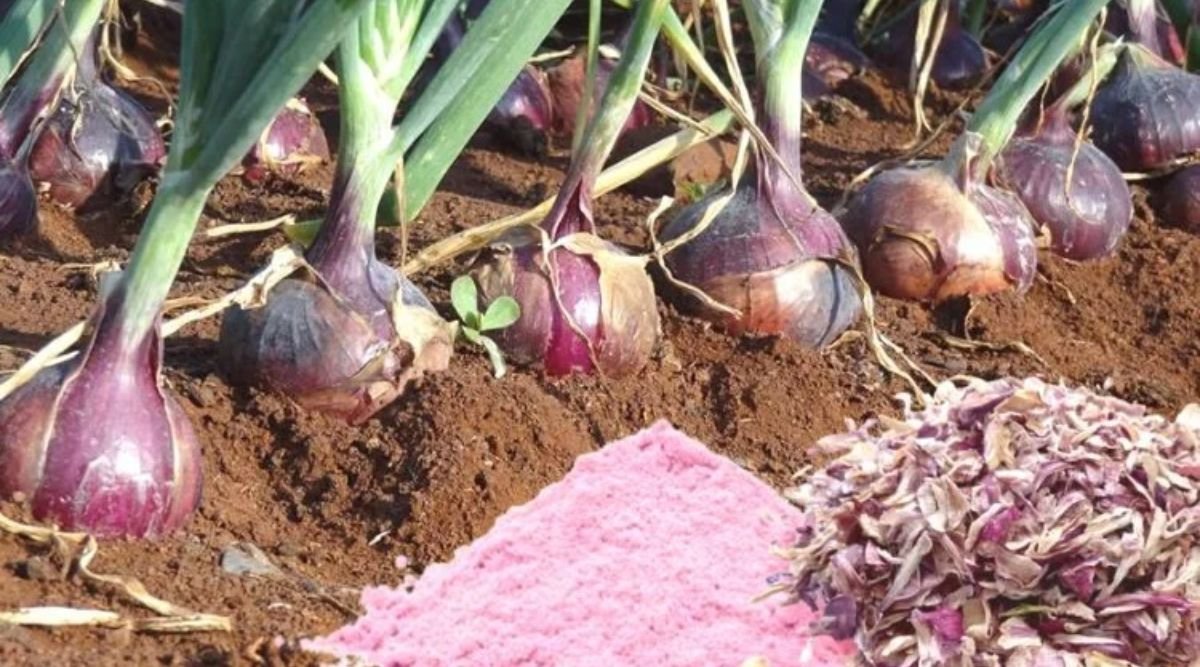
Onion prices can change quickly after harvest. When many farmers bring produce to the market at the same time, growers may have limited bargaining power. Better storage can give farmers another option: keep good-quality onions for a suitable period and sell them when market conditions improve.
ICAR-Central Institute of Agricultural Engineering has developed storage technologies specifically for farm-level use. Its On-Farm Agro-Processing Technology Park in Bhopal demonstrates a five-tonne multi-module onion storage system and an all-side ventilated onion storage structure.
The multi-module system has five one-tonne storage modules connected through an aeration network. ICAR reports that the system is designed to keep overall storage losses below 15% for six months. This gives farmers a possible way to hold marketable onions for longer instead of selling the entire crop immediately after harvest.
How Better Storage Can Help Farmers
Storage does not automatically mean higher profit. The farmer still has to consider construction or rental costs, electricity or ventilation requirements, labour, transport, quality loss and the future market price. The business works only when the additional value from delayed selling is higher than these costs.
ICAR has also developed a simpler all-side ventilated onion storage structure using wooden strips, with a roof that protects the produce from sunlight and rain. The institute reports storage losses below 30% over three months under the evaluated conditions.
The choice between storage systems should depend on farm size and expected production. A small grower may not need to construct a large facility alone. Several farmers can explore collective storage through an FPO, cooperative or farmer group, provided responsibilities for costs, maintenance and marketing are clearly decided.
Storage can also support better market planning. Instead of selling immediately after harvest, farmers can divide their produce into batches. One portion can be sold for immediate cash needs while another portion is stored. This approach can reduce dependence on a single market day or buyer.
Farmers should not put damaged, diseased or wet onions into storage. Proper curing, sorting and removal of damaged bulbs are important before storage. Poor-quality onions can deteriorate quickly and increase losses inside the storage structure, affecting the quality of the remaining produce.
Ventilation is another important factor. Onion bulbs need suitable airflow during storage. ICAR’s storage designs use ventilation systems to help manage storage conditions. Farmers should follow the technical specifications of the selected structure rather than treating storage as simply placing onions inside a closed room.
Farmers should also maintain records of the quantity stored, date of storage, quantity removed and losses observed. These records can show whether storage is actually improving returns. After one season, farmers can compare the result with immediate sale and decide whether expanding storage makes financial sense.
Storage Can Support Collective Farming Businesses
FPOs can play a larger role because they can aggregate onions from several members and manage storage collectively. Government data show that 10,000 FPOs had been formed under the central scheme by July 2026. FPOs undertake activities including aggregation, trading, value addition and processing.
Collective storage can also improve bargaining power because an FPO can hold larger volumes and approach buyers with a more consistent supply. But the group needs clear rules on storage charges, ownership of produce, quality standards, sale timing and payment distribution before starting such an enterprise.
The Agriculture Infrastructure Fund can also support post-harvest infrastructure. As of March 2026, loans worth ₹84,202 crore had been sanctioned for 1.68 lakh projects under AIF, while interest subvention support covered warehouses, cold stores and integrated processing units.
Farmers and FPOs should check eligibility and current guidelines before planning an infrastructure project. They should also prepare a basic business calculation covering construction, equipment, labour, electricity, maintenance, transport, expected storage losses and likely selling prices.
Is Onion Storage Right For Small Farmers?
For a small farmer, building a storage unit may not always be the best option. Renting existing storage or joining an FPO may require less capital. The decision should be based on production volume, local onion prices, storage availability and how much money the farmer needs immediately after harvest.
The wider opportunity is to treat storage as part of farm marketing rather than simply a place to keep unsold produce. Better storage can reduce avoidable post-harvest losses and give farmers more flexibility over when and how they sell their crop.
ICAR’s work shows that farm-level onion storage technologies are available in different designs and capacities. Farmers can approach their nearest KVK or agricultural engineering centre to learn whether a particular system suits their crop, location and scale.
For farmers growing onions, the business question is not simply how much the crop produces. It is also how much of that harvest reaches the market in good condition and whether the farmer has enough flexibility to choose the selling time. Better storage can become one part of that strategy.
Also Read: Punarnava Jal – The world’s first organic fertilizer! Know how it is beneficial for farmers?
Contact us – If farmers want to share any valuable information or experiences related to farming, they can connect with us via phone or whatsapp at 9599273766 or you can write to us at “kisanofindia.mail@gmail.com”. Through Kisan of India, we will convey your message to the people, because we believe that if the farmers are advanced then the country is happy.
You can connect with Kisan of India on Facebook, Twitter, and Whatsapp and Subscribe to our YouTube channel.