



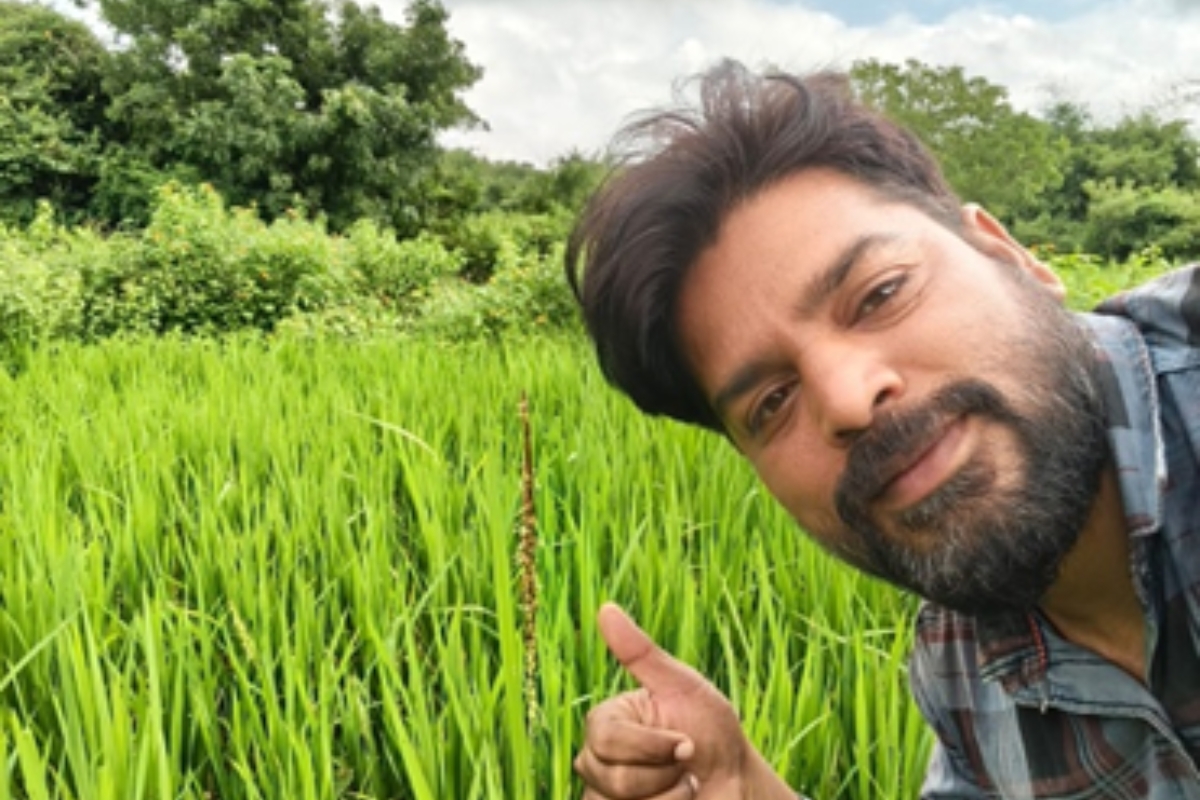
A postgraduate farmer from Odisha has turned black rice cultivation into an export business, sending seven tonnes of Labanya black rice from Chikiti in Ganjam district to Chicago, USA.
Bikram Gouda, 36, returned to farming after completing his postgraduate studies. Instead of continuing with conventional paddy alone, he looked for a high-value crop that could reach premium markets. He chose Labanya black rice and worked with agricultural scientists to develop an export-oriented production system.
Gouda received technical support from the Krishi Vigyan Kendra in Ganjam-II under the guidance of ICAR-Agricultural Technology Application Research Institute, Kolkata. The support covered the entire crop cycle. Scientists advised him on scientific cultivation, nutrient management, pest and disease control and water management.
The guidance continued after harvesting. Gouda received advice on drying, grading, cleaning, storage and packaging. He was also introduced to export standards and traceability requirements.
For a farmer targeting an overseas market, these steps were as important as crop production. Export buyers require consistent quality, proper handling and documentation.
Seven tonnes reach the US market
Gouda produced seven tonnes of export-quality Labanya black rice and sent the entire quantity to Chicago. The export generated a gross income of ₹8.4 lakh, according to ICAR. The result was significantly better than the returns he could expect from conventional paddy cultivation.
Black rice is valued for its nutritional properties and contains anthocyanins, fibre, iron and other minerals. Labanya is described as a non-sticky and high-yielding variety. The crop also targets a niche market. That means farmers can potentially earn through quality and specialised demand rather than competing only in the bulk rice market.
Gouda’s experience has already influenced other farmers in his area. Five progressive farmers have adopted black rice cultivation under his guidance. His farm has also become a learning site for farmers interested in high-value and export-oriented crops.
This farmer-to-farmer spread is important because adopting a new crop involves uncertainty. Farmers are more likely to consider diversification when they can see the results on a nearby farm with similar growing conditions. Gouda’s experience also shows that crop diversification does not end with choosing a new seed. Farmers need knowledge about production, quality control, post-harvest handling and markets.
Quality matters more than just yield
The black rice story highlights a key difference between ordinary commodity farming and premium-market farming.
A farmer producing for an international buyer needs to maintain quality from sowing to packaging. Poor drying, storage or grading can reduce the value of an otherwise good crop.
Gouda’s training therefore covered the complete chain rather than focusing only on field production.
The approach helped him meet international quality requirements and establish a connection with an overseas buyer. His experience shows how extension services can help farmers move from production to market-oriented agriculture.
Export markets need more farmer support
Gouda’s success also points to the challenges faced by farmers who want to enter export markets.
Farmers need access to quality planting material, technical advice, certification, packaging facilities, traceability systems and reliable buyers.
They may also need support with documentation and logistics. A farmer can produce a premium crop but still struggle to export it without the right market connections.
ICAR has highlighted Farmer Producer Organisations, export-oriented production clusters and stronger market linkages as ways to help more farmers reach international markets.
For Gouda, the journey from Chikiti to Chicago started with changing the crop. It became a successful business only after production was combined with quality control and market planning.
His story offers a practical lesson for educated rural youth and other farmers. A high-value crop can create new opportunities, but the bigger gains come when farmers understand the complete chain from field to final buyer.
Also Read: Punarnava Jal – The world’s first organic fertilizer! Know how it is beneficial for farmers?
Contact us – If farmers want to share any valuable information or experiences related to farming, they can connect with us via phone or whatsapp at 9599273766 or you can write to us at “kisanofindia.mail@gmail.com”. Through Kisan of India, we will convey your message to the people, because we believe that if the farmers are advanced then the country is happy.
You can connect with Kisan of India on Facebook, Twitter, and Whatsapp and Subscribe to our YouTube channel.