


Panchagavya in Natural Farming: Can Farm-Made Inputs Support Crop Growth?

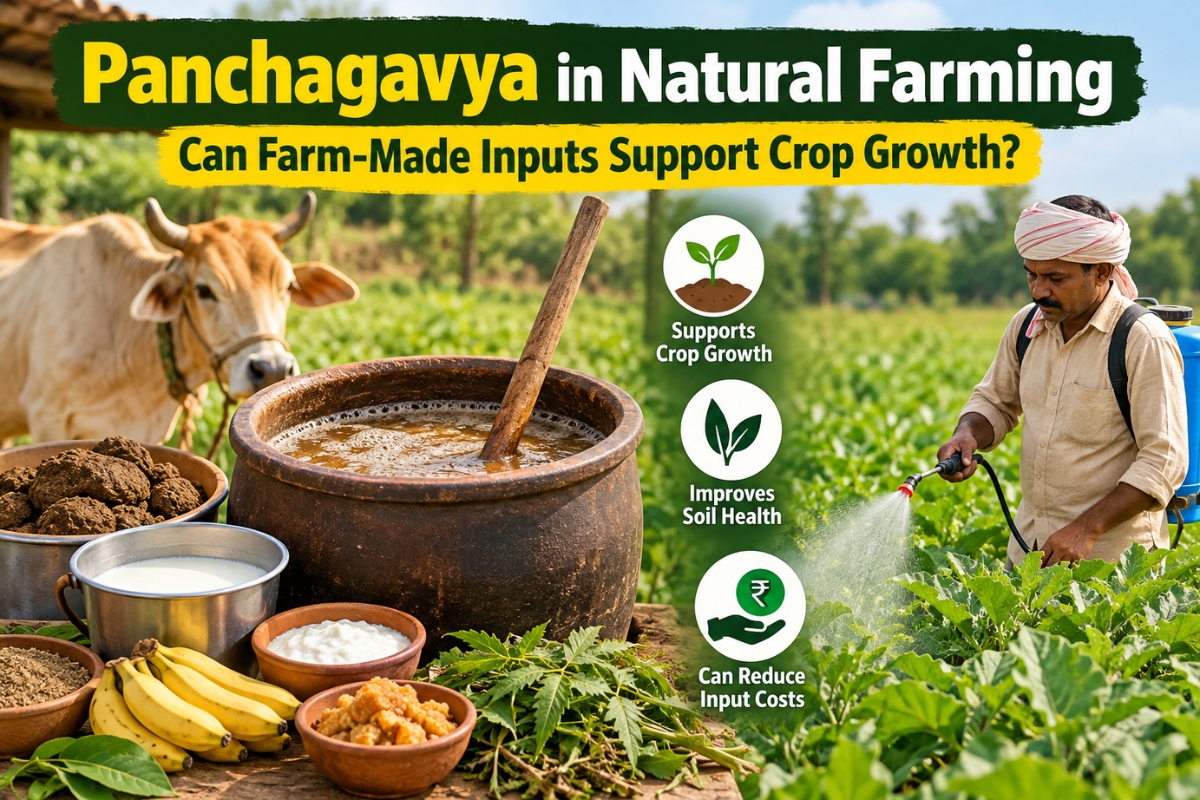
Panchagavya is a traditional farm-made preparation used in some natural and organic farming systems. It is generally prepared using products obtained from cattle along with other ingredients and is used as a crop-input preparation. Farmers use it mainly as a foliar spray or soil application depending on the farming system.
The practice has received attention through natural farming programmes because farmers can prepare many inputs locally rather than purchasing every crop-input product from the market. But the preparation should be made hygienically and according to a recommended method because poor preparation can reduce its usefulness.
The National Mission on Natural Farming promotes locally prepared natural farming inputs and encourages farmers to reduce dependence on purchased agricultural inputs. The programme focuses on farm-based systems, soil health, biodiversity and reduced external input use.
Panchagavya should not be described as a guaranteed replacement for fertilisers or pesticides. Its role is better understood as one component of a broader crop-management system that also includes soil fertility, crop rotation, mulching, water management and pest monitoring.
How Do Farmers Use It?
Farmers using Panchagavya generally apply diluted preparations to crops through foliar spraying or other recommended methods. The exact concentration and application schedule should follow guidance from the local agriculture department, KVK or natural farming training programme.
Farmers should avoid increasing the concentration simply because they believe a stronger solution will work better. Excessive or poorly prepared applications can damage plants or create other problems. A small-area trial is safer before applying any farm-made preparation across the entire crop.
The preparation also needs clean containers and suitable storage. Farmers should avoid contamination from chemicals, waste or other materials. If a preparation develops an abnormal smell, mould growth or other signs of poor fermentation, it should not automatically be applied to crops.
Natural farming inputs work best when they are part of a planned farm system. Soil organic matter, moisture, crop diversity and pest pressure all influence crop performance. One preparation cannot compensate for poor soil management or severe pest and disease pressure.
Can It Reduce Input Costs?
One reason farmers consider farm-made preparations is the possibility of reducing expenditure on purchased inputs. Ingredients available on the farm can lower the cash cost of some crop operations, particularly where farmers already maintain livestock.
But farmers should calculate the real cost of preparation. Labour, ingredients purchased from outside, containers, transport and application all have an economic value. A farm-made input is not automatically cheaper if it requires substantial labour or purchased materials.
Farmers should maintain records when trying Panchagavya. Record the quantity prepared, ingredients used, labour involved, application cost and crop response. This allows farmers to compare the practice with their existing input programme.
The comparison should also include yield and quality. If a lower-cost input programme produces substantially lower yields, the saving may not represent a better economic return. Farmers need to consider total income rather than input cost alone.
What About Soil Health?
Natural farming systems place strong emphasis on improving soil biological activity and reducing dependence on synthetic inputs. Farm-made biological preparations are often promoted as part of this approach.
But soil health depends on many factors. Adding organic matter, maintaining crop residues, reducing unnecessary soil disturbance, managing irrigation and using suitable crop rotations can all influence soil condition.
Farmers should therefore avoid thinking of Panchagavya as a stand-alone soil-health solution. A soil test can provide a clearer picture of nutrient status and help identify problems that a farm-made preparation cannot correct.
Where nutrient deficiencies are confirmed, farmers should follow locally recommended nutrient-management practices. Natural or organic farming does not mean ignoring crop nutrient requirements. Plants still need nutrients in adequate quantities and suitable forms.
What Farmers Should Be Careful About
The biggest mistake is treating Panchagavya as a universal substitute for pesticides, fungicides or fertilisers. Crop diseases and insect pests have different causes and require different management approaches.
For serious pest or disease outbreaks, farmers should first identify the problem correctly. They can seek advice from a KVK, agriculture department or qualified plant-protection expert before deciding what to apply.
Farmers should also avoid applying an untested preparation immediately before harvest. Any crop-input practice should follow recommended safety and crop-management guidance.
When using farm-made preparations, farmers should maintain hygiene during preparation and application. Equipment should be cleaned properly, and farmers should avoid mixing unknown products together.
Can Small Farmers Try It?
Panchagavya may be worth testing for farmers who already have access to the required farm resources and are following a natural or organic farming system. The cost advantage is more likely where ingredients are locally available and labour is manageable.
Farmers new to the practice should begin with a small demonstration area. They can compare treated and untreated sections under the same crop and soil conditions. This gives a more useful indication of whether the preparation is helping their particular farm.
KVKs and state agriculture departments can also provide guidance on natural farming practices. Farmers should ask for the locally recommended preparation method and application schedule rather than relying on social-media recipes.
Keeping records is especially important. A farmer can compare crop growth, pest pressure, yield and total production cost before deciding whether the practice should be continued.
Is Panchagavya Worth Trying?
Panchagavya can be considered as one farm-made input within a broader natural or organic farming system. Its main attraction is that farmers may be able to prepare inputs locally and reduce some purchased-input costs.
But farmers should not expect one preparation to solve soil fertility, pest or disease problems. Crop performance depends on the complete farming system.
The practical approach is to start small, follow a reliable preparation method, maintain hygiene and compare results with the farmer’s existing practice.
For farmers interested in natural farming, the question is not simply whether Panchagavya “works”. The better question is whether it provides a measurable benefit on their farm at a reasonable cost and without creating new crop-management problems.
Also Read: Punarnava Jal – The world’s first organic fertilizer! Know how it is beneficial for farmers?
Contact us – If farmers want to share any valuable information or experiences related to farming, they can connect with us via phone or whatsapp at 9599273766 or you can write to us at “kisanofindia.mail@gmail.com”. Through Kisan of India, we will convey your message to the people, because we believe that if the farmers are advanced then the country is happy.
You can connect with Kisan of India on Facebook, Twitter, and Whatsapp and Subscribe to our YouTube channel.