


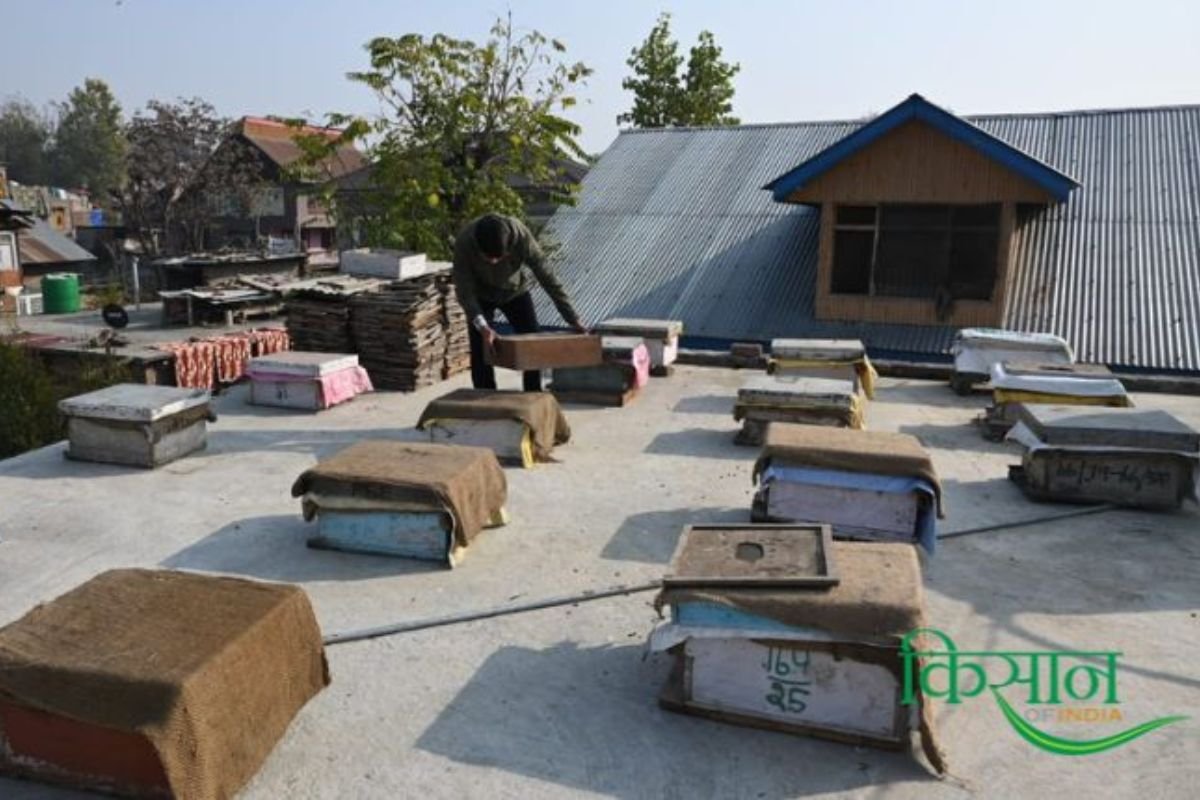
A farmer does not always need more farmland to start another agricultural business. Beekeeping can use field boundaries, bunds and other suitable spaces while giving farmers income from honey and other hive products. Bees also help pollinate crops, linking the enterprise directly with farm production.
India has a large market for honey. The country produced about 152,000 tonnes of honey in 2024-25, while exports reached 114,570 tonnes worth $206.47 million in 2025-26, according to APEDA. Uttar Pradesh, West Bengal, Punjab, Bihar and Rajasthan are among the major producing states.
The business does not depend only on honey sales. Farmers can also earn from beeswax, pollen, propolis, royal jelly, queen bees and bee colonies. Renting colonies to farmers who need pollination for fruits and vegetables can provide another income stream when local demand exists.
Income varies with the number of colonies, bee species, flowering conditions, management, honey yield and market prices. An ICAR study covering beekeepers across 26 states and Union Territories found average net income of ₹92,947 for individual beekeepers managing 50 hives. Group beekeepers averaged ₹1,28,328.
These figures are not guaranteed returns. Honey production can change with weather, availability of flowering plants, colony strength, disease and management. Farmers also need to account for bee boxes, colonies, protective equipment, transport, feeding, extraction, packaging and marketing before calculating their expected profit.
Beekeeping can still suit small farmers because it does not require dedicated farmland. ICAR notes that hives can be placed along field bunds, roadsides, canals and other suitable spaces. The activity can also be combined with crop farming, livestock and horticulture
Bees can help the main farm
The value of bees goes beyond the honey collected from a hive. When bees move between flowers, they transfer pollen and help plants produce fruits and seeds. This makes managed pollination useful for several horticultural and agricultural crops.
ICAR-IIHR has conducted farmer training programmes focused on pollinator conservation and beekeeping. In March 2026, farmers and members of beekeeping FPOs in Karnataka received training on pollinator-friendly practices, including the use of flowering plants to support bee populations.
For a farmer, this creates two possible benefits from the same activity. The bees can generate income through hive products, while their pollination work can support crop production. The actual benefit depends on the crop, bee species, flowering period and how colonies are managed.
The National Beekeeping and Honey Mission is the main central programme supporting scientific beekeeping. The Agriculture Ministry says the mission aims to increase honey and hive-product production, generate rural employment, support farm and non-farm households and improve agricultural and horticultural production.
The programme supports activities such as Integrated Beekeeping Development Centres, honey testing laboratories, bee disease diagnostic facilities, breeding centres, training and technology demonstrations. It also supports marketing, branding and value addition, giving farmers opportunities beyond simply selling raw honey.
Recent government data shows that the programme has supported 90 collection, branding and packaging units, 83 honey processing units, seven honey testing laboratories, 66 mini laboratories and 81 nucleus stock development centres as of August 2026.
Start small and learn first
A new beekeeper needs training before buying colonies. Farmers must learn how to handle bees, inspect colonies, manage feeding, control diseases, harvest honey and protect the queen. Training is available through agricultural universities, Krishi Vigyan Kendras, the National Bee Board and other approved centres.
Farmers should first study the flowering calendar around their farms. Bees need regular access to nectar and pollen. Crops, fruit trees and natural vegetation can provide these resources, but the availability changes with seasons. Planting suitable flowering species can help maintain food sources for colonies.
Climate also matters. Changes in flowering periods, heat, rainfall and pesticide exposure can affect bee colonies and their food sources. Farmers therefore need to select suitable locations, maintain healthy colonies and avoid spraying pesticides when bees are actively visiting flowers.
Beekeeping can work as a small farm enterprise when farmers have suitable flowering resources, basic training and access to markets. Starting with a manageable number of colonies allows farmers to understand local conditions before investing more money in equipment and additional colonies.
The business becomes more attractive when farmers look beyond raw honey. Processing, packaging, branding, beeswax products and pollination services can create additional income opportunities. Farmer groups and cooperatives can also share processing facilities and reach buyers that may be difficult for individual beekeepers to access.
For farmers looking to diversify without acquiring more land, beekeeping offers one possible route. The strongest returns will depend on local conditions, careful colony management and reliable buyers. With scientific training and market support, the hive can become a second farm enterprise rather than simply another source of honey.
Also Read: Punarnava Jal – The world’s first organic fertilizer! Know how it is beneficial for farmers?
Contact us – If farmers want to share any valuable information or experiences related to farming, they can connect with us via phone or whatsapp at 9599273766 or you can write to us at “kisanofindia.mail@gmail.com”. Through Kisan of India, we will convey your message to the people, because we believe that if the farmers are advanced then the country is happy.
You can connect with Kisan of India on Facebook, Twitter, and Whatsapp and Subscribe to our YouTube channel.