


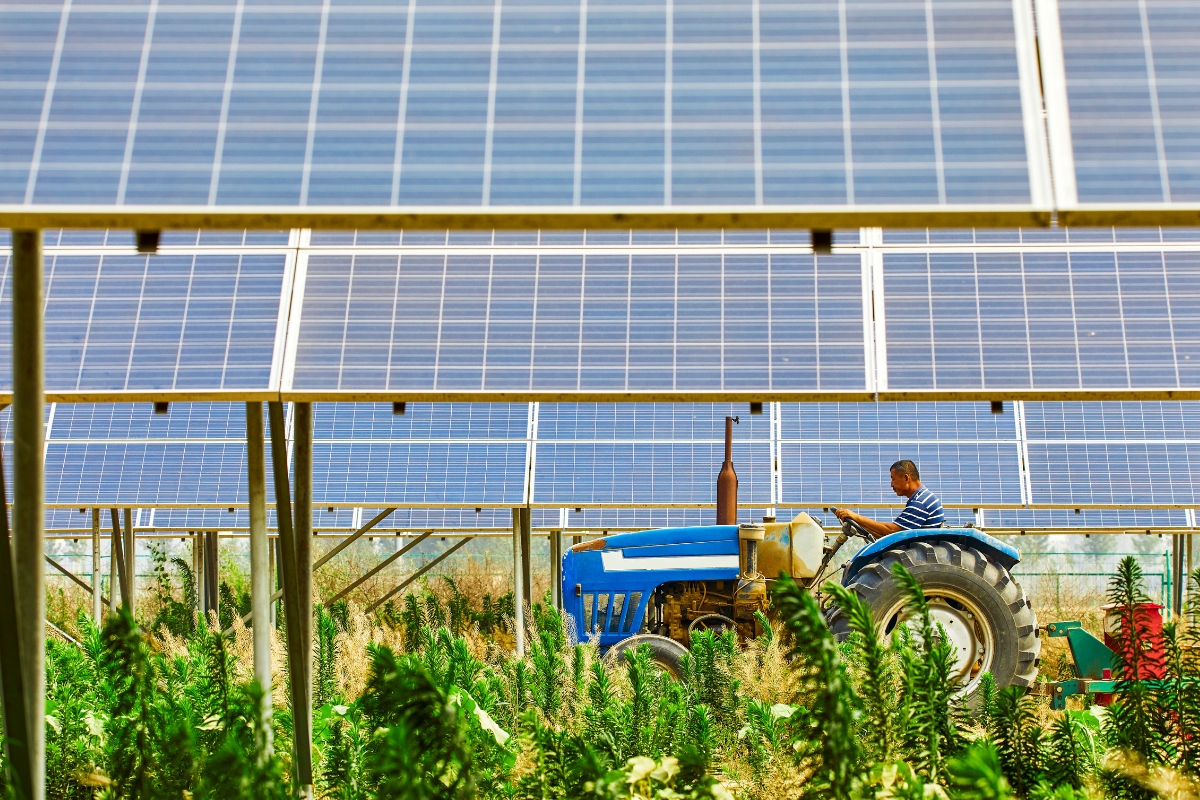
Farmers may soon be able to harvest crops and solar power from the same field. India is preparing to expand agrivoltaics, a system that places elevated solar panels over farmland while cultivation continues below. The approach is gaining attention as the government plans a larger programme under PM-KUSUM.
The seventh AgriVoltaics World Conference opened in New Delhi on October 21 and runs until October 23. Agriculture Minister Shivraj Singh Chouhan said policies must address small and marginal farmers, who account for more than 85% of India’s farmers. He stressed that cultivation should continue under solar structures.
Agrivoltaics can give farmers more than one source of income from the same land. Crops can provide farm earnings, while electricity from solar panels can be sold or used for farm operations. Solar power can also reduce diesel expenses where farmers depend on diesel pumps for irrigation.
India has about 160 million hectares of cropland, of which 47.5 million hectares may be technically suitable for agrivoltaics, according to a TERI study cited by the government. Actual projects would depend on soil, crops, climate, electricity access and local conditions
Agrivoltaics does not mean placing conventional solar plants over every field. Panel height, spacing and design must match farming needs. Structures should leave room for tractors, harvesters and other equipment. Farmers also need drainage and water-harvesting systems so panels do not create problems during heavy rainfall.
Research is still needed to identify crops that perform well beneath panels in different regions. The government has pointed to trials involving multiple solar configurations and crops. ICAR is developing crop suitability data for India’s agro-climatic zones, which could help farmers choose systems suited to local conditions.
Water savings could be another benefit in suitable locations. The government cited field studies showing that some crops may record yield gains of 10–20% and water consumption reductions of about 30% under suitable systems. Results vary by crop, panel arrangement, climate and farm management, so local trials remain important.
PM-KUSUM may expand the model
The next phase of PM-KUSUM is expected to give agrivoltaics a larger role. The government has announced plans for a major agrivoltaic programme through the scheme. Elevated solar structures cost more than conventional ground-mounted plants, so public support may be needed to make projects affordable for farmers
Small farmers will need clear rules before large-scale adoption. Questions around land ownership, electricity purchase, maintenance costs, crop losses and contracts must be settled before projects begin. The government has said farmers should retain land ownership and highlighted Farmer Producer Organisations, cooperatives and panchayats as possible participants.
For farmers, the key question is not whether solar panels can produce electricity. It is whether a solar-crop system can raise farm income without reducing food production. That will depend on crop choice, panel design, financing, electricity tariffs and technical support. Local evidence will be central to that decision.
Agrivoltaics could create rural work beyond farming. The government says villages may need workers trained to operate, repair and maintain solar equipment. Such jobs could support young people while keeping technical services closer to farms. Farmer groups could also share equipment, training and maintenance costs across several holdings.
India’s agrivoltaics push is still taking shape. The current focus is on designing systems that keep farmland productive while adding solar generation. If research, financing and farmer protections move together, the same acre could support food production and electricity without forcing farmers to choose between the two.
Also Read: Punarnava Jal – The world’s first organic fertilizer! Know how it is beneficial for farmers?
Contact us – If farmers want to share any valuable information or experiences related to farming, they can connect with us via phone or whatsapp at 9599273766 or you can write to us at “kisanofindia.mail@gmail.com”. Through Kisan of India, we will convey your message to the people, because we believe that if the farmers are advanced then the country is happy.
You can connect with Kisan of India on Facebook, Twitter, and Whatsapp and Subscribe to our YouTube channel.