



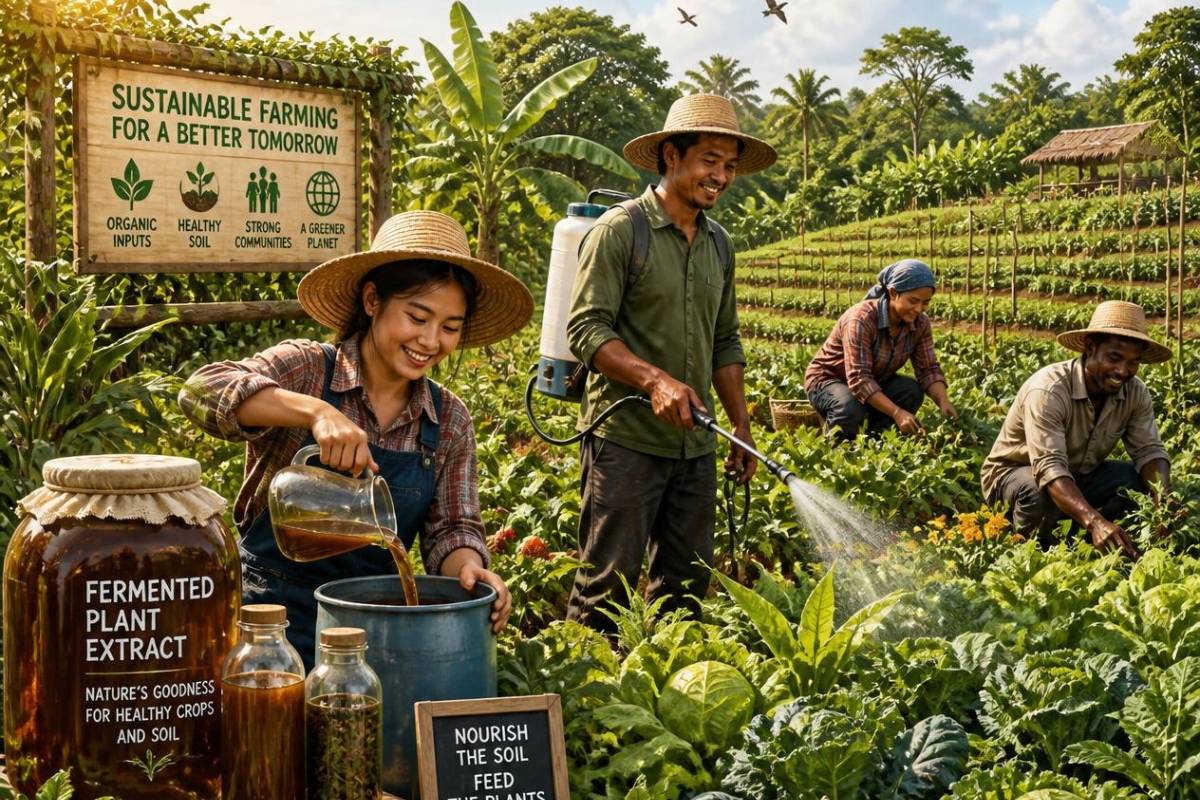
Small farmers often produce limited quantities individually, which can make it difficult to negotiate with large buyers, access processing facilities or purchase farm inputs at favourable rates. A Farmer Producer Organisation, or FPO, can bring producers together so they can undertake activities collectively while retaining individual ownership of their farms.
The government has promoted FPOs to help farmers improve bargaining power, access technology, strengthen value chains and connect with markets. The model can be particularly useful where farmers grow the same crop or operate in the same production area.
7 Ways Farmers Can Benefit
1. Buy Inputs Collectively
An FPO can aggregate demand for seeds, fertilisers, bio-inputs, packaging material and other farm supplies. Instead of every farmer negotiating separately, the organisation can purchase larger quantities and distribute them among members.
Collective purchasing does not automatically guarantee a lower price. Members should compare quotations, check product quality and maintain transparent procurement records. The main benefit is stronger collective demand, which can make it easier to negotiate with suppliers.
2. Aggregate Produce After Harvest
Farmers often have little bargaining power when each household brings a small quantity of produce to market. An FPO can aggregate members’ harvests and create a larger, more consistent lot for buyers.
Aggregation can also make grading, sorting and packaging more practical. Buyers may be more willing to work with an organised supplier that can provide predictable quantities instead of negotiating separately with many individual farmers.
3. Improve Market Access
FPOs can connect farmers with institutional buyers, processors, retailers and other markets that may be difficult for individual producers to reach. The organisation can negotiate contracts or supply arrangements on behalf of its members where appropriate.
Farmers should still understand the terms before committing produce to a buyer. Price, quality specifications, delivery schedules, payment timelines and rejection conditions should be clearly recorded so members know their responsibilities.
4. Share Storage and Equipment
Some agricultural assets are expensive for individual smallholders but can become more practical when shared. An FPO may develop or access storage, grading, processing or farm machinery facilities depending on its business model and available financing.
Shared equipment should have a clear operating system. The organisation needs to decide who can use it, how bookings are made, how maintenance is funded and how costs are recovered. Poor management can turn a useful asset into an underused one.
5. Add Value to Farm Produce
Selling raw produce is not the only option. Depending on the commodity, an FPO can explore cleaning, grading, milling, drying, packaging or other forms of value addition. Processing can create another revenue stream when there is sufficient market demand.
The organisation should study the economics before investing in machinery. Equipment, electricity, labour, packaging, certification, transport and marketing all add costs. A processing unit should be linked to a realistic supply of raw material and identifiable buyers.
6. Improve Access to Information
An organised farmer group can make it easier to circulate information about weather, pest outbreaks, government programmes, market requirements and new technologies. Training can also be arranged for several farmers at once.
FPOs can work with Krishi Vigyan Kendras, agriculture departments, research institutions and other organisations for technical support. Members should still verify important advice before making expensive production decisions, especially when information concerns pesticides, seeds or market commitments.
7. Build Better Business Records
A functioning FPO needs accurate records of procurement, sales, expenses, member transactions, inventory and payments. Good records help members understand whether the organisation is actually creating value and where costs are rising.
Farmers should ask for clear information about prices received, operating expenses and payments made to members. Transparent accounts build trust and allow members to identify problems before they become larger financial losses.
An FPO Needs a Business Plan
Forming an organisation is only the first step. An FPO needs a viable business activity, reliable members, professional management and a market for whatever it plans to sell. Not every FPO needs to build a processing plant or operate a large warehouse.
The right business can differ from one region to another. A vegetable-growing FPO may focus on aggregation and direct marketing, while a pulse-producing group may explore cleaning, grading and packaging. The business should follow the local crop and market rather than a standard template.
Farmers should also understand the difference between collective action and simply handing produce to an organisation. Members need clear rules covering procurement, pricing, payments, membership responsibilities and decision-making.
Start Small and Build Gradually
An FPO does not have to begin with expensive infrastructure. Members can first test collective input purchases or produce aggregation. Once the group understands its costs and market, it can consider larger investments.
Government programmes provide support for the formation and development of FPOs, while financial institutions and other agencies can support eligible activities. Farmers should check the current rules rather than assuming that every FPO automatically receives a subsidy or grant.
The most useful FPOs are built around a practical problem faced by their members. If farmers struggle to sell small quantities, aggregation may be the first priority. If produce is losing value after harvest, grading, storage or processing may deserve attention.
Farmer Producer Organisations can help small farmers work collectively without giving up individual farm ownership. Bulk input purchases, produce aggregation, market access, shared assets and value addition are possible benefits. The success of an FPO depends on transparent management, reliable markets and a business model suited to its members.
Also Read: Punarnava Jal – The world’s first organic fertilizer! Know how it is beneficial for farmers?
Contact us – If farmers want to share any valuable information or experiences related to farming, they can connect with us via phone or whatsapp at 9599273766 or you can write to us at “kisanofindia.mail@gmail.com”. Through Kisan of India, we will convey your message to the people, because we believe that if the farmers are advanced then the country is happy.
You can connect with Kisan of India on Facebook, Twitter, and Whatsapp and Subscribe to our YouTube channel.