



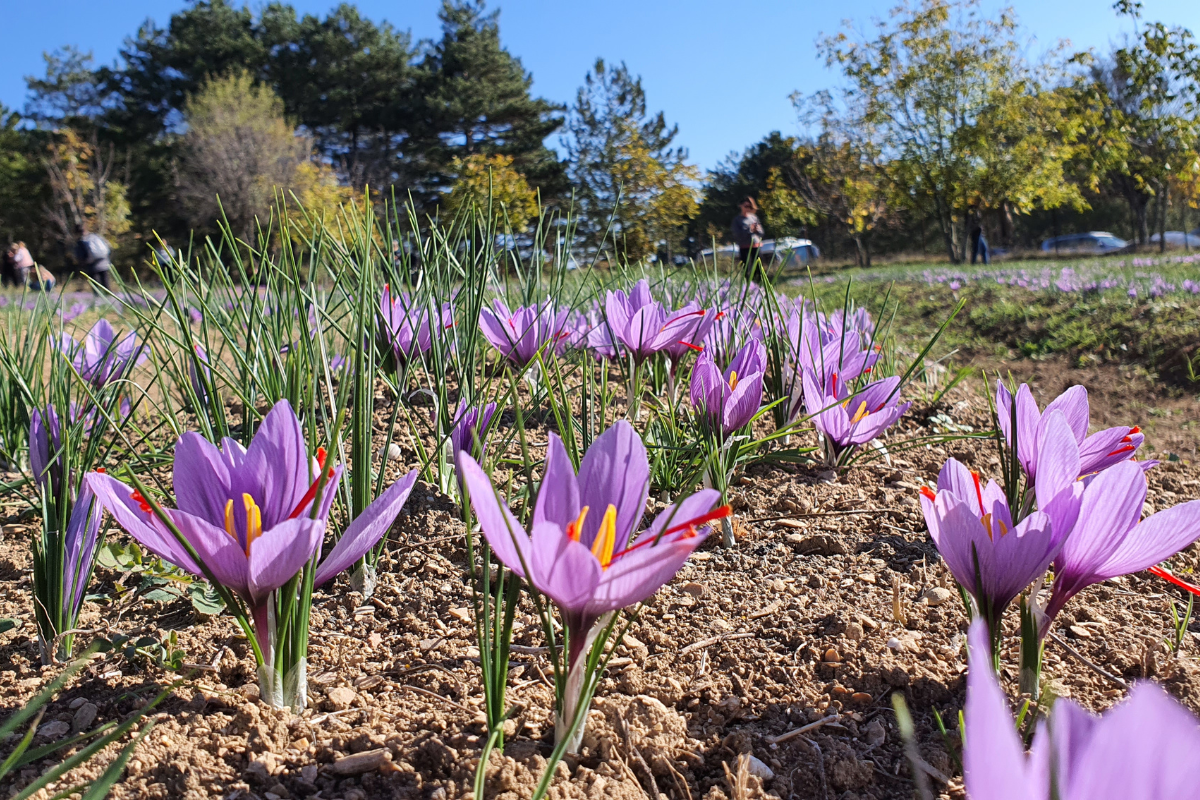
Saffron is one of the highest-value crops grown in Jammu and Kashmir, but its cultivation requires careful land preparation, quality planting material and close field management. Farmers in the Kashmir valley have increasingly adopted scientific practices to improve saffron production and protect the crop from changing weather conditions.
One example comes from Pampore, where the Indian Institute of Integrative Medicine has worked with saffron growers through improved planting material, scientific cultivation practices and training. The institute’s work has focused on improving productivity and supporting farmers involved in Kashmir’s traditional saffron economy.
Why Saffron Needs Careful Management
Saffron is mainly cultivated in the Pampore area of Pulwama district, along with other areas of Kashmir. The crop grows from underground corms, and the quality and size of planting material can affect crop establishment and flowering.
Farmers traditionally depend on experience to manage saffron fields, but scientific practices can help improve planting material, nutrient management and disease control. The Saffron Research Station at Pampore and other agricultural institutions provide technical guidance to growers.
The National Saffron Mission also helped develop irrigation and other infrastructure for saffron-growing areas. The government has reported that the area under saffron cultivation increased from around 5,707 hectares in 2010-11 to 7,201 hectares in 2020-21.
Saffron production is also closely linked with weather. Excess rainfall, dry conditions and changes in temperature can affect flowering and corm development. Farmers therefore need to combine traditional knowledge with better water management and suitable planting material.
Healthy corms are important for saffron cultivation because the crop is propagated through corms rather than ordinary seed. Farmers need planting material that is free from major diseases and has sufficient size and vigour for good establishment.
ICAR-Indian Institute of Integrative Medicine has developed and supplied quality planting material and technologies related to saffron cultivation. Such interventions are intended to improve production while maintaining the quality associated with Kashmir saffron.
Farmers should avoid purchasing corms from unknown sources simply because they are cheaper. Diseased or poor-quality planting material can spread problems across a field and reduce flowering. Farmers should obtain planting material through reliable sources and follow local recommendations.
The GI registration of Kashmir saffron has also strengthened the identity of the product. The government says Kashmir saffron received Geographical Indication registration in 2020, covering saffron produced in the notified areas of Jammu and Kashmir.
Why Processing And Branding Matter
Saffron farmers do not earn only from cultivation. Drying, grading, packaging and marketing can influence the final value of the product. Proper post-harvest handling is important because saffron stigma is delicate and quality can be affected by poor drying or storage.
Kashmir saffron is used in food, beverages, traditional preparations and other products. Better packaging and traceability can help farmers and producer groups distinguish genuine Kashmir saffron from lower-quality or adulterated products.
The government has also promoted the National Saffron Mission as a programme covering productivity improvement, quality improvement, post-harvest management and market development. These activities are important because saffron’s value depends not only on production but also on maintaining quality after harvest.
Farmers can also explore collective marketing through farmer groups or producer organisations. Collective processing and packaging can reduce individual costs and make it easier to reach buyers looking for consistent quality and traceability.
Saffron shows how a small area can produce a high-value agricultural commodity when the crop is carefully managed. But the high market value should not be confused with guaranteed profit. Production is sensitive to weather, planting material, crop management and market conditions.
Farmers interested in saffron should first check whether their land and local climate are suitable. Saffron requires specific soil and climatic conditions, so simply copying the crop in another district may not produce the same results.
Farmers should also calculate the cost of corms, land preparation, labour, irrigation, harvesting, drying and packaging. The crop requires significant labour during flowering and harvesting, making labour availability an important part of the business calculation.
The experience of Kashmir’s saffron growers also shows the value of combining traditional crops with scientific support. Research institutions can help farmers improve planting material and cultivation methods, while GI recognition and better marketing can help protect product identity.
Can Climate Change Affect Saffron?
Climate variability is an important concern for saffron farmers. The crop depends on suitable temperature and moisture conditions for flowering. Changes in rainfall patterns, warmer temperatures or unusual weather during critical stages can affect production.
Farmers can respond by improving soil and water management and following locally recommended cultivation practices. Irrigation can help where suitable, but water management needs to be planned carefully because excess moisture can create problems for saffron corms.
The government has supported saffron cultivation through infrastructure and technology programmes, including irrigation and post-harvest facilities. Such measures can help farmers reduce some production risks, although they cannot eliminate weather-related losses.
For farmers, the practical starting point is to approach the nearest agriculture department or saffron research centre before planting. They should check recommended corm size, planting time, soil requirements, irrigation needs and disease-management practices.
Saffron farming demonstrates how a traditional crop can remain commercially important when farmers combine local knowledge with scientific practices. Quality planting material, careful cultivation, proper drying, traceability and better marketing can all influence the final value of the crop.
For farmers looking at high-value crops, the lesson is not simply to grow saffron because it sells at a high price. The crop works because it is suited to a particular climate and has an established market and product identity. Farmers should match crop choice with local conditions before making an investment.
Also Read: Punarnava Jal – The world’s first organic fertilizer! Know how it is beneficial for farmers?
Contact us – If farmers want to share any valuable information or experiences related to farming, they can connect with us via phone or whatsapp at 9599273766 or you can write to us at “kisanofindia.mail@gmail.com”. Through Kisan of India, we will convey your message to the people, because we believe that if the farmers are advanced then the country is happy.
You can connect with Kisan of India on Facebook, Twitter, and Whatsapp and Subscribe to our YouTube channel.