



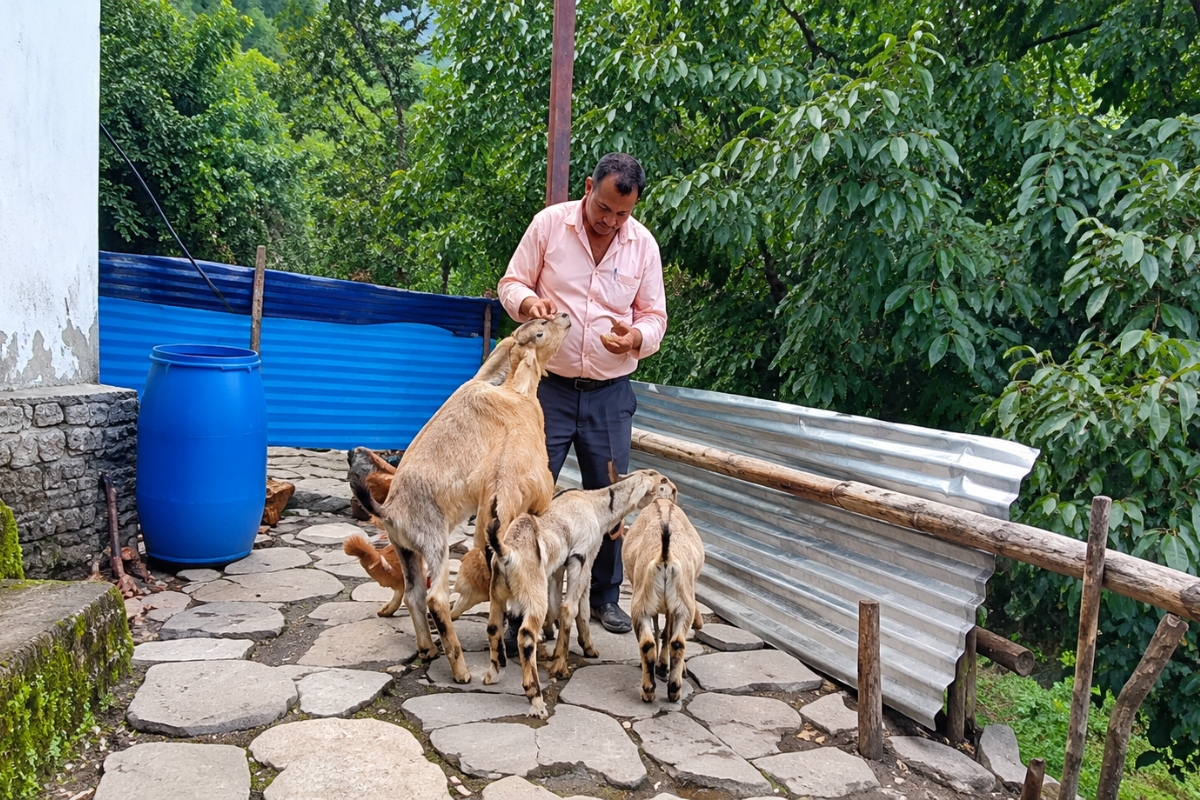
A farmer in Uttarakhand has increased his annual farm income from about ₹72,000 to nearly ₹3.6 lakh by combining dairy, vegetables, fish farming and mushroom cultivation. Kamal Singh Uniyal from Gvin Chhota village in Pauri Garhwal district built the enterprise after returning to farming following unsuccessful business ventures.
Uniyal did not begin with an established commercial farm. He first returned to his ancestral village and sought guidance from the Agriculture Department. During 2015–16, he received training at the State Agricultural Management and Extension Training Institute in Pantnagar, where he learned scientific farming practices and gained skills for managing an agricultural enterprise.
From Traditional Crops To Dairy
Initially, Uniyal cultivated rice and wheat. The returns were limited, so he looked for another source of farm income. With support from the Veterinary Department, he obtained four Sahiwal cattle and started dairy farming. Regular milk sales then gave his household a more consistent source of income.
His dairy unit has since changed. ICAR reports that it now includes two Sahiwal cows, one Sindhi cow, one Badri cow, one Jersey cow and one Pahari buffalo. Together, the animals produce around 20–25 litres of milk each day, adding regular earnings to the farm’s other activities.
Uniyal did not stop with dairy. He later added off-season vegetables, fish farming and mushroom production. His ponds contain grass carp, silver carp and Pangasius, while Dhingri mushroom cultivation provides another source of farm income. The combination allows him to sell different products during different parts of the year.
This approach is different from relying on one crop. If a particular crop faces poor weather or weak prices, other farm activities can continue. Dairy provides regular milk income, while vegetables, fish and mushrooms can generate earnings at different times depending on production and local demand.
The farm also uses training and farmer networks as part of its development. SAMETI-Uttarakhand continued to provide capacity-building support, while its WhatsApp group helped farmers exchange technical information, discuss field problems and promote agricultural products. Online training also connected farmers in remote areas with new information.
How His Income Changed
The change in income is one of the clearest parts of Uniyal’s story. ICAR reports that he earned around ₹72,000 annually during the initial phase of his farming journey in 2017. His diversified farming activities now generate a net annual income of nearly ₹3.6 lakh.
That increase did not come from one technology or one crop. It followed several decisions made over time. Uniyal first built skills through formal training, then added dairy and later introduced vegetables, fish and mushrooms. The farm gradually became a combination of crop and livestock enterprises.
Livestock also expanded beyond dairy. The Veterinary Department provided Uniyal with 11 Pahari goats, further adding to his integrated farming system. Such diversification can help farmers use available land, labour and resources across several activities, though each enterprise still requires separate management and market planning.
His farm has also received recognition. In 2017, he received the Kisan Shree Award from ATMA. He was later honoured as Best Farmer by the Chief Veterinary Officer of Pauri and received another Kisan Shree Award for his work in vegetable production.
The case also shows why training can matter before farmers invest in new activities. Uniyal entered farming without extensive experience but sought technical guidance before expanding. Training gave him information about production practices and helped him make decisions about livestock and other enterprises.
What Other Farmers Can Learn
Farmers do not need to copy Uniyal’s entire model. The more useful lesson is to examine which activities fit their own land, water, labour and market conditions. A farmer with suitable space may combine crops and dairy, while another may find vegetables, poultry or mushrooms more practical.
Integrated farming can also spread income across the year. Milk can provide frequent sales, while vegetables and mushrooms may have shorter production cycles. Fish takes longer to harvest but can create another revenue stream. The right combination depends on the farm’s resources and access to buyers.
Market access remains important. Producing several commodities does not automatically guarantee higher income. Farmers need to know where they can sell milk, vegetables, fish, mushrooms or livestock and what costs are involved in transport, storage and marketing.
Training centres such as KVKs and state agricultural departments can help farmers assess suitable enterprises before investing. Farmers can also seek information about government schemes, livestock support, farm machinery and credit options that may apply to their activities.
Uniyal’s experience shows that a farm can develop gradually. Starting with one activity, learning the required skills and adding another enterprise can reduce the need for a large initial investment. Farmers can assess the results of each activity before deciding whether to expand further.
His current model combines dairy, vegetables, fisheries and mushrooms, while continued training keeps him connected with technical advice. ICAR says his diversified enterprise has helped him increase income and encourage rural youth to consider agriculture as a livelihood.
For farmers looking to diversify, the first step is to identify what your farm already has. Do you have livestock, water, unused space, family labour or access to a nearby market? Those answers can help you choose an additional enterprise instead of investing in an activity that does not fit your farm.
Also Read: Punarnava Jal – The world’s first organic fertilizer! Know how it is beneficial for farmers?
Contact us – If farmers want to share any valuable information or experiences related to farming, they can connect with us via phone or whatsapp at 9599273766 or you can write to us at “kisanofindia.mail@gmail.com”. Through Kisan of India, we will convey your message to the people, because we believe that if the farmers are advanced then the country is happy.
You can connect with Kisan of India on Facebook, Twitter, and Whatsapp and Subscribe to our YouTube channel.