



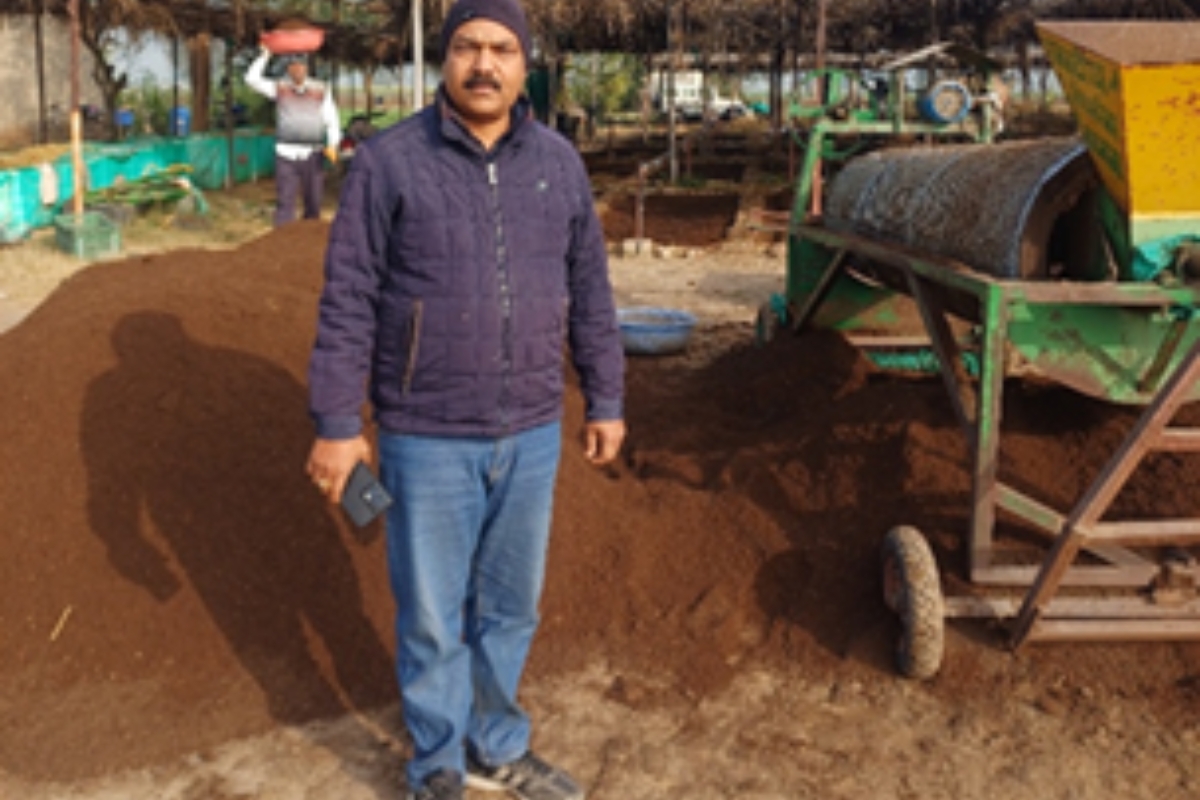
A landless entrepreneur has built a vermicompost enterprise by turning agricultural waste into organic manure, showing how rural businesses can create income without owning farmland.
ICAR has highlighted the story of Subash Chander, a 48-year-old entrepreneur, under its recent success stories. His enterprise, Green Vision Vermicompost, focuses on producing vermicompost and other organic inputs from biodegradable farm waste.
Owning agricultural land is not the only way to build a business around farming. Activities linked to agriculture, such as input production, processing and waste management, can also create rural employment.
Subash Chander’s enterprise is an example of this approach. Instead of cultivating crops himself, he entered the farm-input sector by producing vermicompost.
Vermicompost is made when earthworms break down organic material into a nutrient-rich material that can be used as a soil amendment.
The business therefore connects two needs. Farmers need organic inputs, while farms and other rural activities generate biodegradable material that can otherwise become waste.
Farm waste becomes a marketable product
Vermicomposting uses organic materials such as crop residues, animal waste and other biodegradable matter.
The material is decomposed under controlled conditions with earthworms. Over time, the process produces a fine organic material that farmers can use to improve soil.
For an entrepreneur, the advantage is that the main raw materials can often be sourced locally.
The business still requires proper management. Organic material needs suitable moisture, aeration and temperature, while earthworms need conditions that allow them to remain active.
Quality also matters because farmers buying organic manure need a consistent product.
Demand for organic inputs has increased as farmers look for ways to improve soil health and reduce dependence on purchased chemical fertilisers. Vermicompost does not replace every fertiliser requirement in every farming system. Its value depends on the crop, soil condition, nutrient needs and the way it is used.
For rural entrepreneurs, this creates a market for producing and supplying organic inputs locally. A small enterprise can also expand into related products and services, depending on local demand. The Green Vision Vermicompost story shows how agricultural waste can become the raw material for a business rather than simply something that needs disposal.
A business model beyond farming
Rural entrepreneurship is often closely connected with agriculture even when the entrepreneur does not own a farm.
Input businesses, machinery services, nurseries, food processing and waste management can all support farmers while creating income for people working outside direct crop production.
This can be particularly relevant for landless households that have agricultural skills but limited access to farmland.
A vermicompost unit can also be started at a smaller scale than many agricultural processing businesses, although the actual investment depends on the size of the operation and the availability of raw material.
A vermicompost business needs a dependable supply of organic waste and a nearby market for the finished product. Transport costs can become significant if raw material has to be brought from distant farms or if finished compost has to travel long distances to reach buyers.
This makes location important. Entrepreneurs can look for areas with concentrated farming, dairy activity, horticulture or other sources of organic waste. Farmer Producer Organisations and cooperatives can also become potential buyers or partners because they can aggregate demand from several farmers.
Turning waste into income
Subash Chander’s Green Vision Vermicompost shows how a rural enterprise can connect waste management with agriculture. ICAR has featured the business as an example of entrepreneurship built around organic manure production.
The story also offers a practical idea for people who want to work in agriculture but do not own farmland.
Instead of asking only what crop can be grown, entrepreneurs can look at what farmers need and what materials are already available locally. For some rural areas, farm waste can provide the starting point for businesses that produce compost, bio-inputs or other agricultural products.
The success of such enterprises will depend on product quality, reliable raw materials, local demand and good business management.
Also Read: Punarnava Jal – The world’s first organic fertilizer! Know how it is beneficial for farmers?
Contact us – If farmers want to share any valuable information or experiences related to farming, they can connect with us via phone or whatsapp at 9599273766 or you can write to us at “kisanofindia.mail@gmail.com”. Through Kisan of India, we will convey your message to the people, because we believe that if the farmers are advanced then the country is happy.
You can connect with Kisan of India on Facebook, Twitter, and Whatsapp and Subscribe to our YouTube channel.