


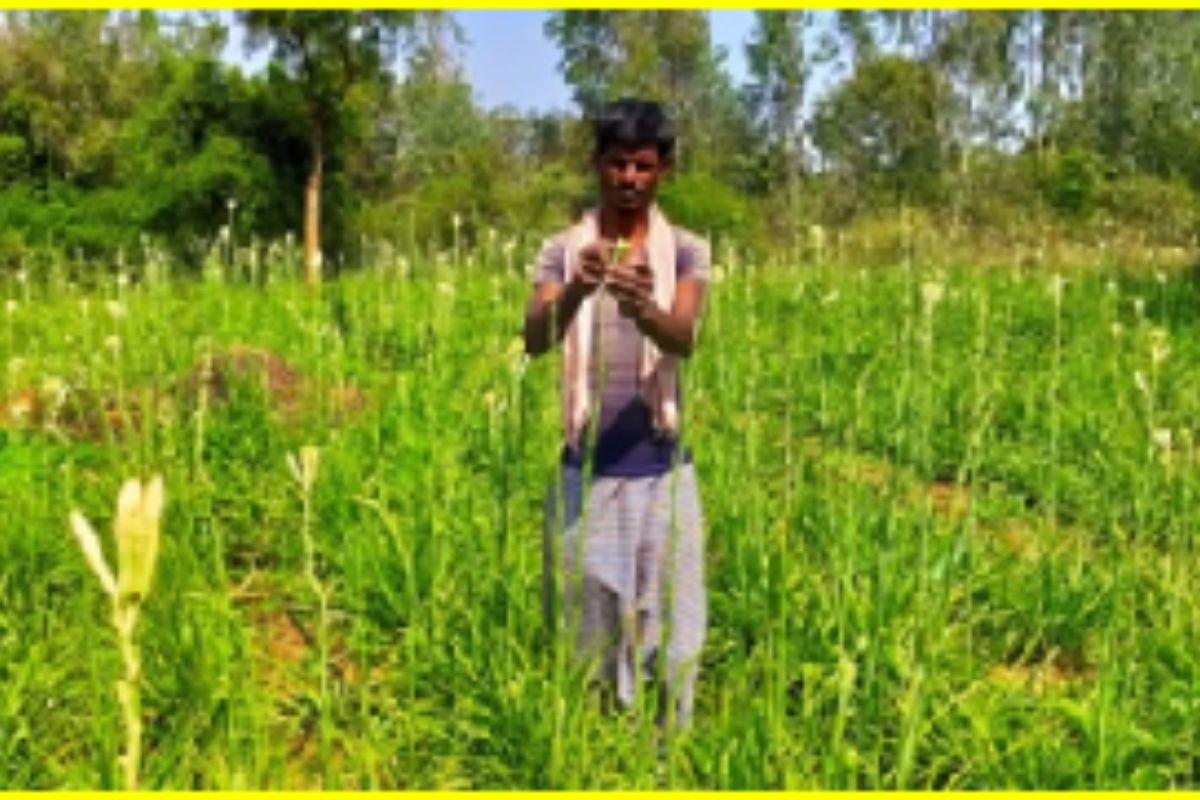
Sri Ramanjunaiah grew tomatoes for years on his land in Yettinahalli, a small village in Pavagada Taluk, Tumakuru district, Karnataka. Like many vegetable farmers, he watched prices crash without warning and income shrink with every bad season. He needed a way out.
He found it in flowers. Today, Ramanjunaiah earns nearly ₹5.85 lakh a year from two acres of tuberose — and at least 15 farm families in his village have followed his path, turning Yettinahalli into one of Karnataka’s emerging floriculture villages.
What Changed
Ramanjunaiah’s shift began when he attended a floriculture training programme run by ICAR-Krishi Vigyan Kendra (KVK) Tumakuru. There he learned about tuberose, known commercially as rajnigandha, and its potential as a stable cash crop.
He adopted a high-yielding variety called Arka Prajwal, a single-type tuberose developed by ICAR-Indian Institute of Horticultural Research, Bengaluru. The variety produces larger and more attractive florets than local cultivars and delivers around 20 percent higher loose flower yield. It is also well suited for garlands and floral decorations, making it a strong fit for India’s festival and wedding markets.
Under the Front Line Demonstration programme, KVK supplied quality planting bulbs and guided him on spacing, organic nutrient management, irrigation, and pest control.
What He Earned
Cultivating tuberose across two acres, Ramanjunaiah harvested 11.74 tonnes of loose flowers within a single year, earning close to ₹5.85 lakh. This far exceeded what he had earned growing tomatoes on the same land.
His income did not stop at flowers. By the end of the crop cycle, he expected to harvest 18 to 20 tonnes per hectare of bulbs and bulblets. These can either be reused to expand his own farm or sold to other farmers, adding a second and reliable income stream to his earnings.
How the Market Works
Tuberose flowers from Yettinahalli now reach Pavagada, Tumakuru, Bengaluru, Chennai, and markets beyond. The crop flowers almost throughout the year, giving farmers a continuous supply to sell rather than a single seasonal harvest.
During festivals and wedding seasons, bulk procurement by traders pushes earnings higher. The Hulume Farmer Producer Organisation (FPO) based in Pavagada has helped farmers sell collectively, improve price realisation, and reduce dependence on middlemen.
Who Benefits
The shift to tuberose has changed daily life in Yettinahalli. Floriculture activities now generate regular employment for local labourers. Women in the village play a central role in harvesting, grading, and sorting flowers, contributing to household income and financial independence.
Collectively, tuberose farming across the village generates over ₹30 lakh annually and supports around 15 farm families. Farmers from neighbouring villages now visit Yettinahalli to understand the model and replicate it on their own land.
How Far It Has Spread
Ramanjunaiah’s results have prompted a broader shift in the region. Today, around 15 hectares in and around Yettinahalli are under tuberose cultivation, up from a single farmer experimenting on two acres.
Farmers who previously grew tomatoes and other vegetables have made the transition, drawn by the stability and higher returns that floriculture offers compared to volatile vegetable prices.
The transformation, driven by one farmer’s decision to try something new and backed by scientific training and institutional support from ICAR-KVK Tumakuru and the Hulume FPO, has reshaped what farming looks like in this part of Karnataka.
Also Read: Punarnava Jal – The world’s first organic fertilizer! Know how it is beneficial for farmers?
Contact us – If farmers want to share any valuable information or experiences related to farming, they can connect with us via phone or whatsapp at 9599273766 or you can write to us at “kisanofindia.mail@gmail.com”. Through Kisan of India, we will convey your message to the people, because we believe that if the farmers are advanced then the country is happy.
You can connect with Kisan of India on Facebook, Twitter, and Whatsapp and Subscribe to our YouTube channel.