



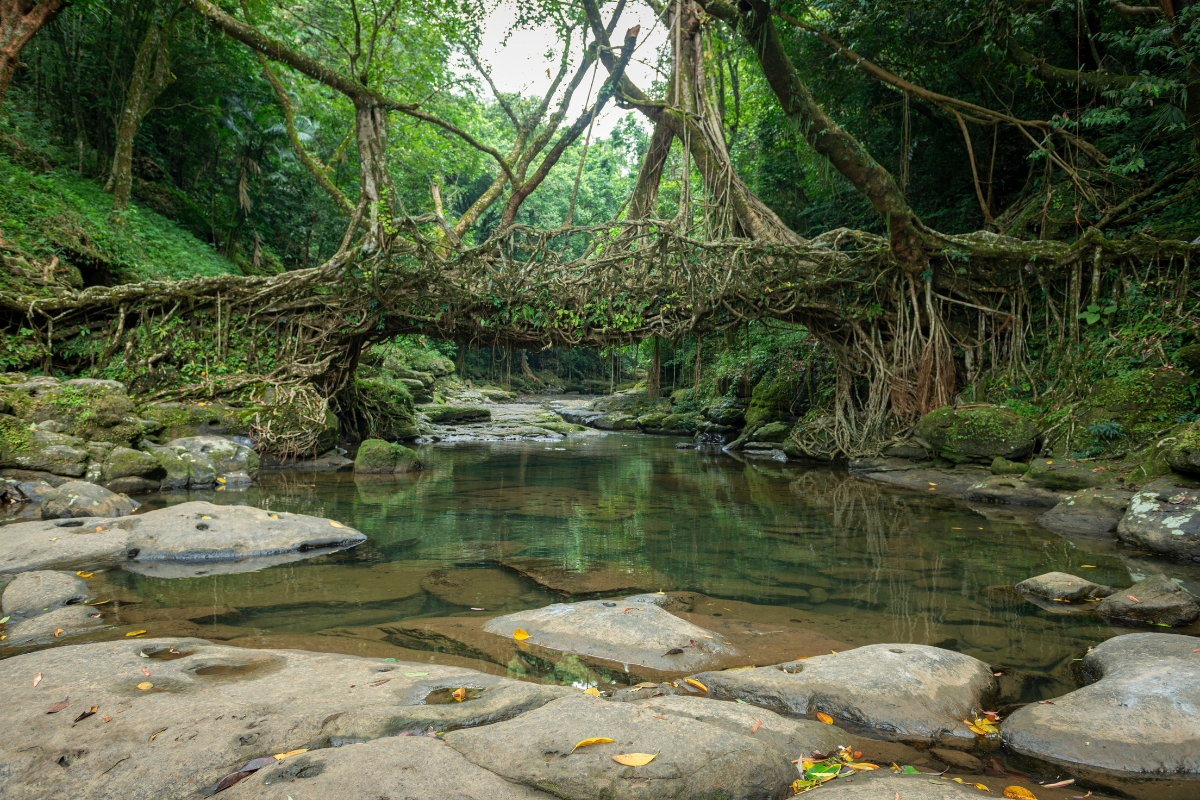
As climate change increases the frequency of floods, landslides, and extreme rainfall events, governments and researchers are searching for infrastructure that can remain functional under difficult environmental conditions. In Meghalaya, communities have been using a remarkable solution for centuries. Instead of building bridges from concrete, steel, or wood, they guide the roots of rubber fig trees to create living structures capable of connecting villages across streams and rivers.
These living root bridges are more than cultural landmarks. They represent a form of nature-based engineering that continues to strengthen as it ages. While conventional infrastructure often deteriorates over time, living bridges grow stronger as roots expand and mature.
Researchers studying climate adaptation are increasingly examining these structures because they demonstrate how traditional ecological knowledge can contribute to modern resilience planning.
Meghalaya receives some of the highest rainfall levels in the world. Heavy monsoon rains regularly create challenges for transportation and connectivity in remote areas. Conventional bridges built from temporary materials often suffered damage during intense weather events.
Local communities responded by developing a system that worked with natural processes rather than attempting to resist them completely. By guiding tree roots across waterways, they created structures capable of adapting to changing environmental conditions.
Climate scientists frequently note that future infrastructure may need similar flexibility as extreme weather events become more common across many regions.
Living Infrastructure Improves Over Time
Most infrastructure requires constant maintenance and eventually needs replacement. Living root bridges operate differently because the biological systems supporting them continue growing year after year.
As roots become thicker and more interconnected, the bridges gain strength and stability. Some structures are believed to be several centuries old and remain in active use today. Researchers view this characteristic as particularly important because it challenges conventional assumptions about infrastructure lifespan.
The bridges demonstrate that nature-based systems can sometimes provide long-term durability while requiring fewer industrial resources.
Traditional infrastructure projects often involve significant environmental disruption. Living root bridges create a different relationship between development and ecosystems because they depend on healthy vegetation and functioning natural environments.
The bridges support biodiversity while providing practical transportation benefits. Environmental researchers increasingly highlight such examples because they show how infrastructure and ecosystem conservation can complement one another rather than compete.
This integrated approach is becoming more relevant as countries explore sustainable development pathways that minimise ecological damage.
The construction and maintenance of living root bridges depend on local knowledge passed through generations. Communities guide roots carefully over many years, requiring patience, observation, and long-term commitment.
Researchers studying climate adaptation often emphasise the importance of community participation in resilience-building efforts. The root bridge system illustrates how local knowledge can create solutions tailored to specific environmental conditions.
The success of these structures is not based solely on biology. It also depends on social systems that support long-term stewardship and collective action.
Global Interest Continues Growing
Scientists, architects, engineers, and environmental planners from around the world are studying Meghalaya’s living root bridges. Interest is growing because many countries are searching for infrastructure approaches that remain effective under changing climate conditions.
While root bridges cannot replace all modern infrastructure, they provide valuable lessons about resilience, sustainability, and adaptation. Researchers believe the principles behind these structures may inspire new approaches to landscape design and climate-resilient development.
The bridges demonstrate that traditional practices can still offer relevant solutions to contemporary challenges.
The story of Meghalaya’s living root bridges highlights a broader shift occurring in climate adaptation thinking. Increasingly, experts are recognising that natural systems can play an active role in addressing environmental challenges.
By combining ecological processes with human ingenuity, communities created infrastructure capable of serving generations while remaining closely connected to the surrounding landscape. The result is a system that supports transportation, biodiversity, and climate resilience simultaneously.
As countries seek sustainable ways to prepare for a changing climate, the lessons from Meghalaya are becoming increasingly valuable.
In the forests of northeastern India, bridges grown from living trees continue proving that some of the strongest climate solutions are rooted in nature itself.
Also Read: Punarnava Jal – The world’s first organic fertilizer! Know how it is beneficial for farmers?
Contact us – If farmers want to share any valuable information or experiences related to farming, they can connect with us via phone or whatsapp at 9599273766 or you can write to us at “kisanofindia.mail@gmail.com”. Through Kisan of India, we will convey your message to the people, because we believe that if the farmers are advanced then the country is happy.
You can connect with Kisan of India on Facebook, Twitter, and Whatsapp and Subscribe to our YouTube channel.