



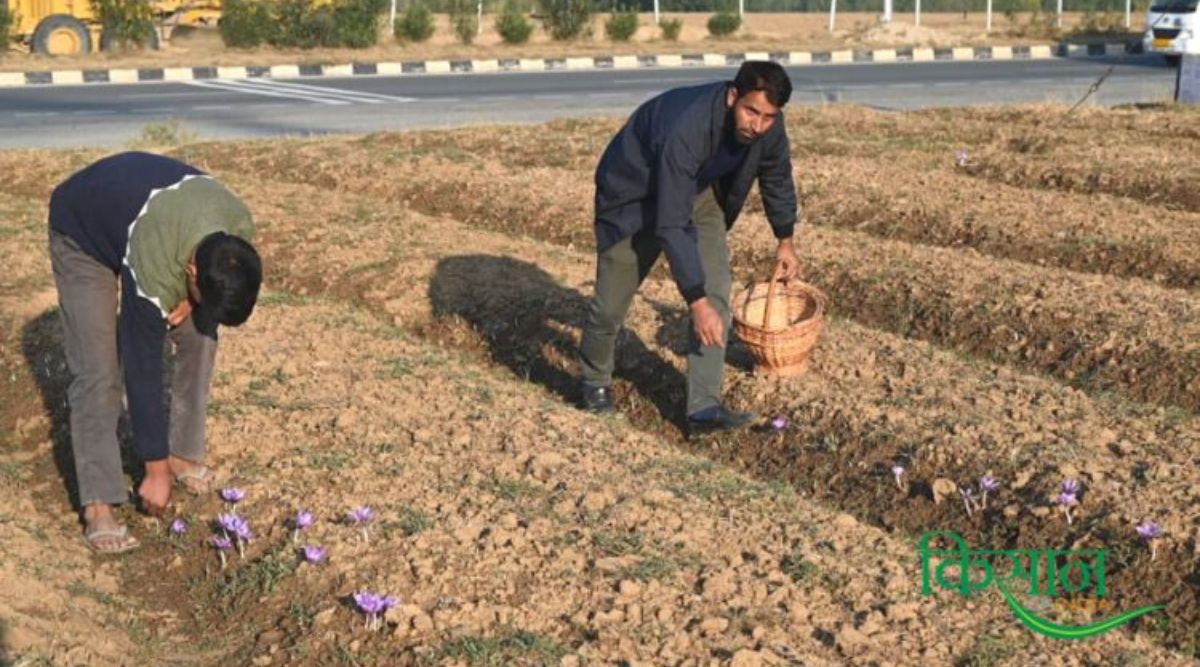
Saffron growers in Kashmir depend on careful harvesting and processing to protect the quality of one of the region’s most valuable spices. The flowers are only the first stage. How growers collect them, separate the red stigmas, dry the spice and store it can influence its colour, aroma and market value.
The National Institute of Agricultural Economics and Policy Research and the Indian Council of Agricultural Research have highlighted the importance of post-harvest management in saffron production. A NITI Aayog roadmap for Jammu and Kashmir also recommends modern drying methods and improved processing facilities to preserve saffron quality.
1. Collect flowers at the right time
Saffron flowers need careful handling from the moment they are picked. Growers should collect freshly opened flowers promptly and avoid leaving harvested flowers exposed in the field for long periods. Delays can make handling more difficult and increase the risk of contamination or deterioration before processing begins.
Research published in the ICAR journal Indian Farming identifies delayed stigma separation and poor handling as factors that can reduce the recovery and quality of commercial saffron. Growers should use clean collection baskets and keep flowers away from mud, standing water and other sources of contamination.
2. Keep harvested flowers clean
After collection, growers should move flowers to a clean, dry processing area. They should avoid crushing or tightly compressing them in baskets because damaged flowers are harder to process. Clean equipment and a hygienic workspace also reduce the chance of foreign material entering the finished spice.
Flowers should not remain piled up for extended periods while growers wait for labour or processing space. A practical approach is to organise collection and processing so that workers can handle each batch promptly. The amount harvested should match the labour and facilities available that day.
3. Separate the red stigmas carefully
The red stigmas are the commercially valuable part of the saffron flower. Workers separate them by hand, taking care not to mix them with petals, unwanted plant material or excessive portions of the yellow style. Consistent separation helps produce a cleaner batch and reduces the time needed for later grading.
Growers should use clean trays and avoid handling the stigmas with dirty or wet hands. They should also keep batches separate when they come from different fields or harvest periods. This makes it easier to identify quality differences and maintain consistent processing standards.
4. Do not delay drying
Freshly separated stigmas contain moisture and need controlled drying before storage. Traditional methods can produce uneven results if the material is spread too thickly or exposed to unsuitable conditions. Research by Sher-e-Kashmir University of Agricultural Sciences and Technology of Kashmir has emphasised that drying affects saffron’s colour, aroma and preservation.
Growers should spread the stigmas in a thin, even layer and follow a tested drying method rather than relying on guesswork. They should protect the material from dust, smoke and direct contamination. Drying conditions must be consistent across batches to reduce differences in the finished product.
5. Consider scientific drying methods
A NITI Aayog roadmap for horticulture development in Jammu and Kashmir identifies solar saffron dryers, solar-tunnel dryers and hot-air dryers as options for improving post-harvest handling. The report describes drying at around 40–50°C for approximately four to seven hours under these methods. Actual drying time depends on the equipment and the quantity being processed.
Farmers should not treat these figures as a universal setting for every dryer. They should follow equipment instructions and local agricultural experts’ guidance, checking the condition of the saffron before storage. A dryer that works well for one batch size may need adjustment when the load changes.
6. Store dried saffron in clean, sealed packaging
Once drying is complete, saffron should be protected from moisture, light, dust and strong external odours. Growers should use clean, food-grade packaging and keep containers sealed in a cool, dry place. Storing dried saffron in damp rooms or leaving containers open can undermine the work done during processing.
Farmers should label containers with the harvest date and batch details. This makes it easier to track quality and handle buyer queries. They should also avoid mixing new saffron with older stock without checking its condition, since inconsistent batches can affect the quality of the final product.
7. Use local processing and quality-testing facilities
Individual growers may not have access to suitable drying, grading and packaging equipment. The India International Kashmir Saffron Trading Centre at Dussu Pampore was established under the National Saffron Mission to provide facilities for stigma separation, drying, grading, packaging and marketing. Farmers can ask local horticulture officials about the services currently available.
SKUAST-Kashmir also conducts training on saffron production, including planting material, nutrient and water management, pest management and post-harvest handling. Growers can contact the university or their local agriculture and horticulture department for advice suited to their fields and processing arrangements.
Saffron quality depends on more than the number of flowers harvested. Prompt collection, clean handling, careful stigma separation, controlled drying and proper storage can help growers reduce avoidable losses and maintain a more consistent product. Farmers should adopt methods suited to their equipment and seek technical advice when changing drying practices.
Better processing alone cannot guarantee higher prices, since market rates also depend on demand, quality assessment and buyer access. Still, careful post-harvest management gives growers a stronger basis for protecting the value of their harvest and presenting a clean, consistent product to the market.
Also Read: Punarnava Jal – The world’s first organic fertilizer! Know how it is beneficial for farmers?
Contact us – If farmers want to share any valuable information or experiences related to farming, they can connect with us via phone or whatsapp at 9599273766 or you can write to us at “kisanofindia.mail@gmail.com”. Through Kisan of India, we will convey your message to the people, because we believe that if the farmers are advanced then the country is happy.
You can connect with Kisan of India on Facebook, Twitter, and Whatsapp and Subscribe to our YouTube channel.