



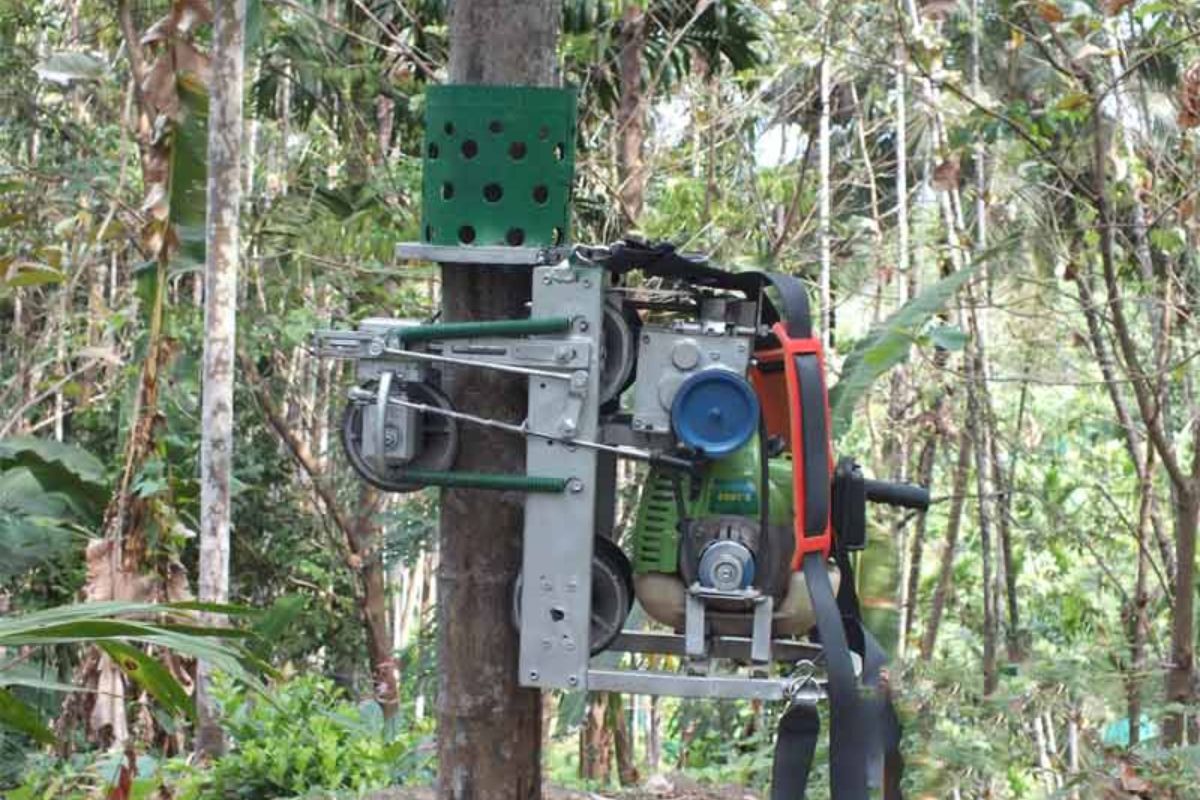
Across the arecanut-growing regions of Karnataka, Kerala, and Assam, farmers face a challenge that has become more serious with every passing year. Harvesting arecanut requires climbing tall palms that often exceed 50 feet in height. For decades, farmers depended on skilled tree climbers to complete this work safely and efficiently.
Today, finding trained climbers has become increasingly difficult.
Many experienced workers have moved to other occupations, while younger generations show less interest in taking up physically demanding climbing jobs. As labour availability declines, harvesting costs continue to rise, creating pressure on farmers already dealing with fluctuating market prices.
To address this challenge, battery-powered arecanut harvesters are emerging as a practical solution. The machines allow farmers to harvest nuts from tall palms without relying entirely on traditional climbing methods.
The technology is gradually reshaping harvesting practices across major arecanut-producing states.
Arecanut cultivation remains one of the most important plantation-based farming systems in southern India. Yet harvesting remains heavily dependent on skilled labour.
A delay in harvesting can affect both quality and productivity. Farmers often struggle to secure workers during peak seasons when demand for climbers increases across entire regions.
The shortage creates operational difficulties, particularly for small and medium-sized growers who cannot afford prolonged delays.
As labour costs rise, many producers are searching for technologies that reduce dependence on specialised workers while maintaining harvesting efficiency.
Mechanisation is becoming an increasingly attractive option.
Portable Machines Improve Accessibility
Battery-powered harvesters are designed specifically for plantation crops grown on tall palms. Most units consist of lightweight cutting systems attached to telescopic poles that allow operators to reach bunches without climbing. Rechargeable batteries power the cutting mechanism, making the equipment suitable for use in remote farms.
Farmers can move the machines easily between trees and across plantations.
The portability is particularly important because arecanut farms often contain hundreds or thousands of palms spread across uneven terrain.
Ease of operation is driving adoption among growers.
One of the strongest arguments in favour of mechanised harvesting is worker safety. Climbing tall palms involves risks, especially during rainy seasons when trunks become slippery. Falls can result in serious injuries and create additional challenges for farming households.
Battery-powered harvesters reduce the need for workers to climb every tree during harvest operations.
Farmers view this as a significant advantage, particularly in areas where labour availability is already limited. Improved safety can also encourage greater participation from family members in harvesting activities.
The technology addresses both labour and safety concerns simultaneously.
Large plantation owners were among the first adopters of harvesting equipment, but interest is increasingly spreading to smaller farms. Manufacturers are introducing more affordable models designed for smallholder conditions. Several farmer producer organisations and cooperatives are also purchasing equipment that members can share.
This collective ownership model lowers costs while increasing access to mechanisation.
Agricultural engineers believe such approaches will play a major role in expanding adoption because many growers operate on relatively small holdings.
Shared access often makes new technology economically viable.
Mechanisation Supports Plantation Agriculture
The arecanut sector faces many of the same challenges affecting plantation crops across India.
Labour shortages, rising costs, and demographic changes are encouraging greater investment in farm mechanisation. Harvesting equipment represents one response to these pressures.
Researchers note that mechanisation is not intended to eliminate labour entirely. Instead, it helps farmers complete essential tasks more efficiently when workers are scarce.
The objective is to improve productivity while reducing operational bottlenecks. Technology is increasingly becoming part of plantation management.
For generations, arecanut harvesting depended almost entirely on human skill and physical endurance.
Those skills remain valuable, but changing labour conditions are creating demand for alternative solutions. Battery-powered harvesters provide farmers with another option for managing tall plantations.
The machines improve safety, reduce labour dependence, and help ensure timely harvests. As equipment becomes more affordable and widely available, adoption is likely to continue expanding.
Across India’s arecanut belt, one of farming’s oldest challenges is being addressed with modern tools.
And for many growers, that change is arriving at exactly the right time.
Also Read: Punarnava Jal – The world’s first organic fertilizer! Know how it is beneficial for farmers?
Contact us – If farmers want to share any valuable information or experiences related to farming, they can connect with us via phone or whatsapp at 9599273766 or you can write to us at “kisanofindia.mail@gmail.com”. Through Kisan of India, we will convey your message to the people, because we believe that if the farmers are advanced then the country is happy.
You can connect with Kisan of India on Facebook, Twitter, and Whatsapp and Subscribe to our YouTube channel.