


At large farm gatherings in India, drones are no longer a side attraction. They are moving closer to the centre of the conversation on future farming. At Pusa Krishi Vigyan Mela 2026, ICAR-IARI presented digital agriculture, robotics, AI-linked farming tools, and precision technologies as part of the larger push toward “Viksit Krishi – Atmanirbhar Bharat.”
But for farmers, the real question is not whether drones look advanced. The real question is much more practical:
Will drones actually save money, reduce waste, and improve crop health?
That question matters because India’s farming challenge is no longer only about increasing yield. It is also about using inputs more carefully. Fertiliser, herbicide, pesticide, labour, diesel, and water have all become costlier or harder to manage. Blanket spraying across an entire field may look simple, but it often wastes chemical, misses problem patches, and increases the risk of drift, residue, and unnecessary expense. Recent Indian research and field demonstrations show that drone-led application can sharply reduce spray volume and improve targeting, while wider precision-agriculture systems use drone imaging to identify stress before the human eye can clearly see it.
This is where the idea of precision nutrition and precision spraying begins. Instead of treating every part of the field as if it had the same problem, drones allow farmers and service providers to identify where the crop is stressed and apply inputs only where they are needed.
Precision agriculture starts with a simple truth: not every plant needs the same thing
Most Indian fields are not uniform. Even within one acre, some patches are more fertile, some retain more moisture, some suffer from nutrient stress, and some are hit by weeds or disease earlier than others. Yet many farmers still apply urea, micronutrients, herbicides, and pesticides at the same dose across the whole field.
This mismatch creates three problems.
First, healthy plants receive chemicals they may not need. Second, stressed areas may receive the right input but at the wrong rate or wrong time. Third, unnecessary spraying raises cost and environmental burden.
Precision agriculture tries to solve this by matching input to need. Drones are becoming important in this system because they can do two jobs together: see the field in detail and apply inputs with more control. ICAR’s recent digital-agriculture work highlights drones for crop monitoring, health assessment, spraying, seeding, and site-specific management.
What exactly do agricultural drones do?
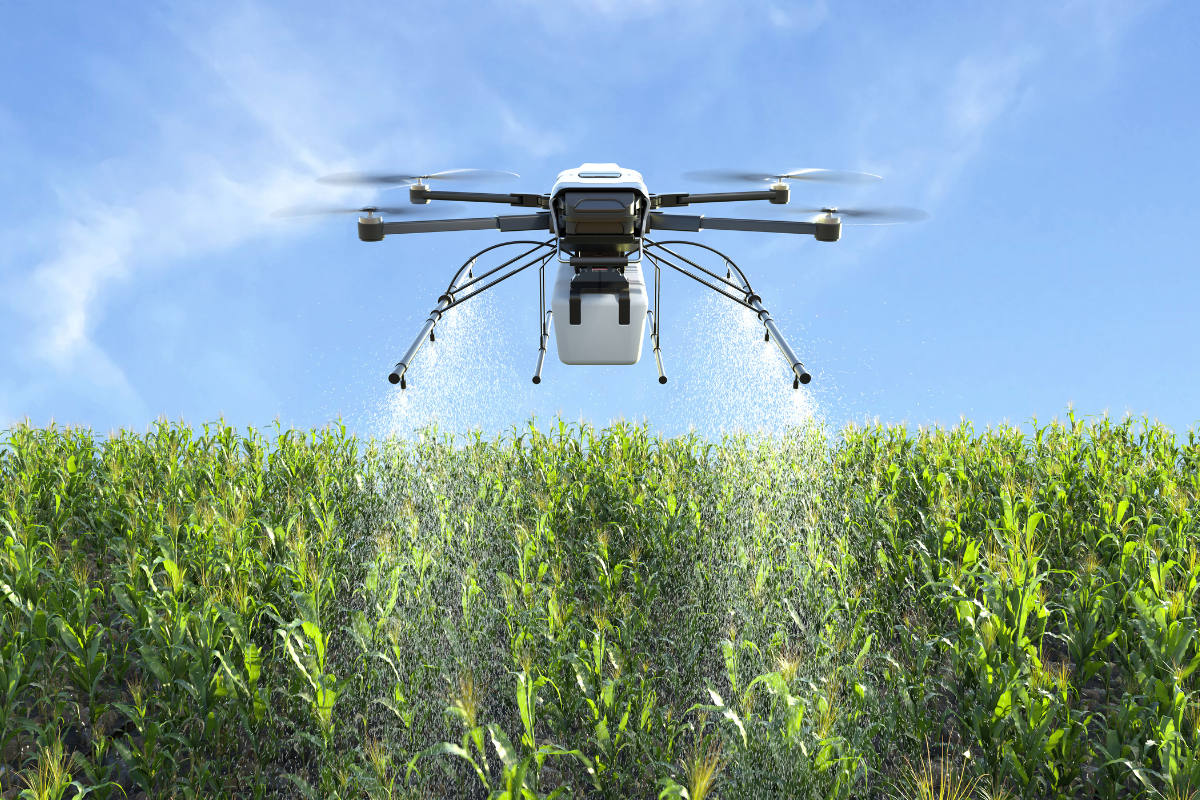
Agricultural drones are small unmanned aerial vehicles fitted with tanks, nozzles, GPS-based navigation, and sometimes cameras or sensors. In Indian farming, their most visible use today is spraying. But spraying is only one part of the story.
A drone can be used for:
• field mapping
• crop monitoring
• nutrient-stress detection
• weed patch identification
• pesticide or liquid fertiliser spraying
• stand-counting and canopy assessment
When a drone carries a camera system, especially a multispectral sensor, it can capture differences in crop condition across the field. When a drone carries a spray system, it can then apply chemicals or liquid nutrients with much greater spatial control than broad, uniform blanket spraying.
That is why drone agriculture is increasingly linked with “data-driven farming,” not just mechanised spraying.
The 2026 conversation: from spectacle to field use
Pusa Krishi Vigyan Mela 2026 did not publish, in the official material I found, a specific verified claim of “90% herbicide waste reduction.” What the official material does show is a strong emphasis on digital agriculture, robotics, AI, and farmer-facing technology platforms.
What is well-supported from Indian field evidence is closely related: a University of Agricultural Sciences, Bengaluru study reported that drone-based agrochemical spraying reduced spray water use by nearly 90%, from about 500 litres per hectare in conventional spraying to about 55 litres per hectare, while also improving operational efficiency in crops like ragi and tur dal.
That matters because lower spray volume often means more concentrated, more controlled deposition and less off-target application. It does not automatically mean every field will save 90% chemical, but it clearly shows why drones are attracting attention: they reduce waste in the broader spraying process.
What is multispectral imaging, and why should farmers care?
A normal camera shows what the human eye can see: red, green, and blue colours. A multispectral camera captures additional bands of light, including wavelengths that plants reflect differently depending on their health.
Healthy leaves rich in chlorophyll reflect light differently from stressed leaves. Crops under nutrient stress, disease pressure, water stress, or root damage often begin to change their light-reflection pattern before strong visual symptoms appear.
That means a multispectral drone image can detect:
• weak crop patches
• early nutrient deficiency
• moisture stress zones
• disease-prone areas
• uneven crop growth
ICAR-IARI has already used drone-based multispectral imaging in crop-health and field-parameter studies, and official reports show its use in stress monitoring and related agricultural analysis.
For farmers, this means the drone can help answer a powerful question:
Which part of my field is actually under stress?
Once that is known, the next question becomes:
Do I need to spray the whole field, or only the stressed part?
How drones identify “stressed” plants
Plants under stress usually change in three major ways:
1. Chlorophyll level changes
Nitrogen deficiency, disease, and water stress reduce chlorophyll, affecting light absorption and reflection.
2. Canopy temperature shifts
Water-stressed plants often become warmer because transpiration declines.
3. Growth pattern changes
Stressed plants may be shorter, thinner, or more uneven.
Multispectral images help convert these changes into digital maps. These maps show high-vigour and low-vigour areas in different colours or values. Such mapping can reveal stress that looks invisible from the edge of the field.
This matters in nutrient management because many farmers apply top-dressing uniformly when the real need is patchy. A precision approach can reduce unnecessary application in healthy zones and increase attention to problem zones.
Precision nutrition: more than just spraying fertiliser
When people hear “drone nutrition,” they often think only of foliar nutrient spraying. But precision nutrition is bigger than that. It means using field intelligence to decide:
• where nutrient stress exists
• what nutrient is likely limiting
• whether the problem is due to nutrient shortage, water stress, root damage, or disease
• whether spraying is the right response at all
This is crucial because not every yellow patch is a nitrogen deficiency. Some patches are waterlogged. Some are root-damaged. Some are diseased. Some are simply low-vigour due to compaction.
If a drone map is interpreted correctly, it can prevent farmers from wasting liquid nutrients on areas where the actual problem is not nutrition.
So precision nutrition is not just about applying more accurately. It is about diagnosing better before applying.
Blanket spraying versus targeted spraying
Traditional blanket spraying assumes uniform need. It is simple, but it has limitations.
With blanket spraying:
• the whole field receives the same dose
• healthy areas may be over sprayed
• weak areas may still remain untreated if the root cause differs
• more labour, water, and time may be used
• drift and runoff can increase
With drone-enabled targeted spraying:
• specific weed or stress patches can be marked
• spray routes can be controlled by GPS
• difficult or waterlogged areas can still be reached
• labour exposure to chemical can fall
• spray timing can be faster and more responsive
This is especially useful in herbicide or nutrient application where patch-level treatment is possible.
Why drone spraying is especially attractive in India
India’s agriculture has several conditions that make drone use attractive.
First, labour shortages are increasing in many regions. Second, uneven terrain and standing crop conditions often make manual spraying difficult. Third, many farmers need quick spraying after a disease outbreak or weed flush, but labour or machinery is not immediately available.
Drones can cover fields quickly and avoid crop trampling. They are also useful when:
• the crop is tall
• the field is muddy
• pest attack is sudden
• weather window is short
The Karnataka drone work reported gains not only in water-saving but also in faster coverage and reduced drudgery.
But can drones really reduce herbicide waste?
Yes, under the right system, but with an important condition: the real saving comes when mapping and spraying are linked.
If a drone is used only as a flying sprayer and the whole field is sprayed anyway, the gain may come mainly from lower spray volume, faster operation, and less labour. But if drone imaging identifies weed patches and only those patches are sprayed, then true herbicide waste can fall sharply.
That is the future direction of precision spraying.
The Indian digital-agriculture literature and global review work support the idea that drones can reduce chemical use and improve deposition by applying spray more precisely where needed.
Still, farmers should be careful with broad claims. Savings depend on:
• crop stage
• weed distribution
• nozzle type
• flight height
• droplet size
• weather conditions
• whether spraying is spot-based or blanket-based
So the technology has real potential, but field protocol matters.
What are the limits and risks?
Drones are not magic. Several practical issues remain.
Sensor interpretation
A drone image can show stress, but it does not always tell the exact cause. Yellowing may be due to nitrogen deficiency, disease, or root stress. Wrong interpretation can still lead to wrong spraying.
Cost
Many small farmers will not buy their own drone. The more realistic path in India is service-based access through FPOs, cooperatives, custom hiring centres, or agri-startups.
Regulation and training
Safe drone use needs trained operators, proper dosage understanding, and adherence to aviation and agrochemical rules.
Drift and calibration
Bad calibration or wrong weather conditions can still lead to poor application.
Small fragmented fields
India’s small landholdings can make standalone drone ownership uneconomical, though shared services may solve this.
Where this can help most in Indian farming
Drone-based precision nutrition and spraying may be especially useful in:
• paddy fields with uneven vigour patches
• wheat fields needing stress mapping
• maize and cotton with patchy nutrient stress
• horticulture blocks where disease starts in localised pockets
• pulse fields where foliar nutrition is used
• weed hotspots where blanket herbicide is wasteful
It is also valuable in seed production plots and high-value crops where precision matters more.
What farmers should watch before trusting a drone service
Before paying for a drone-based nutrient or spray service, farmers should ask:
• Is this only spraying, or is there field mapping too?
• What sensor is being used?
• How is stress being interpreted?
• Is the operator trained?
• What nozzle and spray volume are being used?
• Is the recommendation crop-specific?
• Will the whole field be sprayed or only marked zones?
These questions protect farmers from paying for “technology display” instead of true precision work.
The real promise: not replacing the farmer, but sharpening decisions
Drones do not replace field knowledge. They improve it.
A good farmer already knows that one corner of the field dries faster, another stays wet longer, and some patches always perform poorly. Drone imaging adds a new layer: it makes those differences visible, measurable, and recordable.
So the future is not farmer versus drone.
The future is farmer judgment plus better field intelligence.
Final takeaway
Drones for precision nutrition are not just about spraying liquid fertiliser from the sky. Their deeper value lies in seeing crop stress early, separating healthy plants from weak plants, and helping inputs reach only where they are truly needed.
That is why the conversation around drones is changing. The real breakthrough is not flying hardware. The real breakthrough is site-specific decision-making.
In Indian agriculture, where every litre of spray, every kilogram of input, and every labour hour matters, that shift could be powerful.
The coming years will decide how fast this technology becomes practical at village level. But one thing is already clear: the age of treating every square foot of the field the same way is slowly ending. Precision is becoming the new language of crop care.
Also Read: Punarnava Jal – The world’s first organic fertilizer! Know how it is beneficial for farmers?
Contact us – If farmers want to share any valuable information or experiences related to farming, they can connect with us via phone or whatsapp at 9599273766 or you can write to us at “kisanofindia.mail@gmail.com”. Through Kisan of India, we will convey your message to the people, because we believe that if the farmers are advanced then the country is happy.
You can connect with Kisan of India on Facebook, Twitter, and Whatsapp and Subscribe to our YouTube channel.