



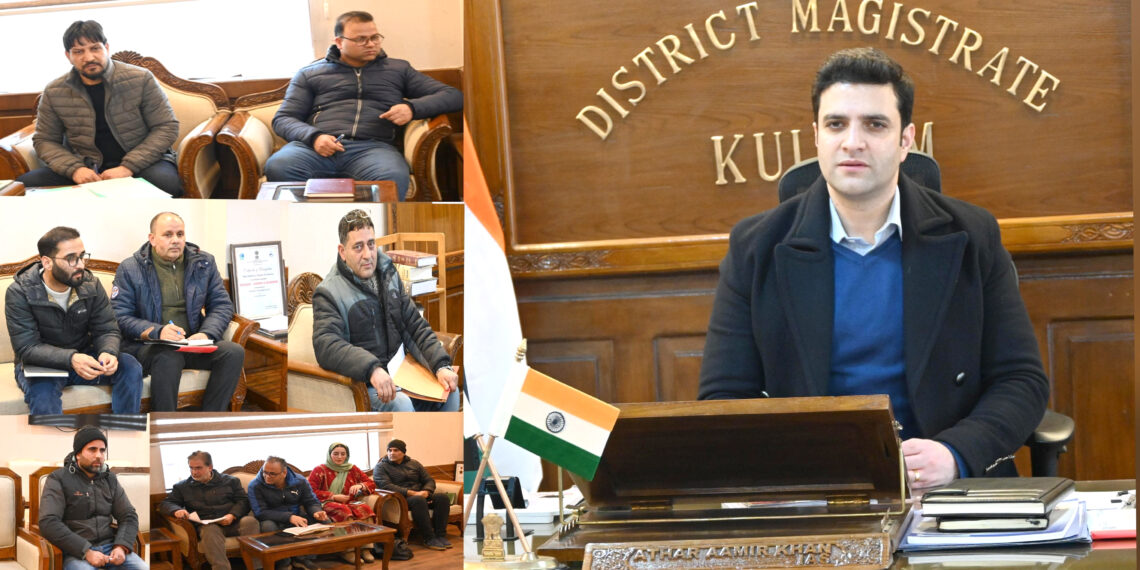
Deputy Commissioner Kulgam, Athar Aamir Khan, conducted a detailed review meeting on Wednesday to assess the progress of the Pradhan Mantri Fasal Bima Yojana (PMFBY) in the district. The meeting took place at the Mini Secretariat, Kulgam, and focused on increasing farmer enrollment under this important crop insurance scheme.
Officials informed the Deputy Commissioner that the Department of Agriculture, Kulgam, has successfully registered 6,590 non-loanee farmers and 733 loanee oilseed growers under PMFBY for the Rabi season 2025-26. The total insured area under the scheme in Kulgam district stands at approximately 1,018.27 hectares.
During the review meeting, DC Khan directed all agriculture officers to work toward achieving maximum enrollment of eligible farmers under PMFBY. He emphasized the importance of reaching out to more farmers to protect them against crop losses.
The meeting saw participation from key officials including Additional Deputy Commissioner Kulgam Viqar Ahmed Gir, Joint Director Planning Malik Suhail, Chief Agriculture Officer Kulgam, Lead District Manager Kulgam, Sub-Divisional Agriculture Officers of Kulgam and Qaimoh, and the District Manager of Agriculture Insurance Company along with other officers.
What is Pradhan Mantri Fasal Bima Yojana?
Prime Minister Narendra Modi launched the Pradhan Mantri Fasal Bima Yojana in 2016 to protect farmers from crop losses caused by natural hazards. The scheme works as a safety net for farmers across India, providing them with financial support when their crops suffer damage.
PMFBY is a government-sponsored crop insurance program that brings together multiple stakeholders on a single platform. The scheme covers crops from the pre-sowing stage to the post-harvest period, giving farmers complete protection throughout the agricultural cycle.
The main goals of PMFBY include providing affordable insurance coverage to farmers, stabilizing their income during crop failures, and encouraging them to adopt modern farming practices. The scheme aims to reduce the financial burden on farmers when natural disasters strike their fields.
The Union Cabinet approved the continuation of PMFBY in January 2025 until 2025-26 with a total budget of ₹69,515.71 crore. This shows the government’s strong commitment to supporting farmers through this important program.
Why Farmers Need PMFBY
Farming in India faces many uncertainties. Farmers deal with unpredictable weather patterns, floods, droughts, unseasonal rains, pest attacks, and diseases that can destroy their crops overnight. These natural calamities can wipe out months of hard work and leave farmers in financial distress.
PMFBY provides farmers with financial security against these risks. When a farmer loses their crop due to covered events, they receive compensation that helps them recover and continue farming. The scheme covers various situations including prevented sowing, standing crop damage, post-harvest losses, and localized calamities.
The scheme uses advanced technology like satellite imagery, GPS, and smartphones to make the claim process faster and more transparent. This technology-driven approach helps farmers get their compensation quickly without long delays.
How PMFBY Works
The scheme operates on a simple principle. Farmers pay a small premium amount, while the central and state governments share the remaining premium cost. For Rabi food and oilseed crops, farmers pay only 1.5 percent of the sum insured. For Kharif crops, the premium is 2 percent, and for commercial and horticultural crops, it is 5 percent.
The government heavily subsidizes the premium to make it affordable for all farmers. In some states like Jammu and Kashmir, Himachal Pradesh, and northeastern regions, the government bears the entire premium cost, making it completely free for farmers.
When crops suffer damage due to natural calamities, agricultural experts conduct crop cutting experiments to assess the yield loss. If the actual yield falls below the threshold yield for the area, all insured farmers in that area become eligible for compensation. The claim amount is calculated based on the shortfall in yield and paid directly to the farmer’s bank account.
How to Apply for PMFBY
Farmers can apply for PMFBY both online and offline. The application process is simple and designed to be farmer-friendly.
Online Application Process:
Farmers can visit the official PMFBY website at pmfby.gov.in. On the homepage, they need to click on the farmer registration link. New users should select “Guest Farmer” and fill in all required details including personal information, residential details, bank account information, and identification details.
After submitting the registration form, farmers receive login credentials. They can then log in and fill out the crop insurance scheme application form with details about their crops and land. The application must be submitted within 10 days of sowing the crop.
Offline Application Process:
Farmers can visit their nearest bank branch where they have an account. They should ask for the PMFBY application form and fill it carefully with all required information. The form must be submitted along with necessary documents to the bank officer.
Farmers can also apply through Common Service Centers (CSCs), insurance company offices, or authorized insurance agents in their area.
Required Documents:
Farmers need to submit several documents with their application. These include land ownership documents like Records of Rights or Land Possession Certificate, identity proof such as Aadhaar card, bank account details, passport-size photograph, and a crop sowing certificate if required by the state government.
Tenant farmers need to provide land rental agreements or contracts as defined by their state government.
Important Points to Remember
The enrollment window for PMFBY opens before each cropping season. For Rabi 2025-26, enrollment was open from December 1 to December 31, 2025. Farmers must apply within this deadline to get coverage for their crops.
If crops suffer damage, farmers must inform the insurance company, bank, or local agriculture department within 72 hours of the incident. This quick reporting helps in faster claim processing and assessment.
The scheme covers losses from natural disasters like floods, droughts, cyclones, hailstorms, landslides, pest attacks, and diseases. However, it does not cover losses from war, riots, theft, or damage by domestic or wild animals.
Farmers can check their application status and claim status online through the PMFBY portal or mobile app. The government has developed a user-friendly Crop Insurance App that farmers can download from the Play Store to manage their insurance and file claims easily.
Benefits for Kulgam Farmers
The PMFBY enrollment in Kulgam district shows good progress with over 7,300 farmers already registered. This coverage will protect farmers growing oilseed crops during the Rabi season against any unforeseen events.
The Deputy Commissioner’s focus on increasing enrollment means more farmers in Kulgam will benefit from this financial protection. With approximately 1,018 hectares already insured, the scheme is providing a safety net to a significant farming area in the district.
Agriculture officers are working actively to spread awareness about PMFBY and help more farmers enroll in the scheme. The goal is to ensure that every eligible farmer in Kulgam gets the benefit of crop insurance and can farm without the constant fear of financial losses from natural disasters.
Contact us: If farmers want to share information or experiences related to farming with us, then they can do this by calling us on the phone number 9599273766 or by writing an email to kisanofindia.mail@gmail.com or by sending your recording. Through Kisan of India, we will convey your message to the people, because we believe that if the farmers are advanced then the country is happy.
You can connect with Kisan of India on Facebook, Twitter, and Whatsapp and Subscribe to our YouTube channel.