


Rotary Disc Drill: Can This Machine Help Farmers Sow Wheat Without Burning Paddy Stubble?

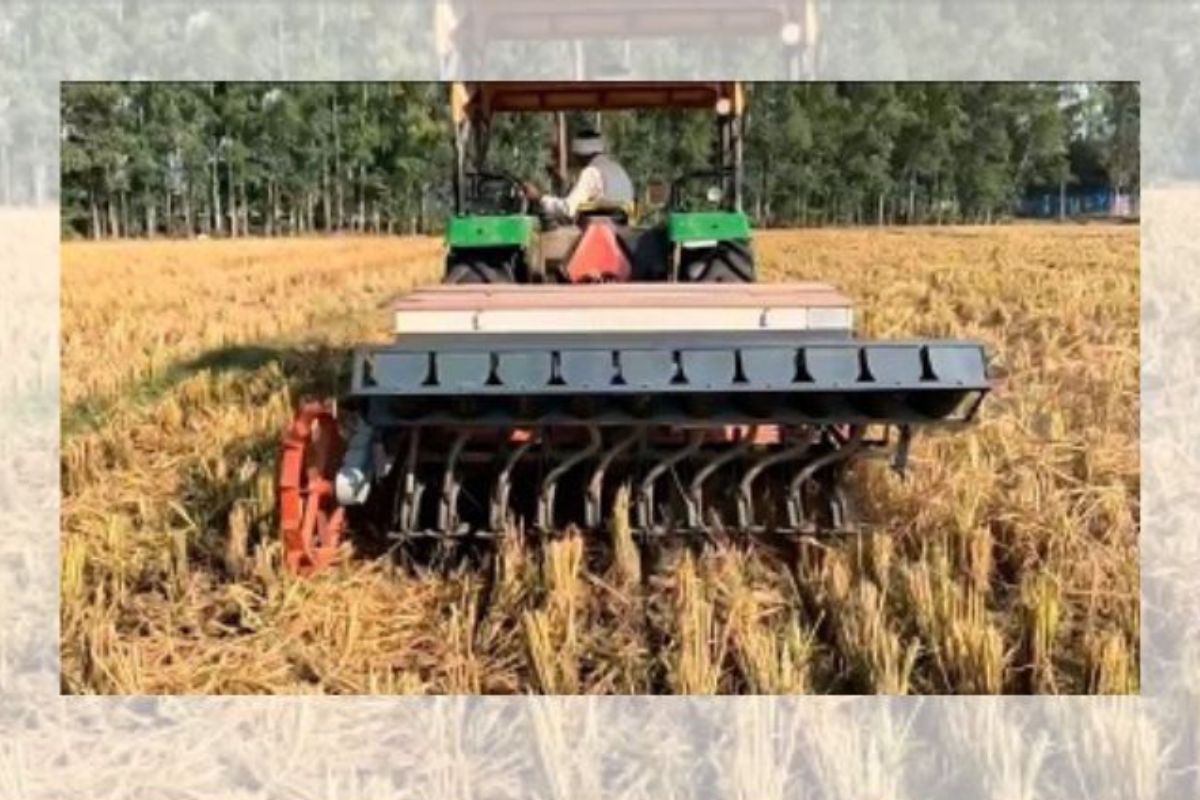
Farmers growing rice and wheat in rotation often face a short gap between harvesting paddy and sowing wheat. Removing the remaining straw takes time and money, while burning it can damage soil quality and contribute to air pollution. The Rotary Disc Drill offers another option by sowing directly through crop residue.
Developed by the ICAR–Indian Institute of Wheat and Barley Research (IIWBR), Karnal, the machine is designed to sow crops in fields containing anchored or loose crop residues. It uses rotating cutting discs to manage the residue, followed by disc furrow openers that place seeds in the soil.
The machine may interest farmers who need to sow wheat quickly after paddy harvest. It is also designed for fields with sugarcane trash and can sow crops such as wheat, rice, soybean, pea, barley, chickpea and pigeon pea under suitable conditions. Its suitability depends on the field, residue load and crop requirements.
How Does the Machine Work?
The Rotary Disc Drill is a tractor-operated implement with a three-disc mechanism. A front rotary cutting unit cuts through crop residue, while the rear seeding attachment opens furrows and places seed. This arrangement allows sowing without first removing all the residue or carrying out conventional full-field tillage.
ICAR reports that the machine can operate in rice residue loads of up to eight tonnes per hectare and sugarcane trash loads of up to 10 tonnes per hectare under suitable conditions. It can also work when residue is relatively moist, allowing use during early morning or late evening. <Cite refs={[“turn129404search2”]}/>
The machine requires a tractor of at least 45 horsepower with a dual-clutch system. Its reported field capacity is 0.4–0.5 hectares per hour, depending on soil conditions and residue load. Farmers should confirm these specifications with a manufacturer or agricultural engineering expert before arranging a purchase or rental.
What Benefits Has ICAR Reported?
1. Lower Sowing Costs
ICAR reports that direct wheat sowing with the Rotary Disc Drill under rice residue can save approximately ₹4,200 per hectare compared with conventional tillage. The saving comes from reduced field preparation requirements, although actual costs depend on tractor fuel consumption, rental rates, labour and the condition of the field.
Farmers should calculate their own costs before adopting the machine. Compare the price of hiring the drill with expenses for residue removal, ploughing, additional tractor operations and sowing. The result will vary by location, the amount of residue left behind and the equipment already available on the farm.
2. Less Fuel Use and Fewer Field Operations
ICAR’s demonstrations in Haryana’s Karnal district and Uttar Pradesh’s Shamli district during 2020–21 to 2022–23 found similar or higher wheat yields under residue-based direct sowing compared with conventional practices. The institute also reported a 60–65% reduction in fuel costs in those demonstrations.
These results should not be interpreted as a guaranteed saving for every farm. Tractor performance, soil moisture, residue distribution and operator experience affect how efficiently the drill works. Farmers should ask local agricultural engineering centres whether demonstrations or rental services are available before investing in the machine.
3. Reduced Emissions and Better Residue Retention
ICAR estimates that direct wheat sowing with the Rotary Disc Drill can save about 120–130 kilograms of carbon dioxide emissions per hectare compared with conventional tillage. Keeping residue in the field also avoids the need to burn it and can help protect soil from direct exposure to sunlight and erosion.
Residue retention may contribute to better soil moisture conservation and organic matter over time, but benefits depend on the field’s management and soil conditions. Farmers should also check whether the amount and distribution of residue could interfere with seed placement or encourage pests and disease under their local conditions.
What Should Farmers Check Before Hiring or Buying?
First, check tractor compatibility. The machine requires at least 45 HP and a dual-clutch-enabled tractor, according to ICAR. Confirm the tractor’s specifications, implement connection and power requirements before booking the equipment.
Second, inspect the field. Residue amount, soil moisture, field levelling and previous crop management can affect performance. Ask an experienced operator to assess the field and set the machine correctly. Uneven seed placement can lead to poor emergence and reduce the benefit of timely sowing.
Third, compare rental and ownership costs. Small farmers may find it more practical to hire the machine through a Custom Hiring Centre (CHC) or a farmer group. Check the rate per acre or hectare, transport charges, operator fees and availability during the narrow wheat-sowing window.
The ICAR–IIWBR website publishes research on wheat varieties, sowing practices and farm technologies. Farmers can also approach their nearest Krishi Vigyan Kendra, agricultural engineering department or state agriculture university to ask about residue-management demonstrations and suitable machinery.
The government’s Farm Mechanisation and Technology platform provides information on agricultural machinery and relevant support systems. Subsidy eligibility and availability depend on current scheme rules and state implementation, so farmers should confirm conditions before buying equipment.
The Rotary Disc Drill offers farmers a way to sow wheat directly through paddy or sugarcane residue, potentially reducing tillage costs, fuel use and the need to burn crop waste. Its performance depends on tractor compatibility, field conditions and operator skill. Farmers should compare local rental costs and seek a field demonstration before investing.
Also Read: Punarnava Jal – The world’s first organic fertilizer! Know how it is beneficial for farmers?
Contact us – If farmers want to share any valuable information or experiences related to farming, they can connect with us via phone or whatsapp at 9599273766 or you can write to us at “kisanofindia.mail@gmail.com”. Through Kisan of India, we will convey your message to the people, because we believe that if the farmers are advanced then the country is happy.
You can connect with Kisan of India on Facebook, Twitter, and Whatsapp and Subscribe to our YouTube channel.