


Can Farm-Made Natural Inputs Cut Input Costs? What ICAR Is Teaching Farmers

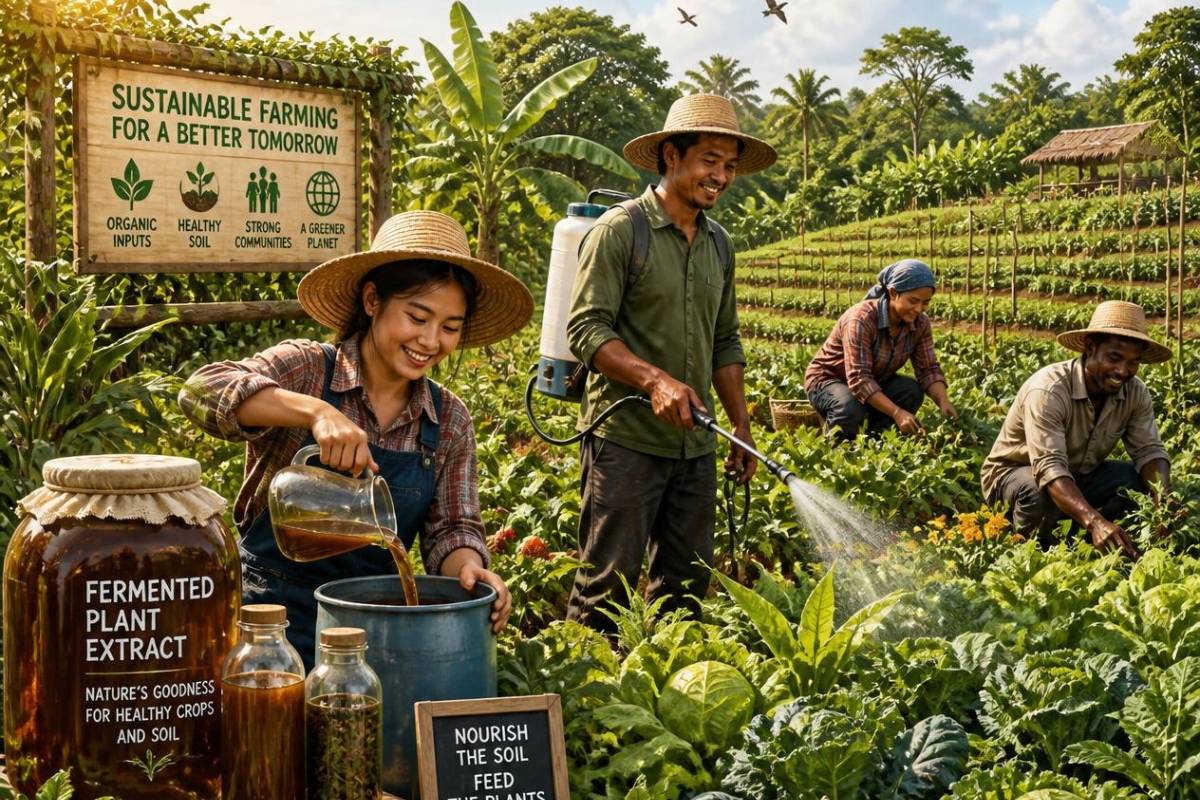
Farmers do not always need to purchase every input used on a farm. Some natural farming systems use materials available locally to prepare seed treatments, soil inputs and botanical pest-control products. ICAR recently trained South Andaman farmers in preparing and using four such formulations.
The training was organised by ICAR-Central Island Agricultural Research Institute on September 22 under the National Mission on Natural Farming. Scientists focused on Beejamrutha, Jeevamrutha, Ghanajeevamrutha and Neemastra, including their preparation, quality, storage and field application.
These formulations have different purposes. Beejamrutha is used for seed treatment, Jeevamrutha is used as a microbial input, Ghanajeevamrutha is its solid form and Neemastra is a neem-based botanical preparation used against certain insect pests.
The important point for farmers is that natural farming does not simply mean stopping chemical fertilisers overnight. Farmers need to understand what each input is intended to do, how it is prepared and whether it suits the crop and farming conditions.
What are these natural farming inputs?
Beejamrutha is mainly used for treating seeds before sowing. ICAR’s natural-farming material describes it as a preparation intended to support seed establishment and protect seeds from some seed-borne problems. Farmers need to follow the recommended preparation and application method for the crop.
Jeevamrutha is a liquid preparation used in natural farming. ICAR describes it as a microbial bio-enhancer that can be applied through irrigation water or as a foliar spray. It is intended to support soil microbial activity, plant growth and nutrient availability.
Ghanajeevamrutha is the solid form of Jeevamrutha. ICAR says it can support soil microbial activity and help the decomposition of organic material, which can improve nutrient availability. Farmers can use it as part of soil and nutrient management rather than treating it as a direct replacement for every fertiliser.
Neemastra is made using neem-based materials and is used as a botanical pest-control preparation. ICAR’s demonstration describes it as an option for managing sap-sucking insects and small caterpillars. Its use should be based on the pest present and the crop being grown.
The four inputs therefore serve different purposes. A farmer should not treat them as interchangeable products. Seed treatment, nutrient management and pest control require different approaches, application timings and quantities.
How can farmers prepare them?
The first requirement is accurate preparation. ICAR’s September training specifically included scientific preparation methods, ingredient proportions and quality considerations. This matters because inconsistent ingredients or preparation can change the characteristics of a farm-made input.
Clean containers and suitable raw materials are also important. Farmers should avoid contamination during preparation and storage. The finished preparation should be used according to recommended practices rather than assuming that a stronger concentration will produce better results.
ICAR’s earlier demonstrations at Sri Vijaya Puram provided hands-on training to staff on preparing the same four formulations. The institute said the training covered ingredient proportions, preparation methods and field application, showing that practical training is part of the approach.
Natural farming formulations can use materials already available around farms. This can reduce the need to purchase some external inputs, but farmers still spend money on labour, materials, storage and application. The actual saving therefore needs to be calculated at farm level.
Farmers should also keep basic records. Recording preparation quantities, application dates, crop stage, pest levels and crop performance can help them understand whether an input is working under their own conditions.
Can these inputs improve soil health?
Natural farming places strong emphasis on soil biological activity, organic matter and recycling of farm resources. ICAR’s work in Andaman has also promoted green manuring, vermicomposting, biofertilisers and balanced nutrient management as part of sustainable farming.
That does not mean farmers should stop considering crop nutrient requirements. ICAR programmes have promoted integrated nutrient management, which combines different nutrient sources according to crop and soil needs.
A June 2026 ICAR programme in North and Middle Andaman encouraged farmers to use green manure, composting, vermicomposting and biofertilisers while promoting balanced fertiliser use. The programme also linked these practices with maintaining soil fertility and reducing dependence on chemical inputs.
This distinction matters because soil health depends on several factors. Organic matter, nutrient balance, moisture, soil structure, crop rotation and biological activity all influence how a soil performs.
Farmers should therefore use natural inputs as part of a wider soil-management plan. Soil testing can help identify nutrient deficiencies before farmers decide which inputs their fields require.
What is the climate-change connection?
Natural and organic farming practices can contribute to climate-resilient agriculture when they improve soil condition, conserve resources and reduce dependence on some external inputs. ICAR’s Andaman programmes have specifically promoted organic and natural farming alongside efficient resource management as climate-friendly practices.
Crop-residue recycling and organic amendments can also return carbon-rich material to the soil. ICAR has linked natural farming with soil moisture conservation and carbon management, though the climate benefit depends on the complete farming system and how practices are carried out.
Farmers facing changing rainfall or higher temperatures may benefit from practices that improve soil moisture retention and reduce unnecessary external inputs. These measures cannot prevent climate-related crop losses, but they can form part of a wider adaptation strategy.
Water management remains important too. ICAR has promoted rainwater harvesting, water recycling, contour farming and other soil-and-water conservation measures alongside sustainable farming in fragile ecosystems.
The climate connection is therefore broader than replacing chemical products. Farmers need to combine soil health, water conservation, crop diversity and suitable varieties to manage changing weather conditions.
What should farmers check before using them?
Farmers should first identify the problem they want to address. Beejamrutha is meant for seed treatment, while Jeevamrutha and Ghanajeevamrutha are used in nutrient and soil management. Neemastra has a pest-management role. Using the wrong formulation can waste labour and materials.
Farmers should seek guidance from their KVK, agriculture department or trained agricultural experts when they are starting. ICAR’s recent South Andaman training shows the importance of practical instruction rather than relying only on informal recipes.
They should also compare costs and results. A farm-made input may require fewer purchased materials, but preparation takes labour and time. Farmers should record these costs and compare crop performance before deciding whether to expand its use.
Natural farming works best when farmers understand the entire system rather than treating individual preparations as quick fixes. Soil testing, balanced nutrient management, crop diversification, water conservation and pest monitoring can all support the transition.
ICAR’s latest training in South Andaman shows that natural farming is increasingly being taught through practical preparation and field application. For farmers, the useful starting point is to learn each input’s purpose, prepare it correctly and assess its results under local soil, crop and weather conditions.
Also Read: Punarnava Jal – The world’s first organic fertilizer! Know how it is beneficial for farmers?
Contact us – If farmers want to share any valuable information or experiences related to farming, they can connect with us via phone or whatsapp at 9599273766 or you can write to us at “kisanofindia.mail@gmail.com”. Through Kisan of India, we will convey your message to the people, because we believe that if the farmers are advanced then the country is happy.
You can connect with Kisan of India on Facebook, Twitter, and Whatsapp and Subscribe to our YouTube channel.