



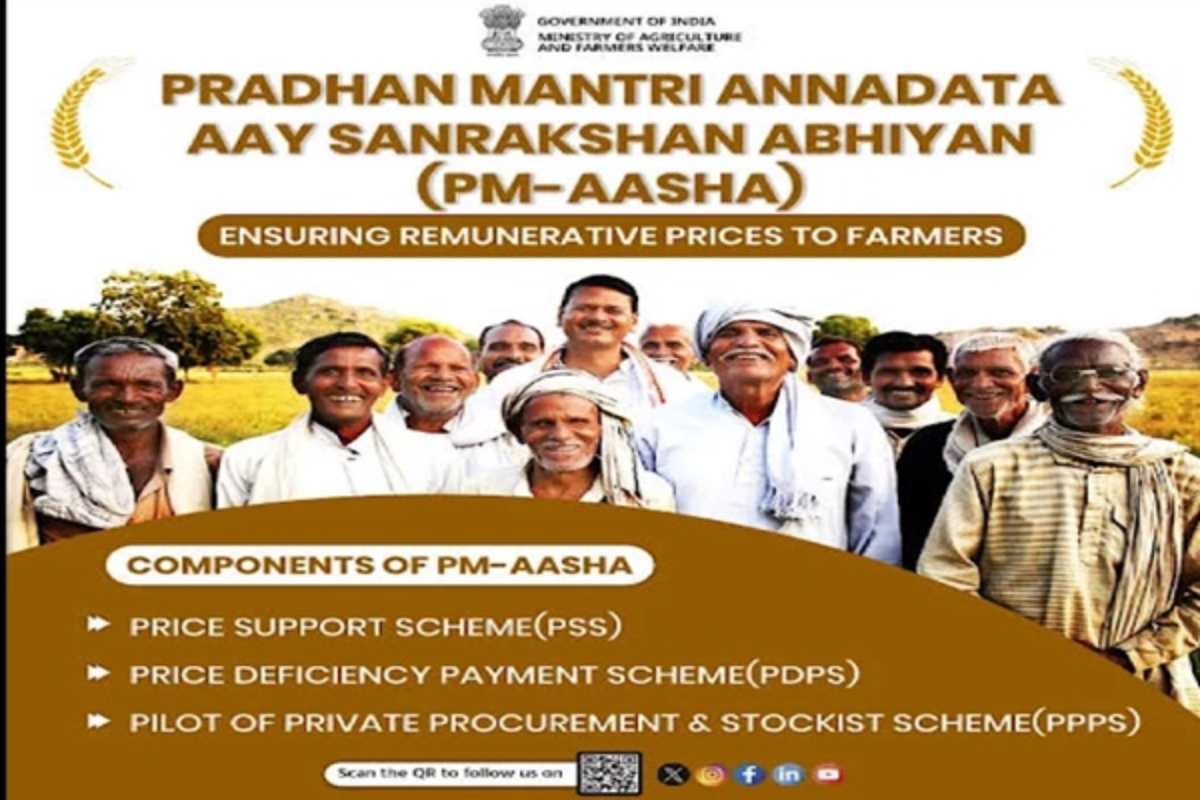
As kharif crops begin reaching markets, farmers will be watching prices closely. For growers of pulses, oilseeds and copra, the Pradhan Mantri Annadata Aay Sanrakshan Abhiyan, or PM-AASHA, is designed to strengthen price support and reduce distress sales when market prices fall below the Minimum Support Price.
The scheme has received a budget allocation of ₹7,200 crore for 2026–27. Procurement of pulses, oilseeds and copra is carried out by central and state agencies, including NAFED and NCCF, when procurement operations are opened for eligible crops and areas.
What does PM-AASHA actually do?
PM-AASHA is not a single cash payment that every farmer receives after harvest. It is a framework for supporting farmers when market prices and MSP conditions require government intervention.
The scheme includes mechanisms for procurement and price support. Farmers therefore need to understand which crop is covered, whether procurement has been opened in their state and what quality conditions apply before taking produce to a procurement centre.
The scheme focuses mainly on pulses, oilseeds and copra. This makes it particularly relevant for farmers growing crops such as tur, urad, moong, soybean, groundnut, mustard and other eligible commodities.
A common misunderstanding is that announcing an MSP automatically means every farmer can sell unlimited quantities to the government at that price. Procurement depends on government decisions, crop coverage, state arrangements and applicable conditions.
Farmers should therefore check local procurement announcements before harvesting or transporting large quantities. They should not assume that a private mandi price and government procurement price will automatically be available at every location.
The government has been expanding digital systems linked with procurement. PM-AASHA uses platforms including e-Samriddhi and e-Samyukti, alongside Aadhaar-enabled authentication and e-NAM, to improve transparency and procurement processes.
Which farmers should pay attention?
Farmers growing pulses and oilseeds should monitor announcements from their state agriculture department, procurement agencies and local mandis. This is particularly important when market prices begin falling below MSP.
Farmers should also check whether their produce meets the required quality standards. Procurement agencies may apply specifications related to moisture, cleanliness and other quality parameters. Produce that fails those requirements may face deductions or rejection.
India imports a significant share of its edible oil requirements, while pulses remain important for food security and nutrition. Improving returns from these crops can encourage farmers to maintain or increase production.
Price uncertainty can discourage farmers from choosing pulses and oilseeds when competing crops offer more predictable returns. A functioning procurement system can therefore support crop diversification when farmers know that a price-support mechanism is available.
Where procurement is opened through a state or central agency, farmers should complete the required registration before arriving with produce. Registration rules can vary by state and crop.
Farmers should keep land records, identity documents, bank details and crop information ready. They should also retain receipts and other documents received during registration or procurement.
Checking these requirements before harvest can prevent delays. Farmers who wait until the procurement centre opens may face longer queues or difficulty correcting missing information.
Quality can affect payment
Farmers should not assume that all harvested produce will receive the same price. Government procurement normally requires produce to meet specified quality standards.
Proper drying, cleaning and storage can help farmers maintain quality before sale. Farmers should avoid mixing damaged or excessively moist produce with good-quality material because this can affect the overall lot.
Local procurement centres can provide information about accepted quality parameters. Farmers should ask what standards apply before transporting their produce.
Farmers facing urgent expenses may need to sell quickly, but those with storage and sufficient cash-flow flexibility can compare different options.
They should check the local mandi price, government procurement price, transport cost and storage expense. If procurement is open and the farmer meets the requirements, selling through the support system may provide an alternative to accepting a very low private-market price.
Government procurement is increasingly linked with digital platforms. e-Samriddhi and e-Samyukti are among the systems being used to support procurement and improve transparency.
For farmers, digital systems can reduce some paperwork and make transactions easier to track. But access to technology can still be difficult in villages with poor connectivity or limited digital literacy.
Farmer groups and local extension workers can help farmers understand registration and procurement procedures.
FPOs can help farmers understand markets
Farmer Producer Organisations can also help members compare market prices and understand procurement opportunities. When several farmers coordinate their produce, transport and information, they may reduce some individual selling costs.
An FPO can also help farmers understand quality requirements before produce reaches a procurement centre. This can be useful for small farmers who may not have enough information or volume to negotiate effectively on their own.
Before selling pulses or oilseeds, farmers should check whether government procurement is open for their crop and district. They should also compare the official MSP, local mandi prices and any applicable quality requirements.
The next step is calculating the actual return after transport and other expenses. A higher quoted price does not always mean a higher net return if the buyer is far away or additional costs are involved.
The scheme works only when farmers can access it
PM-AASHA can provide an important price-support mechanism, but its usefulness depends on timely procurement, adequate centres, clear communication and farmers’ ability to participate.
For the 2026 kharif harvest, farmers should not wait until produce is already sitting at the mandi. They should start checking procurement announcements and registration requirements before harvest reaches its peak.
For farmers growing pulses and oilseeds, PM-AASHA is best understood as another selling option when government procurement is active. It does not remove market risk, but it can give farmers greater protection against very low prices when the programme is properly implemented.
Also Read: Punarnava Jal – The world’s first organic fertilizer! Know how it is beneficial for farmers?
Contact us – If farmers want to share any valuable information or experiences related to farming, they can connect with us via phone or whatsapp at 9599273766 or you can write to us at “kisanofindia.mail@gmail.com”. Through Kisan of India, we will convey your message to the people, because we believe that if the farmers are advanced then the country is happy.
You can connect with Kisan of India on Facebook, Twitter, and Whatsapp and Subscribe to our YouTube channel.