



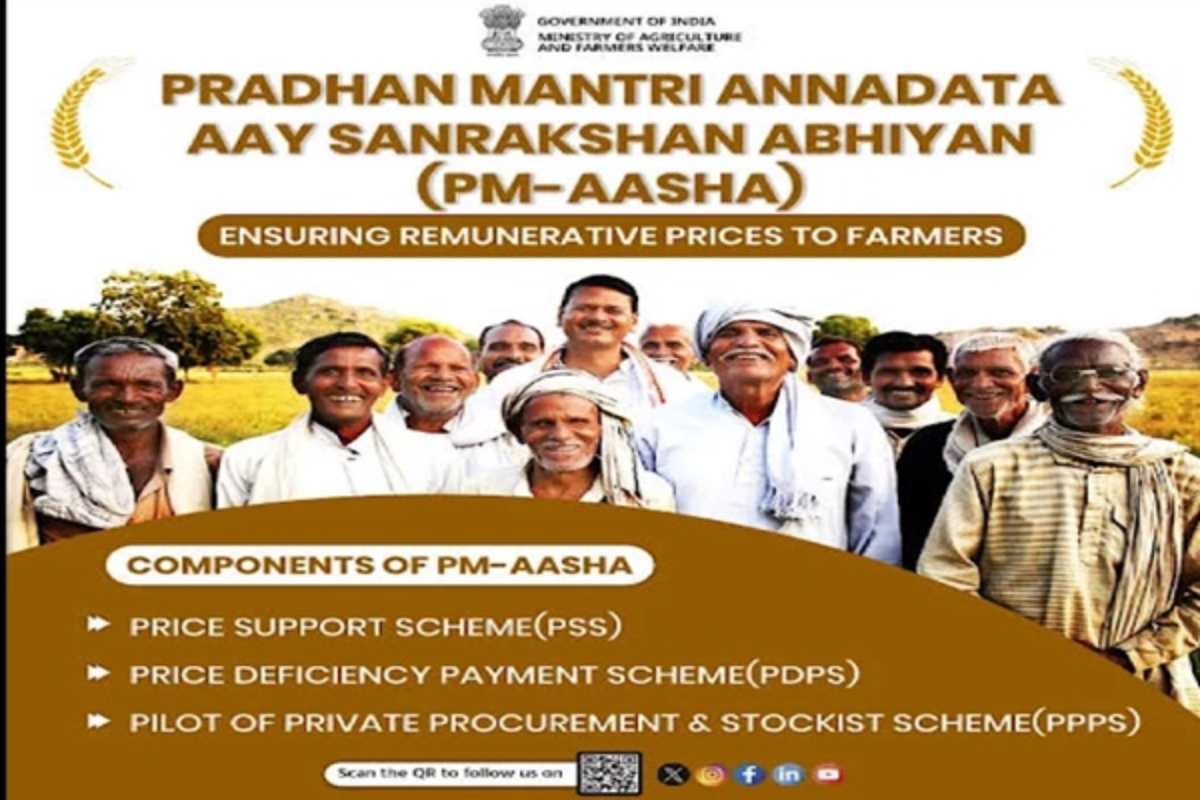
Farmers growing pulses, oilseeds and other notified crops can face a sharp fall in prices when market supply rises after harvest. The government uses the Pradhan Mantri Annadata Aay Sanrakshan Abhiyan, or PM-AASHA, to support farmers when market prices fall below suitable levels.
The scheme combines different price-support measures, including procurement and price-deficiency support. The government recently highlighted PM-AASHA as part of its agricultural support measures.
What PM-AASHA does
PM-AASHA was created to improve farmers’ price realisation for selected agricultural commodities. The scheme includes the Price Support Scheme, Price Deficiency Payment Scheme and other components designed to support farmers when they face weak market prices.
The Price Support Scheme allows government agencies to procure notified pulses, oilseeds and copra at the Minimum Support Price when the required conditions are met. This gives farmers another option when open-market prices fall below the MSP.
The system is particularly important for crops where farmers can face large price movements after harvest because production arrives in the market at roughly the same time.
Farmers often need to sell their produce soon after harvesting to repay loans, buy inputs for the next crop or meet household expenses. If market prices fall at that time, they may have little scope to wait for a recovery.
Government procurement can provide a price floor when the scheme is activated for eligible crops and states. The benefit depends on whether procurement centres are available, whether farmers can meet the required quality standards and whether they can actually access the procurement system.
For farmers, an announced MSP is useful only when they have a practical route to sell at or around that price.
Price deficiency payment offers another approach
PM-AASHA also includes the Price Deficiency Payment Scheme.
Under this approach, farmers do not necessarily have to physically sell their produce to a government procurement agency. Instead, eligible farmers can receive compensation for the difference between the market price and the MSP, subject to the scheme’s rules and limits.
This can reduce the need for the government to physically store large quantities of produce.
For farmers, the important difference is that support can be linked to the price gap rather than only to government procurement.
The system still depends on accurate records, eligible crops, verified transactions and timely payments.
The scheme has particular relevance for pulses and oilseeds because India wants to increase domestic production and reduce dependence on imports. Farmers are more likely to expand cultivation of these crops when they have confidence that production will find a market at a reasonable price.
Price risk can discourage farmers from switching away from familiar crops.
A functioning support system can therefore play a role in crop diversification, but procurement alone cannot guarantee higher farm income. Yield, input costs, local market prices and the cost of transporting produce also affect returns.
Farmers need easier access to procurement
The biggest challenge is often not the existence of a scheme but access to it.
A farmer may live far from a procurement centre or lack information about when procurement begins. Quality requirements can also affect whether a consignment is accepted.
Small farmers may have another disadvantage because they produce smaller quantities and may find transportation costly.
Farmer Producer Organisations and cooperatives can help by aggregating produce from several members and reducing some of the costs involved in reaching larger markets.
Digital registration and better market information can also help farmers know where and when procurement is taking place.
Price support works best with better market information
PM-AASHA is one part of the larger farm-price system. Farmers also need timely information about mandi prices, expected arrivals and government procurement.
If farmers know that prices are falling in nearby markets, they can compare their options before selling.
The government has been expanding digital agricultural markets and farmer databases to improve market access and information.
For farmers, the practical value of PM-AASHA comes down to one question: if market prices fall, can you actually access the support available for your crop?
The scheme can provide a safety net, but its impact depends on procurement reaching farmers, payments arriving on time and farmers having clear information about eligibility and procedures.
Also Read: Punarnava Jal – The world’s first organic fertilizer! Know how it is beneficial for farmers?
Contact us – If farmers want to share any valuable information or experiences related to farming, they can connect with us via phone or whatsapp at 9599273766 or you can write to us at “kisanofindia.mail@gmail.com”. Through Kisan of India, we will convey your message to the people, because we believe that if the farmers are advanced then the country is happy.
You can connect with Kisan of India on Facebook, Twitter, and Whatsapp and Subscribe to our YouTube channel.