


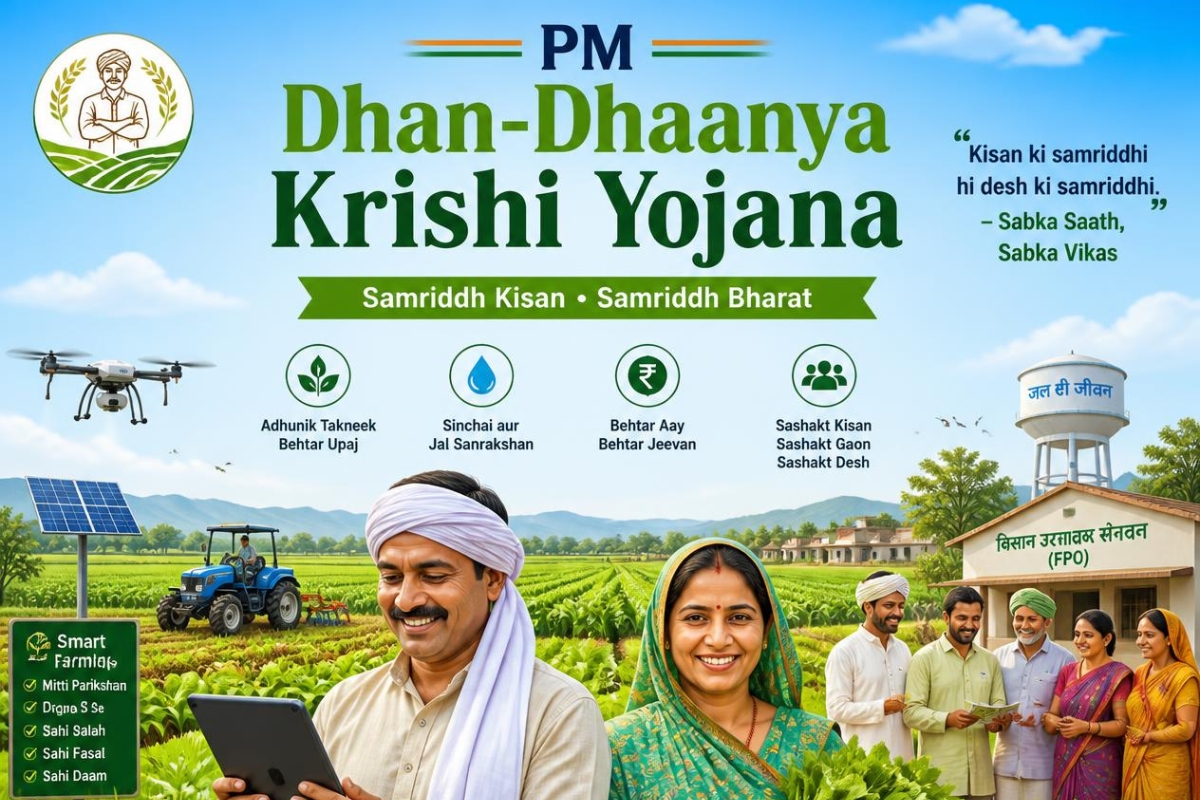
The Prime Minister Dhan-Dhaanya Krishi Yojana is now being monitored across 100 districts identified for focused agricultural development. The government reviewed its progress on September 1, 2026, with the latest dashboard showing the average score of these districts rising from 22.54 in April to 38.85 in July.
The scheme was approved for six years from 2025-26 and focuses on districts with low agricultural productivity, lower cropping intensity and weaker agricultural credit access. Instead of creating a completely separate set of programmes, it brings existing central and state schemes together around district-level agricultural plans.
Why were these 100 districts selected?
The government selected the districts using three indicators: low crop productivity, low cropping intensity and lower agricultural credit disbursement. The selection also considers each state’s net cropped area and number of operational holdings, while ensuring that every state has at least one selected district.
This means the scheme is not designed as a single cash payment for farmers. Its approach is broader. District authorities are expected to identify local agricultural problems and use different government programmes together to address irrigation, storage, crop diversification, productivity, credit and other farm needs.
The scheme aims to improve agricultural productivity and encourage crop diversification and sustainable farming. It also focuses on increasing post-harvest storage at the panchayat and block levels, improving irrigation and making short-term and long-term agricultural credit more accessible.
One important point is that PM Dhan-Dhaanya Krishi Yojana works through convergence of 36 existing schemes across 11 departments. This means farmers may receive benefits through programmes they already know rather than receiving one separate PM-DDKY payment.
For example, a district may identify irrigation as a major constraint and coordinate relevant water or micro-irrigation programmes. Another district may prioritise storage, crop diversification, livestock, agricultural credit or post-harvest activities depending on its local conditions.
This district-based approach can be useful because farming problems differ widely across India. A district facing unreliable irrigation needs different support from one where farmers have adequate water but struggle with storage, markets or low crop productivity.
District plans decide the priorities
Each selected district prepares a District Agriculture and Allied Activities Plan through the District Dhan-Dhaanya Krishi Yojana Samiti. District plans are expected to bring together central schemes, state programmes and other available resources around local agricultural priorities.
Farmers are also included in the district-level planning structure. This matters because local farmers can identify problems that may not be visible through government data alone, such as water shortages, poor storage access, transport problems or difficulty finding suitable markets.
Improving irrigation is one of the scheme’s stated objectives. For farmers dependent heavily on rainfall, better access to water can reduce production risks and allow more reliable cropping.
But irrigation does not always mean building a new large project. Depending on local conditions, support can involve improving existing systems, expanding suitable irrigation facilities or coordinating programmes that help farmers use available water more effectively.
The scheme also aims to increase post-harvest storage at panchayat and block levels. This can matter when farmers are forced to sell immediately after harvesting because they lack suitable storage.
Better local storage could give farmers more time to compare buyers and prices. It does not guarantee higher returns, but reducing the need for immediate distress sales can give farmers greater control over when and how produce enters the market.
Credit is another important area
The 100 districts were partly selected because of lower agricultural credit disbursement. Improving access to formal credit is therefore an important part of the programme.
Farmers need timely working capital for seed, fertiliser, machinery, irrigation and other farm activities. Better access to formal loans can reduce dependence on informal borrowing, particularly when farmers face high input costs or unexpected crop expenses.
The latest review shows that the government is trying to move beyond simply recording how much money has been spent. A dashboard is being used to track district performance, District Action Plans, financial progress, field monitoring and beneficiary-level outcomes.
The Financial Progress Module became operational on August 31, while a Beneficiary Progress Module was targeted for implementation by mid-September. The aim is to track not only activities but also the farmers who receive benefits and the outcomes produced through the interventions.
What should farmers do?
Farmers in selected Dhan-Dhaanya districts should first check which schemes and activities are being prioritised in their district plan. They should contact the agriculture department, KVK or local extension officials rather than assuming every farmer receives the same benefit.
Farmers should also keep documents such as land records, bank details, crop information and previous scheme applications updated. Many agricultural programmes have separate eligibility requirements, so access to one programme does not automatically mean eligibility for every linked scheme.
The improvement in the average district score is an early sign of progress, but it does not by itself show whether farm incomes have increased. The government will need to demonstrate whether irrigation has improved, productivity has risen, storage has expanded and more farmers have actually received useful support.
For farmers, the value of PM Dhan-Dhaanya Krishi Yojana will ultimately depend on what changes on the ground. If different schemes work together around local needs, the programme could help address several farm problems at once. If coordination remains weak, its benefits may be harder to notice.
Also Read: Punarnava Jal – The world’s first organic fertilizer! Know how it is beneficial for farmers?
Contact us – If farmers want to share any valuable information or experiences related to farming, they can connect with us via phone or whatsapp at 9599273766 or you can write to us at “kisanofindia.mail@gmail.com”. Through Kisan of India, we will convey your message to the people, because we believe that if the farmers are advanced then the country is happy.
You can connect with Kisan of India on Facebook, Twitter, and Whatsapp and Subscribe to our YouTube channel.