



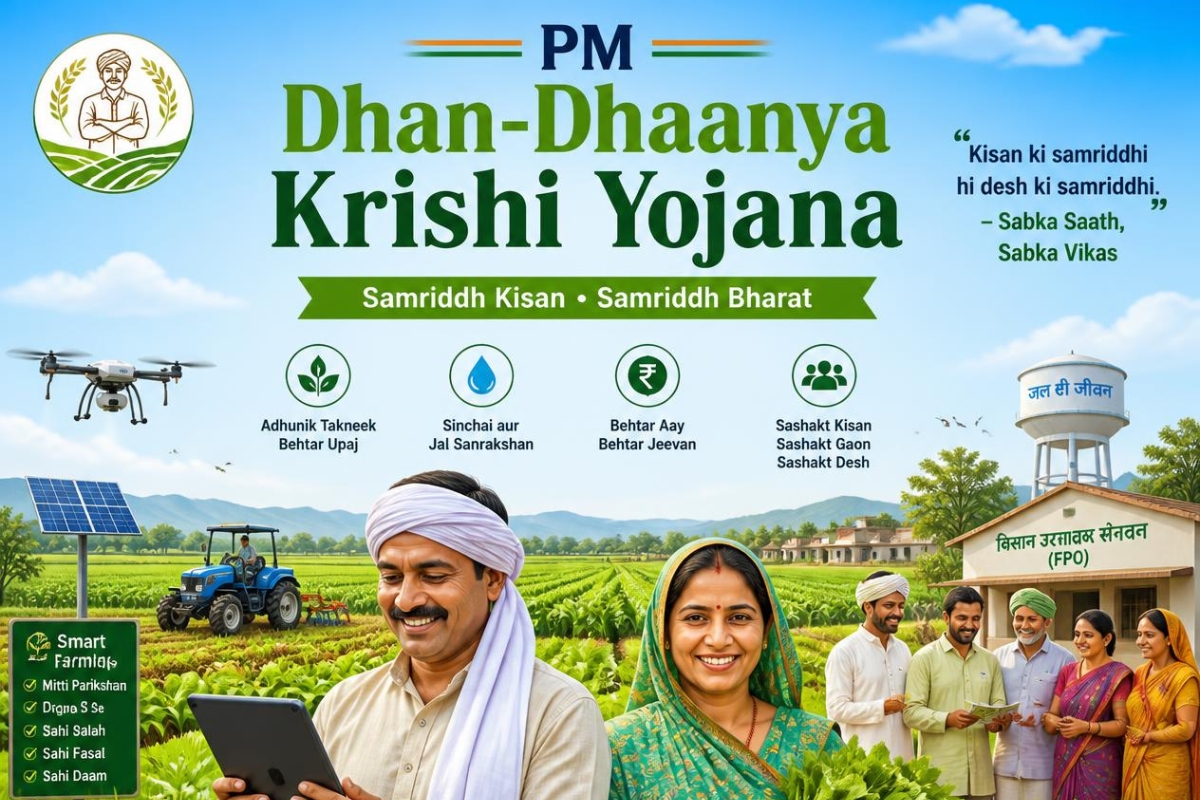
Farmers often face several problems at once. Some struggle with low crop yields, others lack reliable irrigation or affordable credit, while many have limited facilities to store and process their produce. The Prime Minister Dhan-Dhaanya Krishi Yojana (PMDDKY) aims to address these gaps through coordinated agricultural development in 100 selected districts.
The Union Cabinet approved the six-year scheme on 16 July 2025, and it was launched on 11 October 2025. The programme began in the 2025–26 financial year and brings together existing Central and state government schemes to meet district-specific agricultural needs.
The selected districts were identified using indicators such as low agricultural productivity, low cropping intensity and limited agricultural credit disbursement. The selection also considered the share of cultivated land and operational agricultural holdings in each state and Union Territory. The programme covers agriculture and allied activities rather than focusing on a single crop.
What Support Does the Scheme Aim to Improve?
PMDDKY works through the convergence of 36 Central schemes across 11 ministries and departments, alongside state programmes and private-sector participation. Its main objectives are to raise productivity, encourage crop diversification, improve irrigation, expand storage and help farmers access short-term and long-term agricultural credit.
Irrigation and water management: District plans can identify gaps in irrigation infrastructure and connect farmers with relevant existing programmes. Depending on local needs and eligibility, farmers may explore micro-irrigation, water-management projects and other available support through their agriculture or irrigation departments.
Better seeds and crop productivity: District-level planning can focus on improving crop yields and encouraging farming practices suited to local conditions. Farmers should ask their local agriculture office which seed, extension and crop-development programmes are active in their district.
Storage and processing: In areas where farmers lose value because they sell immediately after harvest, better warehouses, processing facilities and farmer collectives may help. Such facilities can reduce handling problems and create opportunities to sell graded or processed produce, although benefits depend on market demand and actual access.
Agricultural credit: The scheme also seeks to improve access to formal credit. Farmers can approach banks, cooperative institutions and other eligible lenders to check the available agricultural loans and documentation requirements. PMDDKY does not automatically guarantee a loan or waive repayment obligations.
How Can Farmers Find Out Whether Their District Is Covered?
Farmers should first confirm whether their district is among the 100 selected districts. They can check the official PMDDKY website and ask their district agriculture department or District Collector’s office about the local District Action Plan.
The scheme is coordinated at district, state and national levels. District committees prepare and implement action plans, while state and national committees review progress. These plans are based on local agricultural needs and link relevant government programmes to specific targets.
Farmers should ask which interventions are approved for their district, which department is responsible and whether applications are currently open. They should also clarify whether support is available to individual farmers, Farmer Producer Organisations (FPOs), cooperatives or other eligible groups. The process can differ because PMDDKY coordinates several existing schemes rather than offering one uniform benefit to every farmer.
Keep land records, identity documents, bank details and any required farmer registration information ready when applying for an individual scheme. Do not pay an unofficial agent who promises guaranteed selection or benefits.
According to a government update published on 10 October 2026, all 100 selected districts had prepared District Action Plans, and the plans were under implementation. The government also reported that the average score across six programme objectives rose from 18.85 in April 2026 to 46.89 in August 2026.
Examples from selected districts illustrate the programme’s intended approach. In Gadchiroli, Maharashtra, a farmer producer company established a rice-processing unit with a capacity of three tonnes per hour and a 900-tonne warehouse. In Jaisalmer, Rajasthan, an FPO used solar-powered sprinkler irrigation across 500 acres of cumin cultivation.
These examples show the types of interventions that district planning can support, but they do not mean every farmer in a selected district will receive the same facilities. Farmers should check what has actually been approved and made available in their own area.
What Should Farmers Do Next?
Farmers in selected districts can begin by identifying their main production problem, whether it is poor irrigation, high input costs, limited credit or a lack of storage. They should then contact the relevant department and ask which existing scheme or district intervention addresses that need.
FPOs and cooperatives can also discuss shared infrastructure, including warehouses, processing units, irrigation equipment and market-linkage facilities. Groups should prepare a clear proposal showing the number of farmers who would benefit, the expected costs and the local need before pursuing support.
PM Dhan-Dhaanya Krishi Yojana aims to improve farming conditions in 100 selected districts by coordinating existing programmes around local priorities. Its practical value for farmers will depend on which projects are approved, whether services reach villages and how easily eligible farmers can access them. Checking the district action plan is the best first step.
Also Read: Punarnava Jal – The world’s first organic fertilizer! Know how it is beneficial for farmers?
Contact us – If farmers want to share any valuable information or experiences related to farming, they can connect with us via phone or whatsapp at 9599273766 or you can write to us at “kisanofindia.mail@gmail.com”. Through Kisan of India, we will convey your message to the people, because we believe that if the farmers are advanced then the country is happy.
You can connect with Kisan of India on Facebook, Twitter, and Whatsapp and Subscribe to our YouTube channel.