



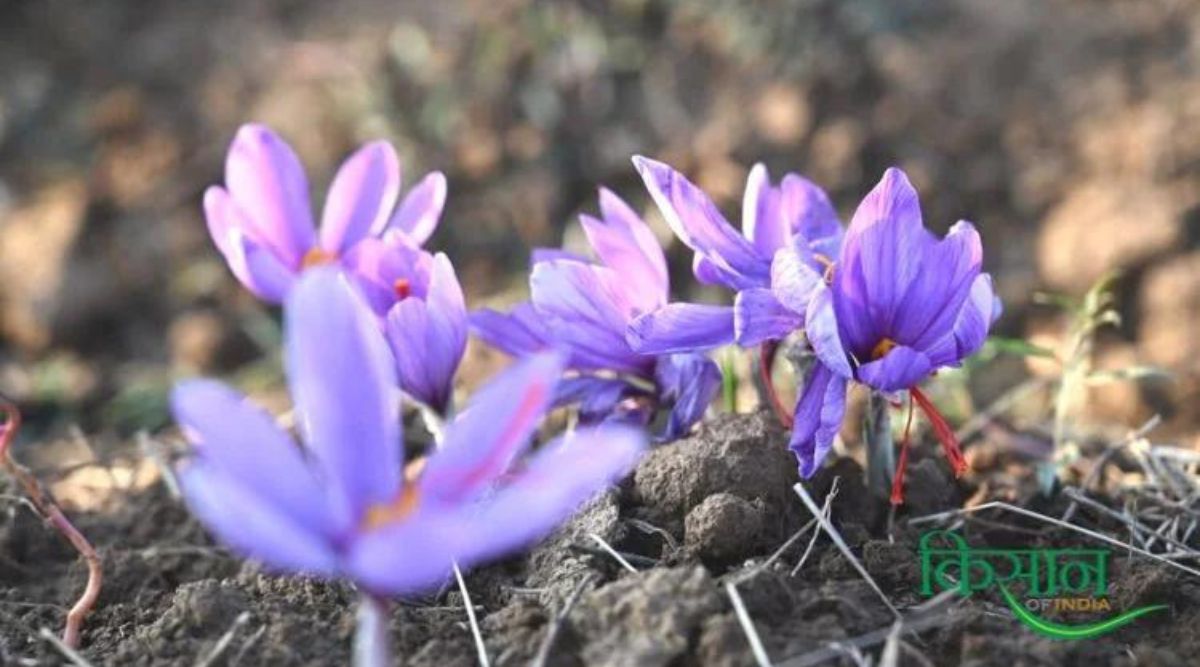
For most saffron growers, income comes from harvesting the prized crimson stigmas that are sold as one of the world’s most valuable spices. In Jammu and Kashmir’s Kishtwar district, one farmer saw an opportunity elsewhere in the saffron value chain.
Instead of focusing only on spice production, he began producing healthy saffron corms for sale to other growers.
The idea emerged from a growing problem.
As saffron cultivation expanded into new areas, farmers needed reliable planting material. Many struggled to obtain disease-free corms capable of producing strong yields. Recognising this gap, the farmer established a specialised nursery dedicated to producing quality saffron corms.
What started as a small initiative gradually developed into a profitable enterprise serving growers across the region.
The business now generates income even before a single saffron flower blooms.
Agricultural success often depends on recognising opportunities others overlook. Most saffron farmers concentrate on flower production because it is the most visible part of the industry. The farmer realised that every new plantation begins with quality planting material.
Without healthy corms, productivity suffers from the start.
Demand for planting material was increasing as government agencies promoted saffron cultivation and farmers explored diversification into high-value crops.
The need created a specialised market.
Instead of competing directly with spice producers, the farmer entered a less crowded segment of the industry.
The decision proved highly valuable.
Quality Planting Material Makes a Difference
Saffron productivity depends heavily on the condition of corms used during planting.
Healthy corms establish more successfully, produce stronger plants, and contribute to better flowering performance. Farmers therefore place considerable importance on sourcing reliable planting material.
The nursery focused on maintaining quality standards throughout production.
Corm selection, grading, storage, and disease management became central parts of the business. Growers purchasing planting material gained confidence that they were investing in healthy stock.
Trust became one of the enterprise’s biggest assets.
Reputation helped drive demand.
Traditional saffron farming generates income primarily during harvest periods. A corm nursery creates additional revenue opportunities throughout the production cycle. Farmers purchasing planting material provide a separate market that operates independently of saffron spice prices.
This diversification improved financial stability.
Rather than depending entirely on one product, the entrepreneur developed multiple income streams within the same agricultural sector. Agricultural economists frequently highlight diversification as a way to strengthen farm resilience.
The nursery demonstrates this principle effectively.
More than one opportunity existed within saffron farming.
Supporting Other Farmers
The business has benefits beyond its own profitability. Reliable access to planting material helps other growers establish and expand saffron cultivation. Farmers no longer need to depend solely on limited local sources or uncertain supply channels.
The nursery contributes to the development of the wider saffron sector. As more growers access quality corms, cultivation standards improve across producing regions. The enterprise therefore supports both individual and regional agricultural growth.
Its impact extends beyond a single farm.
The sector benefits collectively.
Mountain regions often face limitations in terms of land availability and large-scale farming opportunities. High-value crops such as saffron provide one pathway for increasing income from relatively small holdings. The corm nursery demonstrates how entrepreneurs can build businesses around specialised agricultural products.
Researchers studying rural development frequently note that value chains contain opportunities beyond primary production.
Processing, planting material, and specialised services can all generate income.
The entrepreneur succeeded by identifying one of these niches.
The result is a stronger business model.
Growing More Than Saffron
The success of the Kishtwar nursery highlights an important lesson in modern agriculture.
Sometimes the greatest opportunities are not found in the final product itself but in the systems that support its production. By focusing on corms rather than only flowers, the farmer built a business serving an expanding market.
Today, the nursery supplies planting material, supports local growers, and generates stable income from a specialised segment of the saffron industry.
Its growth reflects the increasing sophistication of high-value agriculture in mountain regions.
In the saffron fields of Kishtwar, one farmer discovered that cultivating future harvests could be just as profitable as harvesting the spice itself.
Also Read: Punarnava Jal – The world’s first organic fertilizer! Know how it is beneficial for farmers?
Contact us – If farmers want to share any valuable information or experiences related to farming, they can connect with us via phone or whatsapp at 9599273766 or you can write to us at “kisanofindia.mail@gmail.com”. Through Kisan of India, we will convey your message to the people, because we believe that if the farmers are advanced then the country is happy.
You can connect with Kisan of India on Facebook, Twitter, and Whatsapp and Subscribe to our YouTube channel.