



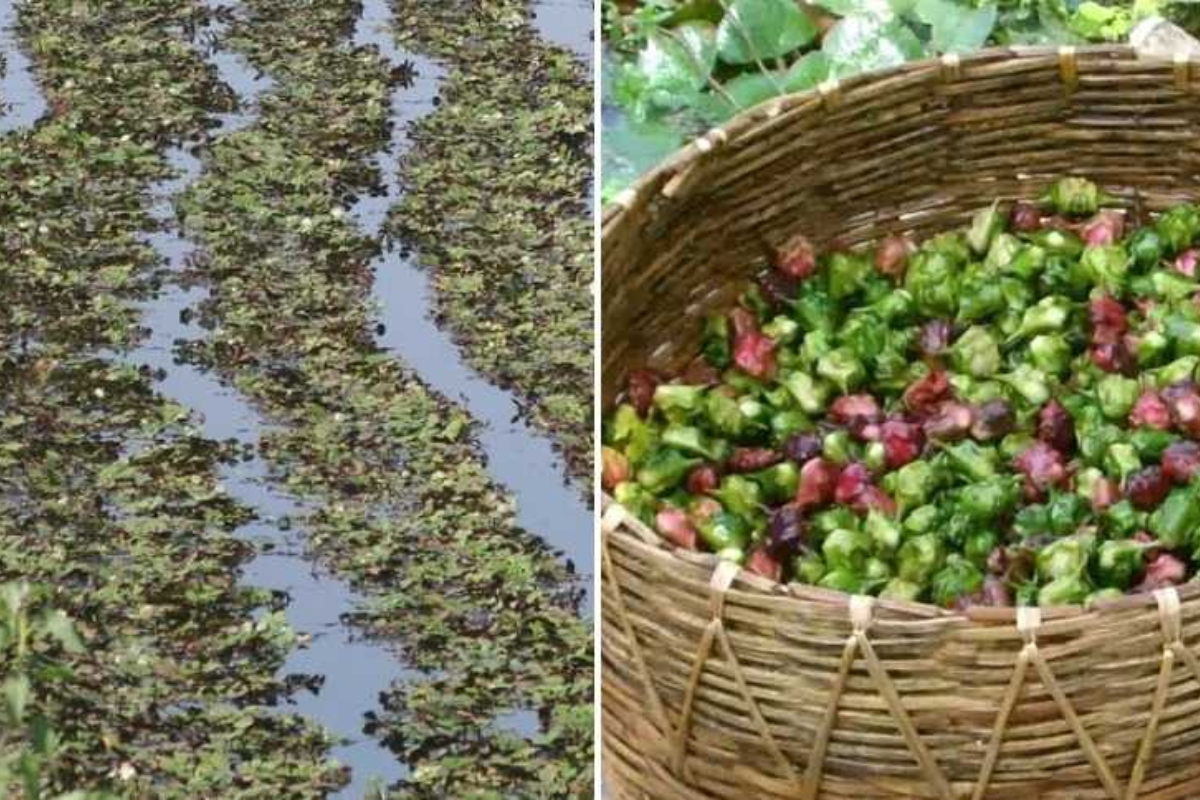
For years, a farmer in northern Bihar watched large village ponds remain underutilised for much of the year. While these water bodies provided fish and seasonal resources, they generated limited income compared with their potential.
Instead of viewing the ponds as unused space, he saw an opportunity.
The farmer decided to cultivate water chestnut, locally known as singhara, a crop naturally suited to aquatic environments. Starting on a small scale, he gradually expanded production as demand increased in nearby markets.
Today, the enterprise has become a major source of income, demonstrating how wetland resources can support profitable agriculture when linked to the right crop and market strategy.
His journey is inspiring other farmers to reconsider the economic value of village water bodies.
Many rural ponds remain underused despite their agricultural potential. The farmer recognised that water chestnut could thrive in conditions unsuitable for conventional crops. Rather than investing in land development, he focused on making better use of existing aquatic resources.
The crop adapted well to local conditions.
Production costs remained manageable, and the ponds provided a stable growing environment. What was once considered idle space became a productive farming asset.
The transformation changed the economics of the farm.
A neglected resource became a source of revenue.
Demand Created Strong Market Opportunities
Water chestnut enjoys steady demand across many parts of India. Consumers purchase the fresh fruit, while processors use it to produce flour and other food products. Seasonal demand often strengthens prices during major festivals and fasting periods.
The farmer built relationships with traders and wholesalers in nearby towns.
Reliable market access encouraged production expansion and reduced uncertainty about sales. Understanding demand proved just as important as successful cultivation.
The market rewarded consistent supply.
Growth followed naturally.
Instead of expanding rapidly, the farmer increased cultivation step by step. Each season provided practical experience in crop management, harvesting techniques, and marketing strategies. Profits from early harvests were reinvested into expanding production areas.
This gradual approach strengthened the business.
Agricultural experts often recommend controlled expansion because it allows farmers to learn while limiting financial exposure.
The strategy worked effectively in this case.
Knowledge accumulated with every season.
The enterprise became stronger over time.
Wetland Agriculture Gains Recognition
Researchers are increasingly studying crops suited to aquatic and semi-aquatic environments. Wetland agriculture remains underdeveloped in many regions despite substantial resource availability. Water chestnut demonstrates how such landscapes can contribute to food production and rural incomes.
The farmer’s success has attracted attention from neighbouring communities.
Many are exploring similar opportunities in ponds and wetlands previously viewed as having limited economic value.
The example is changing perceptions.
Water bodies are being seen differently.
Harvesting, sorting, transportation, and marketing activities created additional work opportunities within the community. Seasonal labour demand increased as cultivation expanded. The enterprise therefore generated benefits beyond the farmer’s own household.
Several families gained income through participation in different stages of the value chain.
Rural development experts frequently note that successful agricultural enterprises often create indirect economic benefits throughout local economies.
This enterprise illustrates that principle clearly.
Its impact extends beyond one farm.
Finding Opportunity in Unused Resources
The Bihar farmer’s story highlights a lesson often overlooked in agriculture.
Success does not always require new land, expensive machinery, or complex technology. Sometimes it begins with identifying overlooked resources and finding productive ways to use them.
Through water chestnut cultivation, the farmer transformed village ponds into profitable agricultural assets. The enterprise increased income, created employment, and demonstrated the potential of wetland farming systems.
As interest in diversified agriculture continues to grow, similar opportunities may emerge in many other regions.
In Bihar’s wetlands, one farmer proved that some of the most valuable farmland may lie beneath the water’s surface.
Also Read: Punarnava Jal – The world’s first organic fertilizer! Know how it is beneficial for farmers?
Contact us – If farmers want to share any valuable information or experiences related to farming, they can connect with us via phone or whatsapp at 9599273766 or you can write to us at “kisanofindia.mail@gmail.com”. Through Kisan of India, we will convey your message to the people, because we believe that if the farmers are advanced then the country is happy.
You can connect with Kisan of India on Facebook, Twitter, and Whatsapp and Subscribe to our YouTube channel.