



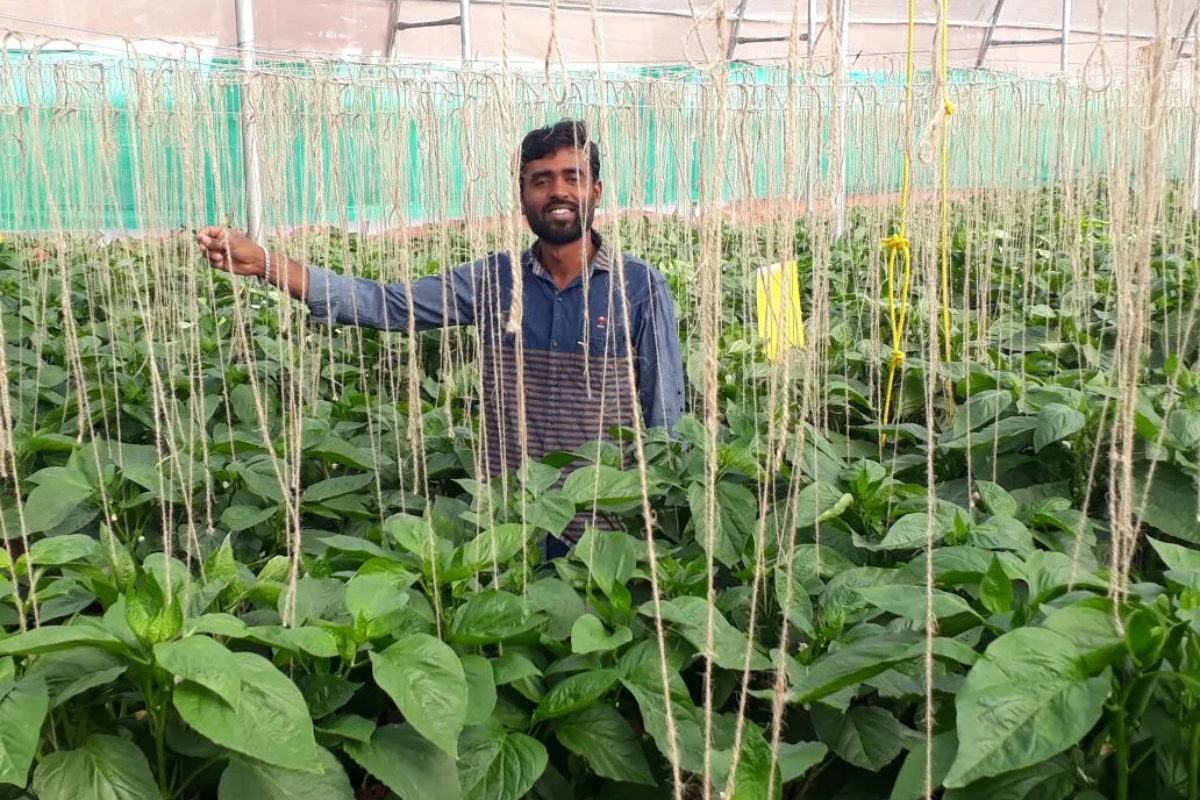
A farmer in Maharashtra has earned ₹15 lakh in net income from coloured capsicum grown inside a polyhouse, showing how protected cultivation can help farmers target premium markets.
Mr. Subhash Gadge grew red and yellow capsicum on 3,000 square metres of protected land during the 2025 season. By the time ICAR documented the case, he had harvested 20 tonnes of produce and was expecting another 10 tonnes.
Protected cultivation allows farmers to grow crops inside structures such as polyhouses, where they can manage parts of the growing environment. This can help farmers produce crops that may face greater risks in open fields because of heavy rain, temperature changes, pests or other weather conditions.
Gadge chose coloured capsicum, which has demand in urban markets, hotels and retail chains. The crop requires careful management, but protected cultivation can help farmers produce more uniform and marketable vegetables.
His case also shows that farmers need to select crops based not only on yield but also on access to buyers.
20 tonnes harvested from 3,000 square metres
Gadge planted red and yellow capsicum on June 1, 2025, in his 3,000-square-metre polyhouse. By the time ICAR recorded his story, he had harvested 20 tonnes of high-quality capsicum. The market price varied sharply during the season, ranging from ₹60 to ₹300 per kilogram. His average realisation was about ₹100 per kilogram.
Price variation is common in horticulture. Farmers can receive high prices during periods of lower supply and much lower prices when more produce reaches the market. For Gadge, maintaining quality and reaching the right buyers helped improve his returns.
Gross income reached ₹20 lakh
The 20 tonnes of harvested capsicum generated a gross income of ₹20 lakh. His operational costs were about ₹5 lakh, leaving a reported net income of ₹15 lakh.
ICAR also noted that harvesting was expected to continue for another three months, with nearly 10 tonnes of additional production anticipated. The figures show the potential of protected cultivation, but they should not be treated as guaranteed returns for every farmer.
Income can change depending on crop prices, polyhouse costs, water availability, pest management, crop losses and access to markets.
One of the important parts of Gadge’s success was his connection with buyers. According to ICAR, buyers from Mumbai, Ahmedabad and Indore began approaching him directly at the village level because of his consistent product quality and reliable supply.
This reduced his dependence on finding a buyer for each harvest through traditional markets. Direct purchase arrangements can help farmers plan production and sales, especially for high-value horticultural crops.
But building such relationships takes time. Buyers expect consistent quality, regular supply and produce that meets market requirements.
Protected cultivation is more than building a polyhouse
A polyhouse alone does not guarantee higher income. Farmers need to select the right crop and variety, manage irrigation and nutrients, monitor pests and diseases and understand market demand.
Coloured capsicum also requires careful harvesting and grading because buyers often pay attention to size, colour and appearance.
The cost of operating a protected structure can also be significant. Farmers should calculate expected production costs before investing and examine whether they have reliable access to high-value markets.
For a farmer located far from major buyers, transport and handling costs can reduce profits.
Gadge’s experience offers a practical lesson for farmers interested in protected cultivation. The first question should not only be what can grow inside a polyhouse. It should also be who will buy the crop.
High-value crops can generate strong returns, but only when farmers can sell them at prices that justify higher production costs. Farmers can study demand in nearby cities, wholesale markets, hotels, retailers and food businesses before deciding what to plant.
Farmer Producer Organisations can also help smaller growers aggregate produce and reach larger buyers.
A model for market-linked farming
ICAR highlighted Gadge’s experience as an example of how protected cultivation can support productivity, stable income and market-oriented farming in water-scarce areas. His story is not simply about producing capsicum inside a polyhouse.
It is about combining production with market access. The farmer produced a crop that had demand, maintained quality and built a reputation among buyers.
For farmers considering protected cultivation, that connection between the farm and the market may matter as much as the structure itself. The next article can move to Organic Farming, keeping today’s topics separate and avoiding the carbon-market and climate stories already covered.
Also Read: Punarnava Jal – The world’s first organic fertilizer! Know how it is beneficial for farmers?
Contact us – If farmers want to share any valuable information or experiences related to farming, they can connect with us via phone or whatsapp at 9599273766 or you can write to us at “kisanofindia.mail@gmail.com”. Through Kisan of India, we will convey your message to the people, because we believe that if the farmers are advanced then the country is happy.
You can connect with Kisan of India on Facebook, Twitter, and Whatsapp and Subscribe to our YouTube channel.