


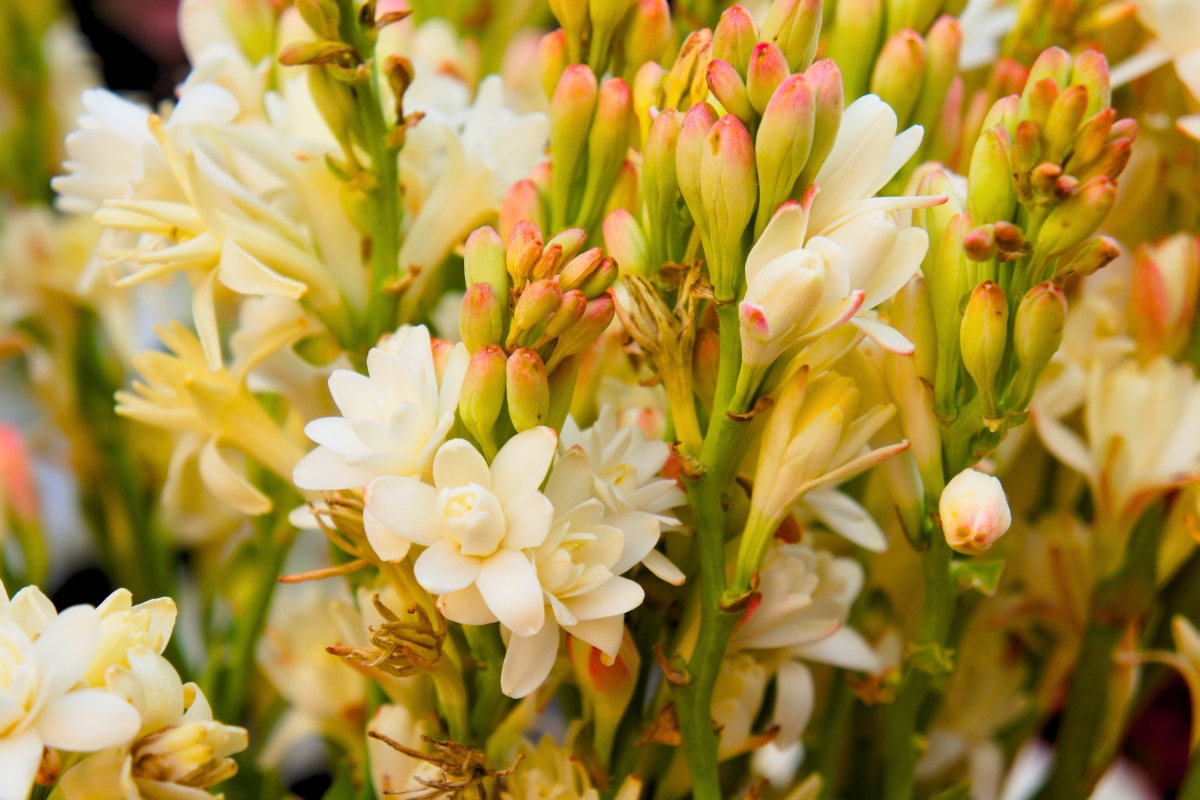
For Ramanjunaiah, a farmer from Yettinahalli village in Karnataka’s Tumakuru district, tomato farming brought uncertain returns because prices frequently changed. He decided to try floriculture instead. With training from ICAR-Krishi Vigyan Kendra Tumakuru, he adopted tuberose and began shifting his farm towards a crop with stronger market demand.
Ramanjunaiah selected Arka Prajwal, a high-yielding tuberose variety developed by ICAR-Indian Institute of Horticultural Research, Bengaluru. The variety produces larger florets and is suitable for loose flowers, garlands and decorations. ICAR reports that it can provide about 20% higher loose-flower yield than local cultivars.
The change was supported by a Front Line Demonstration. The KVK supplied quality planting bulbs and helped him follow recommended spacing, organic nutrient management, efficient irrigation and timely pest and disease control. These practices gave the farmer a structured production system instead of relying only on traditional cultivation methods.
₹5.85 Lakh From Two Acres
Ramanjunaiah cultivated tuberose on two acres and harvested 11.74 tonnes of loose flowers within a year. According to ICAR, the crop generated nearly ₹5.85 lakh in income, substantially higher than what he previously earned from vegetable cultivation. The result encouraged him to expand his floriculture activities.
The business did not stop with selling flowers. Ramanjunaiah also began producing tuberose bulbs and bulblets. ICAR estimates that he could harvest 18–20 tonnes of bulbs and bulblets per hectare by the end of the crop cycle, creating another potential source of income through farm expansion and sales.
Tuberose also offers an important advantage for farmers seeking regular cash flow. The crop has a near year-round flowering period, allowing flowers to reach markets over a longer period. This differs from crops where income is concentrated around one harvest and gives farmers more opportunities to sell produce.
Flowers from Yettinahalli are now sold in markets including Pavagada, Tumakuru, Bengaluru and Chennai. Demand increases during festivals and wedding seasons, when traders procure flowers in larger quantities. This wider market access has helped farmers move beyond depending only on nearby buyers for their produce.
The Hulume Farmer Producer Organization in Pavagada has also supported collective marketing. Working through an FPO can help farmers combine produce, negotiate with buyers and reduce dependence on individual traders. For small growers, collective marketing can be important when selling a perishable crop such as fresh flowers.
The shift has spread beyond one farmer. ICAR reports that around 15 hectares in and around Yettinahalli are now under tuberose cultivation. About 15 farm families are involved, while village-level floriculture generates more than ₹30 lakh annually. Women also participate in harvesting, grading and sorting flowers.
What Other Farmers Can Learn
Ramanjunaiah’s experience does not mean every farmer should replace vegetables with flowers. Floriculture requires suitable soil, water, planting material, labour and reliable markets. Farmers considering tuberose should first study local demand, production costs, expected yields and access to buyers before shifting land away from existing crops.
The success also shows why variety selection matters. Arka Prajwal was not chosen simply because it was a new variety. Its flower characteristics, yield potential and suitability for garlands and decorations matched an existing market. Farmers should similarly select varieties according to local climate, buyers and the purpose for which produce will be sold.
Training played another important role. The farmer received guidance on spacing, nutrition, irrigation and pest management before expanding cultivation. This reduced the risk of adopting a new crop without technical knowledge. Farmers interested in floriculture can approach KVKs and horticulture departments for local recommendations before making a major investment.
Yettinahalli’s experience shows how a crop change can reshape farm income when three things come together: suitable planting material, scientific cultivation and dependable markets. Ramanjunaiah’s move from uncertain tomato prices to tuberose has now encouraged neighbouring farmers, turning individual experimentation into a wider village floriculture model.
Also Read: Punarnava Jal – The world’s first organic fertilizer! Know how it is beneficial for farmers?
Contact us – If farmers want to share any valuable information or experiences related to farming, they can connect with us via phone or whatsapp at 9599273766 or you can write to us at “kisanofindia.mail@gmail.com”. Through Kisan of India, we will convey your message to the people, because we believe that if the farmers are advanced then the country is happy.
You can connect with Kisan of India on Facebook, Twitter, and Whatsapp and Subscribe to our YouTube channel.