



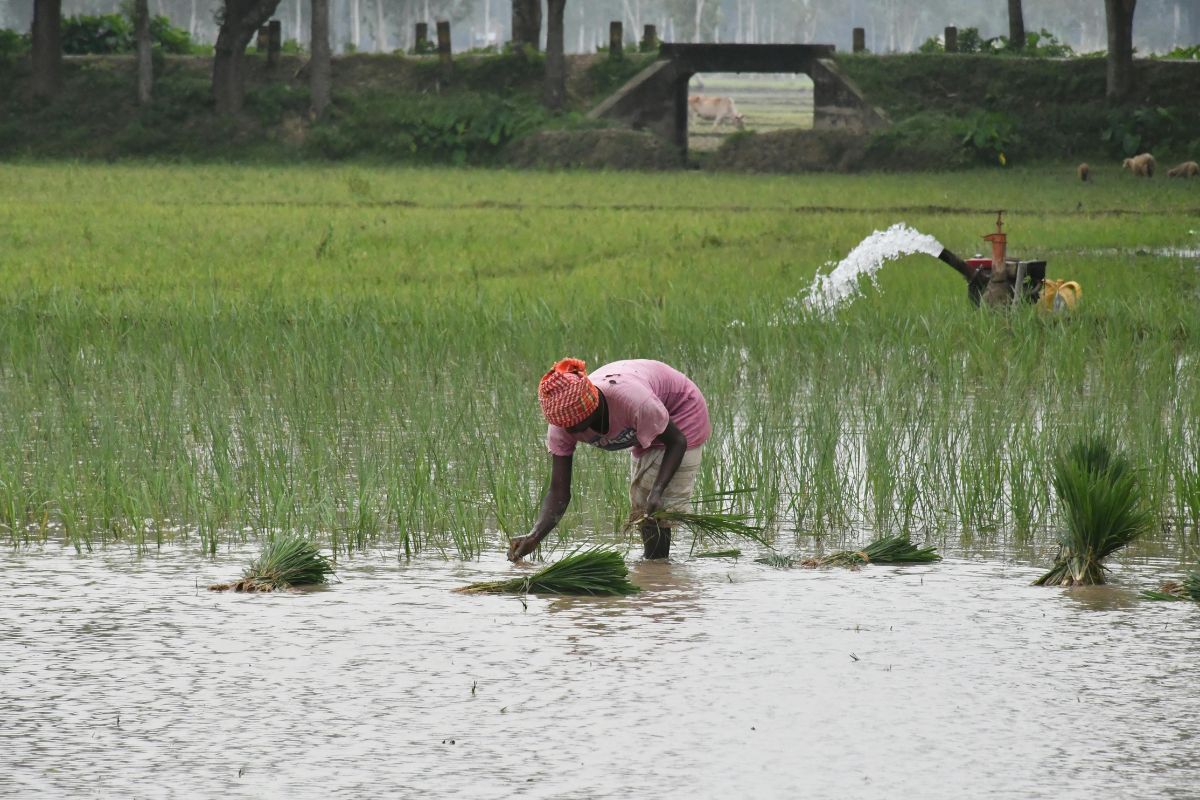
In the coastal villages of the Sundarbans, farmers have learned to live with uncertainty. Cyclones, tidal flooding, embankment breaches, and rising salinity have become recurring challenges that affect both livelihoods and food production. In many areas, fields that once supported traditional paddy varieties now struggle to maintain yields after repeated exposure to saltwater.
The problem has intensified over the past decade as extreme weather events have become more frequent. Farmers often spend months restoring fields after cyclones push saline water into agricultural land. Even when floodwaters recede, salt can remain in the soil, reducing productivity and making cultivation more difficult.
Against this backdrop, salt-tolerant paddy varieties are emerging as an important adaptation strategy. Across coastal districts of West Bengal, more farmers are adopting rice varieties capable of performing under saline conditions, helping protect production in one of India’s most climate-vulnerable agricultural regions.
Agriculture in the Sundarbans has always depended on a delicate balance between land and water. That balance is becoming harder to maintain as rising sea levels, stronger storms, and tidal intrusion increase salinity in many farming areas.
When salt enters agricultural fields, it affects plant growth, nutrient uptake, and grain development. Traditional rice varieties often experience significant yield reductions under such conditions.
Farmers in several coastal blocks report that land which once supported reliable paddy cultivation now requires careful crop selection. In some villages, repeated cyclone damage has forced growers to abandon varieties that had been cultivated for generations.
The challenge extends beyond individual farms. Salinity is gradually influencing agricultural planning across entire coastal landscapes.
New Rice Varieties Offer Hope
Agricultural scientists have spent years developing paddy varieties capable of tolerating higher salt concentrations without major yield losses. These varieties are specifically designed for coastal environments where saline conditions regularly affect production.
Farmers adopting the new seeds report greater confidence during difficult seasons. While no variety can eliminate the effects of severe flooding or extreme weather, salt-tolerant rice often performs better than conventional alternatives when saline conditions occur.
The improved resilience is particularly important for smallholders who depend heavily on a single crop cycle for annual income. A failed harvest can create financial difficulties that last well beyond one season.
For many growers, salt-tolerant rice represents a practical response to changing environmental realities.
Major cyclones affecting eastern India have highlighted the vulnerability of coastal agriculture. Events such as Amphan, Yaas, and other severe storms caused extensive damage to farmland, infrastructure, and rural livelihoods.
Farmers remember how saltwater inundation affected fields long after the storms passed. In some locations, agricultural recovery required multiple seasons of effort before productivity returned to previous levels.
These experiences have influenced crop choices.
Many growers now prioritise varieties that can better withstand environmental stress rather than focusing exclusively on maximum yield potential. The shift reflects a broader change in agricultural thinking, where resilience is becoming just as important as productivity.
Climate adaptation increasingly begins with seed selection.
Government Programmes Support Adoption
State agricultural departments and research institutions have expanded efforts to promote salt-tolerant varieties in vulnerable districts. Demonstration plots, seed distribution programmes, and farmer training sessions are helping increase awareness.
Officials believe adaptation measures must be introduced before major climate events occur rather than after damage has already been done. Seed-based solutions are particularly attractive because they can often be adopted without major infrastructure investments.
Several coastal districts have incorporated climate-resilient crop promotion into broader agricultural development plans. The goal is to ensure that farmers have access to varieties suited to emerging environmental challenges.
Support programmes are helping accelerate the transition.
The importance of salt-tolerant crops extends beyond the Sundarbans. Coastal regions across India face similar concerns related to salinity, sea-level rise, and extreme weather events.
Researchers believe lessons learned in West Bengal could prove valuable for other vulnerable agricultural areas. Climate-resilient crop development is increasingly viewed as a critical component of national food security planning.
The focus is not solely on responding to current problems. Scientists are also preparing for conditions that may become more common in future decades.
Crop breeding programmes are therefore becoming an important part of climate adaptation efforts.
Farming on the Front Line of Climate Change
Few places illustrate the agricultural impact of climate change as clearly as the Sundarbans. Farmers here face challenges that many other regions may encounter more frequently in the years ahead.
Every cyclone, tidal surge, and saline intrusion tests the resilience of local farming systems. Yet communities continue adapting through new practices, improved seeds, and careful management of limited resources.
Salt-tolerant paddy varieties are one example of that adaptation.
They do not eliminate the risks facing coastal agriculture, but they help farmers maintain production under increasingly difficult conditions.
In the fields of the Sundarbans, the future of farming may depend not only on rainfall and soil, but also on how effectively crops can withstand a changing climate.
Also Read: Punarnava Jal – The world’s first organic fertilizer! Know how it is beneficial for farmers?
Contact us – If farmers want to share any valuable information or experiences related to farming, they can connect with us via phone or whatsapp at 9599273766 or you can write to us at “kisanofindia.mail@gmail.com”. Through Kisan of India, we will convey your message to the people, because we believe that if the farmers are advanced then the country is happy.
You can connect with Kisan of India on Facebook, Twitter, and Whatsapp and Subscribe to our YouTube channel.