



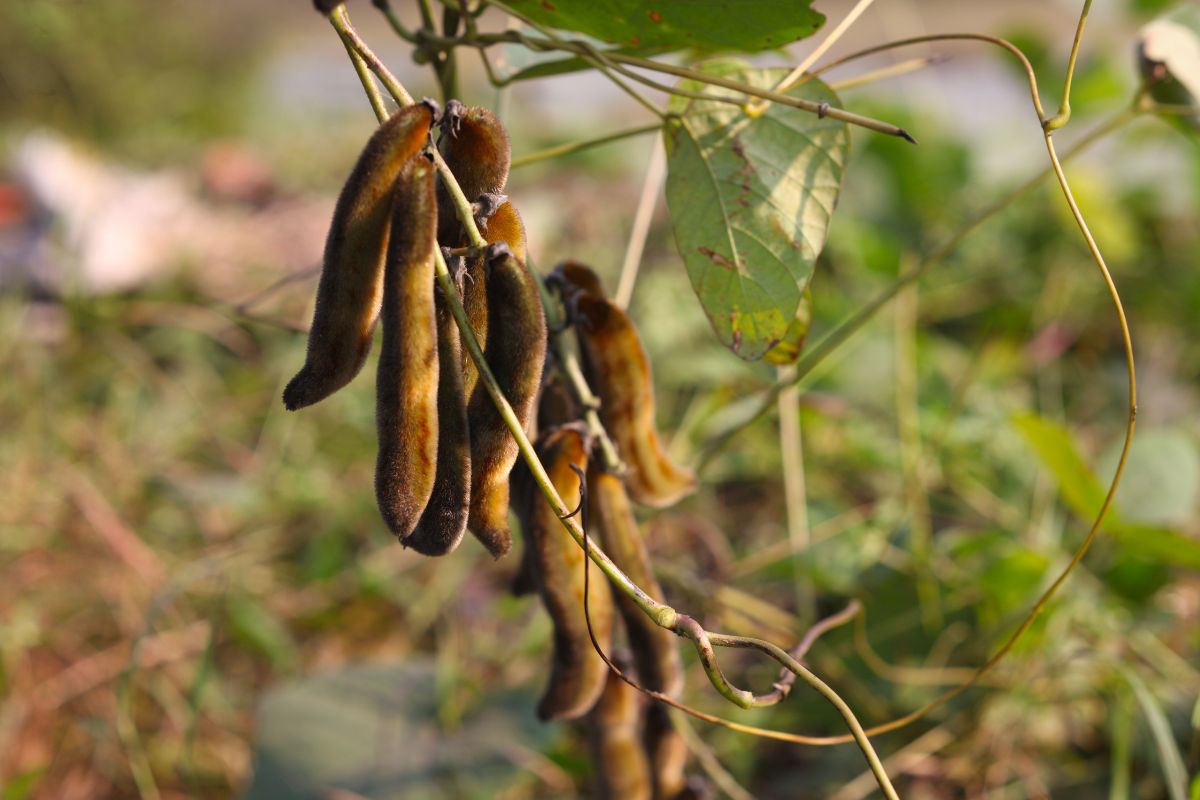
In parts of Karnataka’s Western Ghats and transitional farming regions, a little-known legume is attracting attention from farmers, researchers, and specialty buyers. Velvet bean, once grown mainly as a cover crop and green manure, is increasingly being explored as a commercial crop with multiple agricultural benefits.
For decades, the plant remained largely outside mainstream farming discussions despite its ability to improve soil fertility and thrive under diverse conditions. Most farmers viewed it as a support crop rather than a source of direct income.
That perception is beginning to change.
Growing demand from herbal product manufacturers, seed suppliers, and niche agricultural markets is creating fresh opportunities for producers willing to cultivate the crop commercially.
The result is renewed interest in a plant long valued for reasons beyond harvest alone.
Velvet bean stands apart from many commercial crops because it serves several purposes simultaneously.
The plant fixes nitrogen, suppresses weeds, improves soil structure, and produces seeds that have commercial applications. Farmers can therefore benefit both from the crop itself and from its impact on future cultivation.
Agricultural scientists often highlight legumes because of their ability to improve soil health naturally.
Velvet bean performs particularly well in this role. Its vigorous growth generates substantial biomass that can be incorporated into the soil, helping maintain fertility over time.
This combination of agronomic and commercial value is attracting growing interest.
Demand From Specialty Markets Is Increasing
While the crop remains unfamiliar to many consumers, demand exists within several specialised sectors.
Seed companies, herbal product manufacturers, and research institutions purchase velvet bean for various applications. The crop’s unique characteristics have helped create niche markets that offer opportunities for farmers.
Unlike commodity crops that compete primarily on volume, specialty crops often compete through uniqueness and limited supply.
This can allow producers to earn stronger returns when quality standards are maintained.
Farmers exploring diversification are paying closer attention to such opportunities.
Alternative markets are becoming increasingly important. One reason velvet bean is gaining attention among sustainable agriculture advocates is its contribution to soil improvement.
The crop helps add organic matter and supports nutrient cycling within farming systems. Farmers frequently use it between main crops to restore soil condition and reduce weed pressure.
These benefits can lower dependence on external inputs over time.
As fertiliser costs remain a concern for many producers, crops that improve soil naturally are becoming more attractive.
Researchers increasingly emphasise that profitability depends not only on yields but also on long-term soil productivity.
Healthy soils remain a critical farm asset.
Climate Resilience Supports Adoption
Changing weather patterns are encouraging farmers to evaluate crops capable of performing under varied conditions.
Velvet bean’s adaptability makes it suitable for different environments, including areas that experience periodic moisture stress. Its vigorous growth allows it to establish quickly and protect soil surfaces from erosion.
Agricultural experts note that diversified farming systems often prove more resilient than those dependent on a limited number of crops.
Introducing alternative legumes can strengthen both ecological and economic stability.
The crop’s flexibility is therefore becoming an important advantage.
Adaptability is increasingly valuable in modern agriculture.
Universities and agricultural research institutions are conducting studies aimed at identifying profitable alternatives to conventional cropping patterns. Velvet bean frequently appears in these discussions because it combines ecological benefits with commercial potential. Demonstration programmes are helping farmers understand cultivation practices, seed management, and market opportunities.
Researchers believe diversification will become increasingly important as agriculture responds to environmental and market uncertainty.
No single crop can solve every challenge.
A broader range of options improves resilience and flexibility.
Velvet bean contributes to that wider strategy.
A Forgotten Legume Gains New Attention
Many agricultural innovations involve discovering new technologies or introducing entirely new crops.
Sometimes, however, innovation means re-evaluating plants that have been overlooked for years.
Velvet bean fits that description. Long valued as a soil-improving crop, it is now finding recognition as a commercial opportunity in its own right. Farmers are beginning to see that ecological benefits and economic returns do not have to be separate goals.
The crop’s future remains linked to market development and farmer awareness.
Yet interest continues to grow.
In Karnataka’s fields, a legume once treated as a supporting player is gradually moving into the spotlight.
Also Read: Punarnava Jal – The world’s first organic fertilizer! Know how it is beneficial for farmers?
Contact us – If farmers want to share any valuable information or experiences related to farming, they can connect with us via phone or whatsapp at 9599273766 or you can write to us at “kisanofindia.mail@gmail.com”. Through Kisan of India, we will convey your message to the people, because we believe that if the farmers are advanced then the country is happy.
You can connect with Kisan of India on Facebook, Twitter, and Whatsapp and Subscribe to our YouTube channel.