



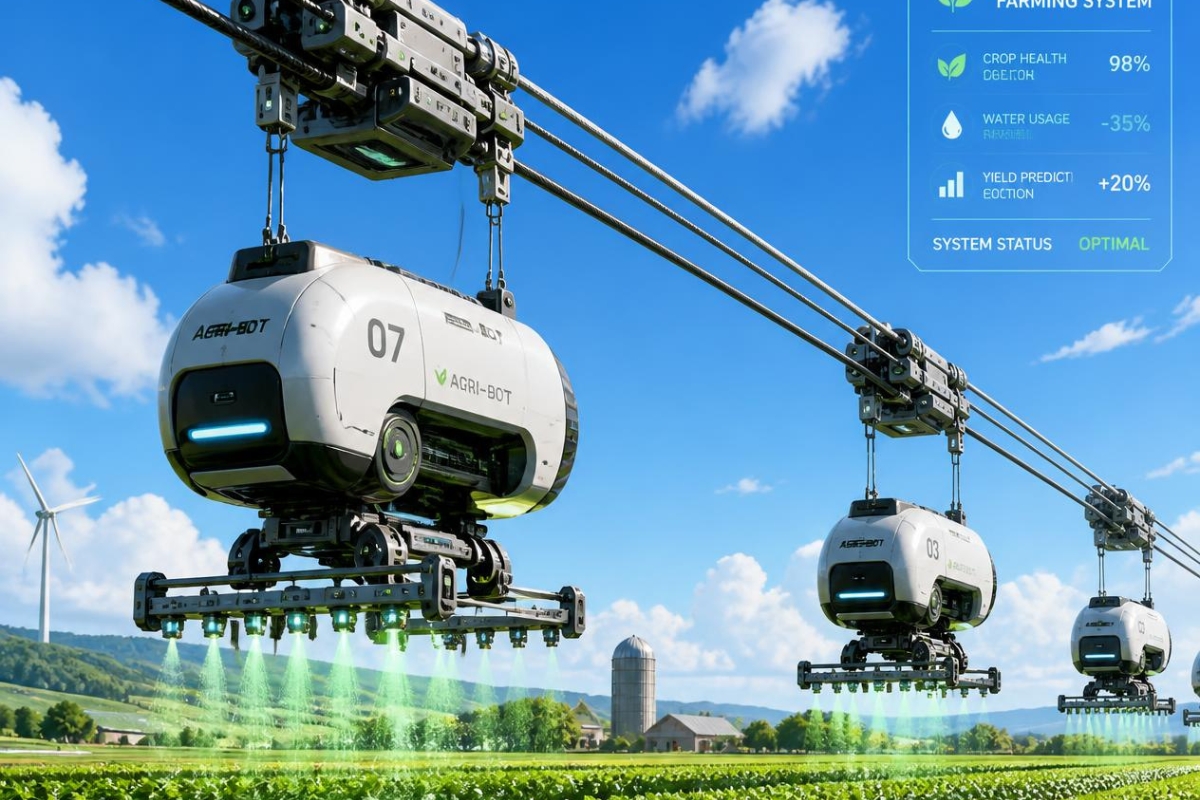
Farming on steep hillsides presents challenges that are rarely seen on flat land. Tractors struggle to operate safely, labour costs are high, and many field operations must still be done manually. To overcome these problems, researchers have developed cable-suspended farm robots that move above crops using a network of steel cables instead of travelling on the ground.
The system works much like a cable car. A lightweight robotic platform is suspended over the field and moves precisely in different directions using motorised cables fixed to poles around the farm. Cameras, sensors, and specialised tools allow the robot to spray crops, monitor plant health, collect data, and even harvest selected fruits without compacting the soil.
Scientists believe cable-driven robotics could become an important solution for orchards, vineyards, tea gardens, and other farms located on difficult terrain.
Many orchards and plantations are located on slopes where heavy machinery cannot operate efficiently.
Cable-suspended robots move above the crop canopy instead of travelling across the soil. Since they remain suspended, they avoid the risks of slipping on steep ground and can reach areas that conventional equipment cannot.
Agricultural engineers say this approach expands mechanisation to landscapes that have traditionally depended on manual labour.
One Machine Can Perform Multiple Tasks
Different tools can be attached to the robotic platform depending on the season.
The robot can carry cameras to inspect crop growth, sensors to measure plant health, precision sprayers for crop protection, or lightweight harvesting equipment for fruits and vegetables.
Researchers say multifunctional machines reduce the need for separate equipment throughout the growing season.
Heavy machinery repeatedly moving through fields can compact soil, affecting root growth and water movement.
Because cable robots operate above the ground, they avoid wheel traffic altogether. This helps maintain soil structure while allowing farm operations even after rainfall, when fields may be too wet for tractors.
Soil scientists note that reducing compaction contributes to healthier crop growth over time.
High-resolution cameras and positioning systems allow the robot to stop exactly where work is required.
Instead of treating an entire field, farmers can spray individual plants, inspect disease-affected areas, or monitor crop development with greater accuracy. This reduces chemical use and improves operational efficiency.
Researchers believe precision robotics will become increasingly important in high-value horticulture.
Interest Is Growing Worldwide
Universities and agricultural technology companies in Europe and Asia are testing cable-driven robotic systems for vineyards, apple orchards, berry farms, and tea plantations.
Engineers are working to improve carrying capacity, battery life, and autonomous navigation so the machines can perform longer field operations with minimal supervision.
Experts expect the technology to become more practical as robotic systems become lighter and more affordable.
Cable-suspended robots show that farm machinery does not always need wheels to improve productivity.
As farming adapts to labour shortages and the need for greater precision, machines that work above the field instead of on it may become an important part of agriculture’s future.
Also Read: Punarnava Jal – The world’s first organic fertilizer! Know how it is beneficial for farmers?
Contact us – If farmers want to share any valuable information or experiences related to farming, they can connect with us via phone or whatsapp at 9599273766 or you can write to us at “kisanofindia.mail@gmail.com”. Through Kisan of India, we will convey your message to the people, because we believe that if the farmers are advanced then the country is happy.
You can connect with Kisan of India on Facebook, Twitter, and Whatsapp and Subscribe to our YouTube channel.