



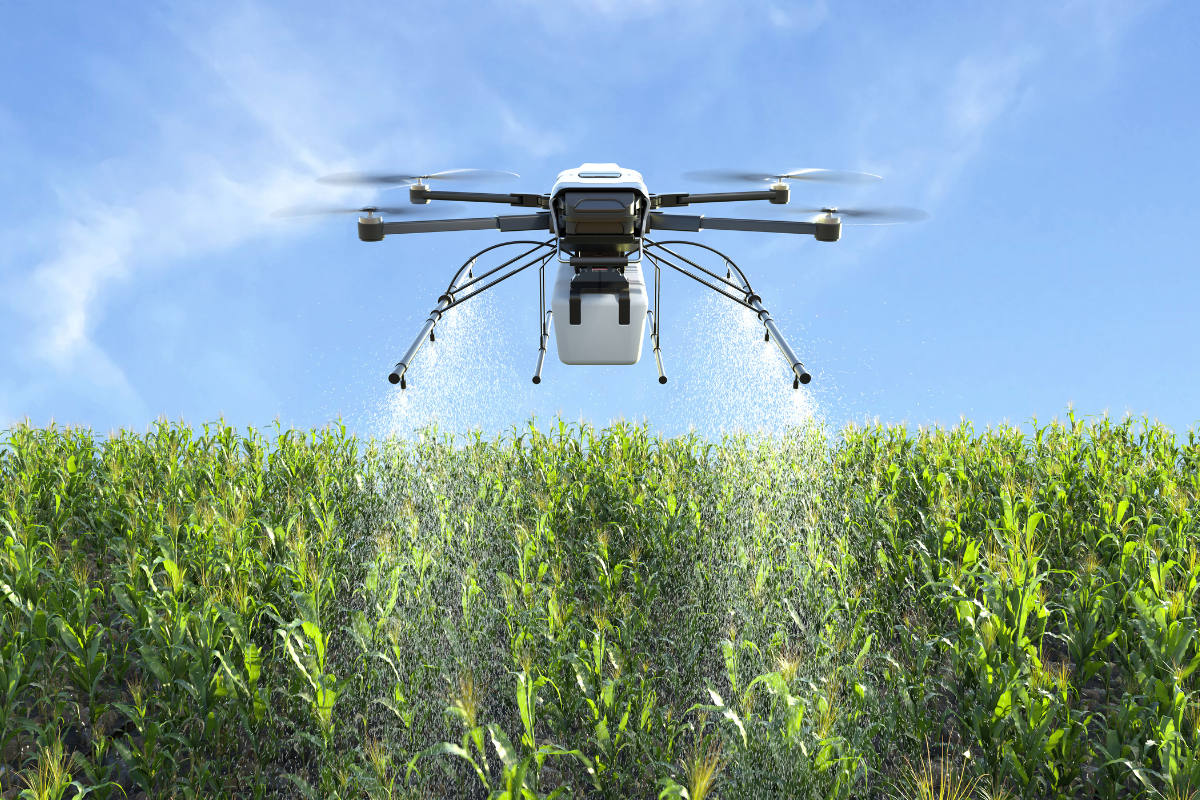
On a wheat and paddy farm outside Lucknow, farmers gather around a machine that would have looked out of place in rural India just a few years ago.
A drone lifts off from the edge of the field carrying a tank filled with liquid fertilizer. Within minutes, it begins spraying crops in neat, uniform patterns across several acres. What once required multiple labourers and several hours of work is completed in a fraction of the time.
Scenes like this are becoming increasingly common across Uttar Pradesh.
Agricultural drones, once viewed as experimental technology, are moving into mainstream farming operations. From paddy fields in eastern Uttar Pradesh to sugarcane farms in the west, farmers are using drones for fertilizer application, crop protection, field monitoring, and precision agriculture.
The shift reflects growing demand for technologies that save labour, reduce input waste, and improve operational efficiency.
One of the biggest factors behind drone adoption is labour availability. Farmers across many parts of India report increasing difficulty in finding workers during peak agricultural seasons. Labour costs have also risen steadily over the past decade.
Tasks such as spraying fertilizers and pesticides often require significant manpower.
For larger farms, these operations can take days to complete.Drones reduce that dependence.
A single operator can cover large areas quickly, allowing farmers to complete time-sensitive field operations within narrow weather windows.
For crops where timing affects productivity, this speed has become an important advantage.
Precision Application Reduces Waste
Traditional spraying methods frequently result in uneven application. Some sections of a field may receive excess fertilizer while others receive less than required. Drone systems are designed to improve accuracy.
Using GPS-guided navigation, drones follow predetermined flight paths and apply materials uniformly across the field. The technology allows farmers to target specific areas and reduce wastage.
Agricultural experts say precise application can help improve nutrient-use efficiency while reducing unnecessary input costs.
As fertilizer prices remain a major concern for farmers, efficient use of inputs is becoming increasingly important.
Uttar Pradesh’s vast agricultural landscape makes it one of the country’s most promising markets for drone services. Paddy growers have shown particular interest because drone spraying reduces the need for workers to enter waterlogged fields.
Sugarcane farmers are also adopting the technology due to the difficulty of moving through dense crop stands during spraying operations. The ability to treat fields without physically entering them offers practical benefits. Farmers report reduced crop damage and faster completion of field activities.
Several custom hiring centres now provide drone services on a per-acre basis, allowing farmers to access technology without purchasing equipment.
Government programmes have played a significant role in expanding agricultural drone use. Subsidies, training programmes, demonstration projects, and certification initiatives have encouraged adoption among farmer groups, cooperatives, and rural entrepreneurs.
Agricultural universities and Krishi Vigyan Kendras are conducting demonstrations to familiarise farmers with drone operations.
Officials view drones as part of a broader effort to modernise Indian agriculture through digital technologies and precision farming practices.
The policy support has helped move drones from pilot projects into commercial farming operations.
Rural Youth Are Finding New Business Opportunities
The drone sector is creating opportunities beyond farming itself. Young entrepreneurs are establishing service businesses that provide spraying operations to multiple farmers. Instead of each grower purchasing a drone, service providers operate equipment and charge fees based on acreage.
This model has made the technology more accessible.
It has also created a new category of rural employment involving drone operation, maintenance, data collection, and agricultural advisory services.
For many young people, agricultural technology is becoming a viable business opportunity.
Weather conditions are becoming less predictable. Farmers often have shorter windows for spraying because rainfall, wind conditions, and temperature changes can affect field operations. Drones allow farmers to respond quickly.
A field that once required an entire day to treat can often be covered in less than an hour. This flexibility is becoming more valuable as climate variability increases.
Rapid application can help farmers take advantage of favourable conditions before weather patterns change.
Challenges Still Remain
Despite rapid growth, several obstacles remain. The cost of purchasing drones remains high for many individual farmers. Training requirements, battery limitations, and regulatory compliance also present challenges. Small and fragmented landholdings can reduce operational efficiency in some regions.
Many experts believe service-based business models will remain more practical than widespread individual ownership. As technology improves and costs decline, adoption is expected to expand further.
For decades, agricultural mechanisation focused on tractors, harvesters, and irrigation equipment. Drones represent a different kind of transformation. They bring digital technology, automation, and precision agriculture directly into everyday farm operations.
Across Uttar Pradesh, the sight of drones flying over fields is becoming less unusual with each season. For farmers, the attraction is not the technology itself. It is the promise of completing essential work faster, more accurately, and with fewer labour constraints.
And that promise is helping drones move from novelty to necessity in India’s largest agricultural state.
Also Read: Punarnava Jal – The world’s first organic fertilizer! Know how it is beneficial for farmers?
Contact us – If farmers want to share any valuable information or experiences related to farming, they can connect with us via phone or whatsapp at 9599273766 or you can write to us at “kisanofindia.mail@gmail.com”. Through Kisan of India, we will convey your message to the people, because we believe that if the farmers are advanced then the country is happy.
You can connect with Kisan of India on Facebook, Twitter, and Whatsapp and Subscribe to our YouTube channel.