



After paddy harvest, farmers often have only a short window before sowing the next crop. Burning straw can clear the field quickly, but machines offer other options. The government supports residue-management equipment that can chop, spread, incorporate or retain straw in the field.
The choice of machine depends on the harvesting method, next crop, farm size and whether the farmer wants to keep the residue in the field or remove it. For small farmers, hiring equipment through a Custom Hiring Centre can be more practical than purchasing an expensive machine.
The Super Straw Management System, or Super SMS, attaches to a combine harvester. It cuts and spreads the straw evenly behind the combine, making it easier to manage the residue before sowing the next crop.
The system is designed for in-situ residue management. Government-supported machinery lists include Super SMS among the machines eligible under crop-residue management programmes in participating states.
A Happy Seeder allows farmers to sow wheat directly into a field containing standing or loose paddy residue. It cuts and manages the straw while placing seed into the soil, reducing the need to remove all residue before sowing.
The machine is part of the government’s supported crop-residue machinery. ICAR demonstrations have included Happy Seeder technology along with Super Straw Management Systems and other equipment for direct sowing and residue management.
What is a Super Seeder?
A Super Seeder performs several operations in one pass. It cuts and incorporates paddy residue into the soil while sowing the following crop, such as wheat.
The machine can be useful when farmers want to retain residue instead of removing it. A recent Punjab farming case showed farmers using a subsidised Super Seeder for wheat sowing after managing paddy residue in their fields.
A paddy straw chopper, shredder or mulcher cuts residue into smaller pieces. The chopped material can then be spread across the field and incorporated into the soil using suitable tillage equipment.
Government crop-residue guidelines include mounted and trailed straw choppers, shredders and mulchers among supported machines. The machines are particularly useful when farmers want to break down residue before another field operation.
Can farmers remove the straw instead?
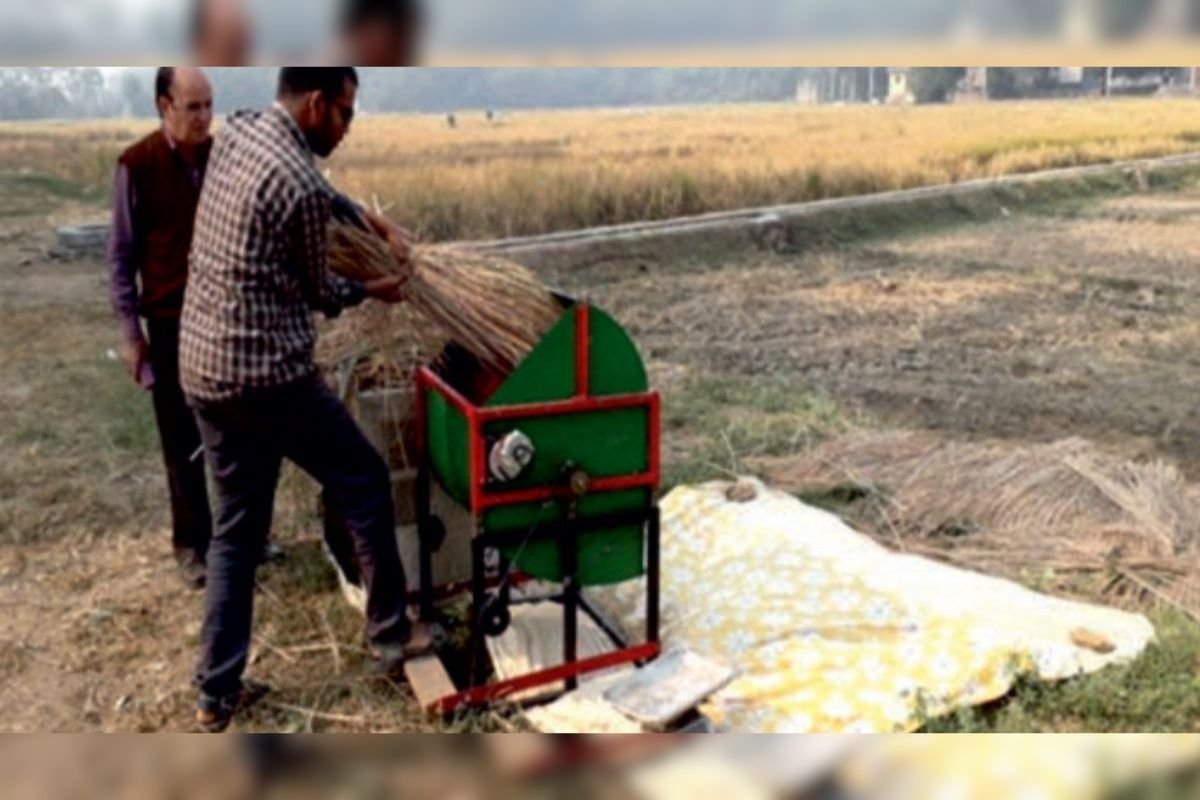
Yes. Farmers who want to collect residue rather than incorporate it can use equipment such as balers and straw rakes. These machines collect loose straw into manageable bundles that can be transported for other uses.
The government also supports paddy-straw supply chains connecting farms with biomass power, biofuel and other end users. In 2026–27, the Centre set a target of developing 141 stubble supply-chain projects.
Under the Crop Residue Management scheme, individual farmers can receive financial assistance of 50% for eligible crop-residue machinery. Rural entrepreneurs, cooperatives, farmer groups, FPOs and Panchayats can receive higher support for establishing Custom Hiring Centres.
The government has also provided support for machinery used in paddy-straw supply chains. Current policy includes assistance for projects involving equipment such as balers, rakes, loaders and other machinery needed to move residue from farms to end users.
A Custom Hiring Centre allows farmers to rent agricultural machinery instead of purchasing it. This matters for small and marginal farmers because the cost of owning specialised equipment may not make sense when the machine is used only for a short period each year.
The government reported more than 43,500 Custom Hiring Centres under the relevant mechanisation and residue-management programmes by March 2026. These centres are intended to improve access to machinery for farmers who cannot afford individual ownership.
A farmer should first consider how the paddy is harvested and what crop will follow. If residue needs to remain distributed across the field, Super SMS can help. For direct wheat sowing, a Happy Seeder may be suitable.
Where farmers want to combine residue incorporation with sowing, a Super Seeder can perform both tasks. For collection and sale of straw, balers and rakes become more relevant. The choice should follow the farm operation, not simply the subsidy available.
Can residue improve the soil?
Keeping crop residue in the field can return organic material and some nutrients to the soil. ICAR has reported that residue management can conserve water, reduce labour requirements and help maintain soil fertility and organic matter compared with burning.
Residue management also needs proper timing. Farmers must ensure that the material is distributed and incorporated or retained in a way that does not interfere with the next crop’s establishment.
The answer depends on the machine and whether farmers own or hire it. Government estimates have placed the operational cost of a Super Seeder at about ₹5,822 per hectare, compared with around ₹3,778 for a Happy Seeder and ₹2,967 for a paddy straw chopper.
These figures are estimated average operating costs and can differ by location, fuel prices, field conditions, machine capacity and hiring charges. Farmers should compare local rental rates with the cost of burning, manual removal or other residue-management options.
The Centre has made a provision of ₹544.15 crore under the Crop Residue Management scheme for 2026–27. It has set a target of distributing more than 46,000 residue-management machines and establishing 910 additional Custom Hiring Centres.
The government also plans 141 stubble supply-chain projects during the season. The strategy covers both in-situ management, where residue stays on the farm, and ex-situ use, where straw moves to another facility.
Government data show a reduction in reported paddy-stubble burning in Punjab, Haryana and Uttar Pradesh. ICAR’s CREAMS laboratory recorded 18,457 burning events between September 15 and November 30 in 2024, compared with 42,962 during the same period in the previous year.
The figures cover specific states and periods and should not be interpreted as meaning that residue burning has ended. Machinery is one part of the response, alongside crop planning, enforcement, markets for straw and access to affordable equipment.
Can small farmers afford these machines?
Individual ownership may not always make economic sense for a small holding. A specialised residue machine may be used for only a few days each season, leaving the owner with a large investment relative to annual use.
Hiring can reduce that burden. Farmers can approach local Custom Hiring Centres, cooperatives, FPOs or farmer groups to check availability and rental rates before purchasing machinery themselves.
Farmers should calculate the area they can cover each season, expected hiring income if the machine is shared, fuel consumption, maintenance costs and local demand. They should also check whether the machine is compatible with their tractor and existing farm equipment.
The available subsidy should be treated as part of the calculation, not the main reason to purchase. A machine that remains unused after the harvest season can still create maintenance and financing costs.
Paddy residue does not have to be removed or burned after every harvest. Machines can chop, spread, incorporate, retain or collect the straw, depending on the farming system.
Also Read: Punarnava Jal – The world’s first organic fertilizer! Know how it is beneficial for farmers?
Contact us – If farmers want to share any valuable information or experiences related to farming, they can connect with us via phone or whatsapp at 9599273766 or you can write to us at “kisanofindia.mail@gmail.com”. Through Kisan of India, we will convey your message to the people, because we believe that if the farmers are advanced then the country is happy.
You can connect with Kisan of India on Facebook, Twitter, and Whatsapp and Subscribe to our YouTube channel.