



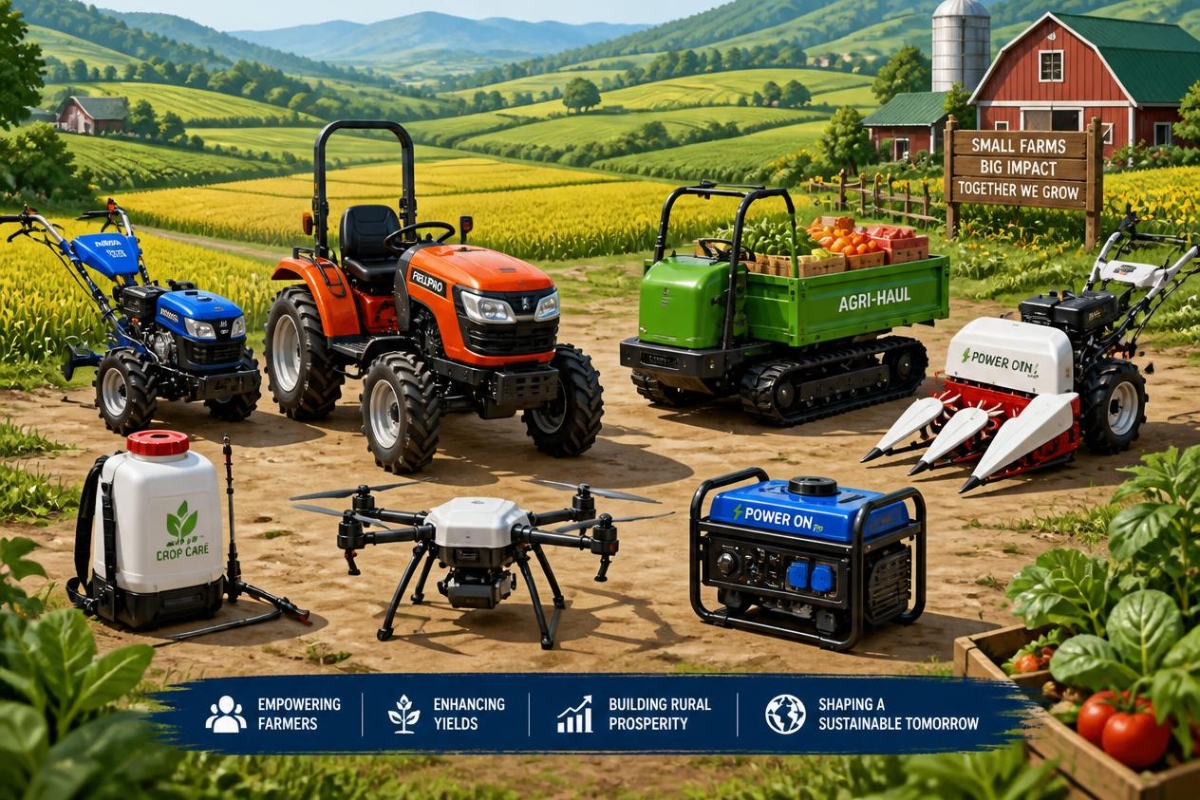
Farm mechanisation is often associated with tractors, harvesters and other large machines. But many Indian farmers cultivate small holdings where large equipment may not be practical. Smaller tools such as weeders, planters and ridgers can sometimes offer a more suitable way to reduce labour and improve farm operations.
ICAR has developed and tested several small farm implements for different crops and field conditions. These include manually operated cono weeders, hand ridgers, inclined plate planters, dibblers, twin-wheel hoes and dryland weeders. Such equipment can target specific farm operations without requiring large machinery.
Labour availability is becoming an important concern for farmers during sowing, weeding and harvesting. When workers are difficult to find during peak periods, delays can affect crop growth and increase production costs.
Small equipment can help farmers complete specific operations faster. A hand weeder, for example, can reduce the physical effort required for removing weeds, while a planter can improve the speed and consistency of seed placement.
The benefit is not simply replacing human labour. Good equipment can reduce physical strain and allow farmers to complete time-sensitive operations when labour availability is limited.
Weeders can save repeated labour
Weeding is one of the most labour-intensive activities in many crops. Farmers may have to repeat the operation several times during the season, depending on crop and weed pressure.
Mechanical weeders can reduce the time spent removing weeds manually. ICAR lists several types of mechanical weeders designed for different field conditions, including intra-row and inter-row weeders.
Farmers should choose a weeder according to crop spacing. A machine designed for wider rows may damage crops if used in closely spaced fields. The operator also needs training to maintain the correct depth and avoid harming crop roots.
Seed placement affects crop establishment. Manual sowing can sometimes result in uneven spacing and depth, particularly when large areas need to be planted quickly.
Small planters can help farmers place seed more consistently. ICAR has developed equipment including inclined plate planters, multi-crop planters and seed drills for different crops and field conditions.
But farmers should not buy a planter simply because it is described as multi-crop. They should check whether the machine handles the seed size, spacing and planting method required for their main crops.
Ridgers are used to form raised structures in fields and can support planting and water management in suitable crops. Hand-operated versions can be useful where tractor-mounted equipment is difficult to use.
The choice depends on soil type, field size and crop. Farmers should first understand the operation they need before selecting equipment. A machine that performs well in one soil condition may require more effort in another.
Small equipment can reduce drudgery
Farm work can place considerable physical pressure on farmers, particularly during repeated operations such as weeding and interculture.
ICAR’s field programmes have reported that distributing small agricultural tools and equipment reduced drudgery and supported mechanisation among farmers. Around 40–50% of beneficiaries in one Bhopal programme adopted the promoted technologies, with reported productivity improvements in crops including wheat, soybean, rice and vegetables.
Women farmers can also benefit from equipment designed to reduce physical effort. This matters in areas where women perform a significant share of agricultural operations.
A cheap machine is not necessarily a good investment. Farmers should first estimate how often they will use it during the year.
If a tool is needed only for a few days, hiring may be cheaper. If it will be used repeatedly across several crops, ownership may make more sense. Farmers should compare purchase price, maintenance, storage and expected annual use before making a decision.
Small farmers can also purchase equipment collectively. An FPO, cooperative or farmer group can buy a machine and make it available to several members.
This approach can reduce the cost for individual farmers while keeping the equipment in regular use. It can also create an opportunity for one trained operator to provide services to other farmers in the group.
Custom Hiring Centres provide another option. Under the Sub-Mission on Agricultural Mechanization, the government supports such centres to improve access to machinery for farmers who may not be able to afford individual ownership.
Check the machine before buying
Farmers should test equipment in actual field conditions whenever possible. Demonstrations can reveal problems that may not be obvious from brochures or product descriptions.
They should check whether the machine is suitable for their soil, crop spacing, field size and available power source. Spare parts and repair services should also be available nearby.
Maintenance matters because equipment that remains unused for weeks after a minor breakdown provides little value during critical farm operations.
The Sub-Mission on Agricultural Mechanization provides financial assistance of 40–50% of the cost of eligible agricultural machinery and equipment, subject to applicable scheme rules. It also supports Custom Hiring Centres with assistance linked to project cost.
Farmers should check current state-level guidelines before purchasing equipment. Subsidy eligibility, approved machinery and application procedures can differ, so farmers should not assume that every machine automatically qualifies.
What farmers should consider first
Before buying equipment, farmers should answer four questions. Which operation takes the most labour? How often is that operation repeated? Can a machine complete it safely? And will the machine be used enough to justify its cost?
If the answer is yes, small mechanisation may provide a practical investment. If not, hiring from a Custom Hiring Centre or neighbouring farmer may be better.
Farm mechanisation does not always require expensive machines. For many small farms, the more useful solution may be a simple tool that saves labour during one difficult operation.
ICAR’s work shows that India already has a wide range of small implements suited to different crops and farming conditions. The challenge for farmers is choosing equipment that fits their actual needs rather than buying machinery simply because it is new.
The best machine is therefore not necessarily the biggest one. It is the one that saves enough time, labour or cost to justify its purchase or hiring charge. For small farmers, that calculation should come before mechanisation.
Also Read: Punarnava Jal – The world’s first organic fertilizer! Know how it is beneficial for farmers?
Contact us – If farmers want to share any valuable information or experiences related to farming, they can connect with us via phone or whatsapp at 9599273766 or you can write to us at “kisanofindia.mail@gmail.com”. Through Kisan of India, we will convey your message to the people, because we believe that if the farmers are advanced then the country is happy.
You can connect with Kisan of India on Facebook, Twitter, and Whatsapp and Subscribe to our YouTube channel.