



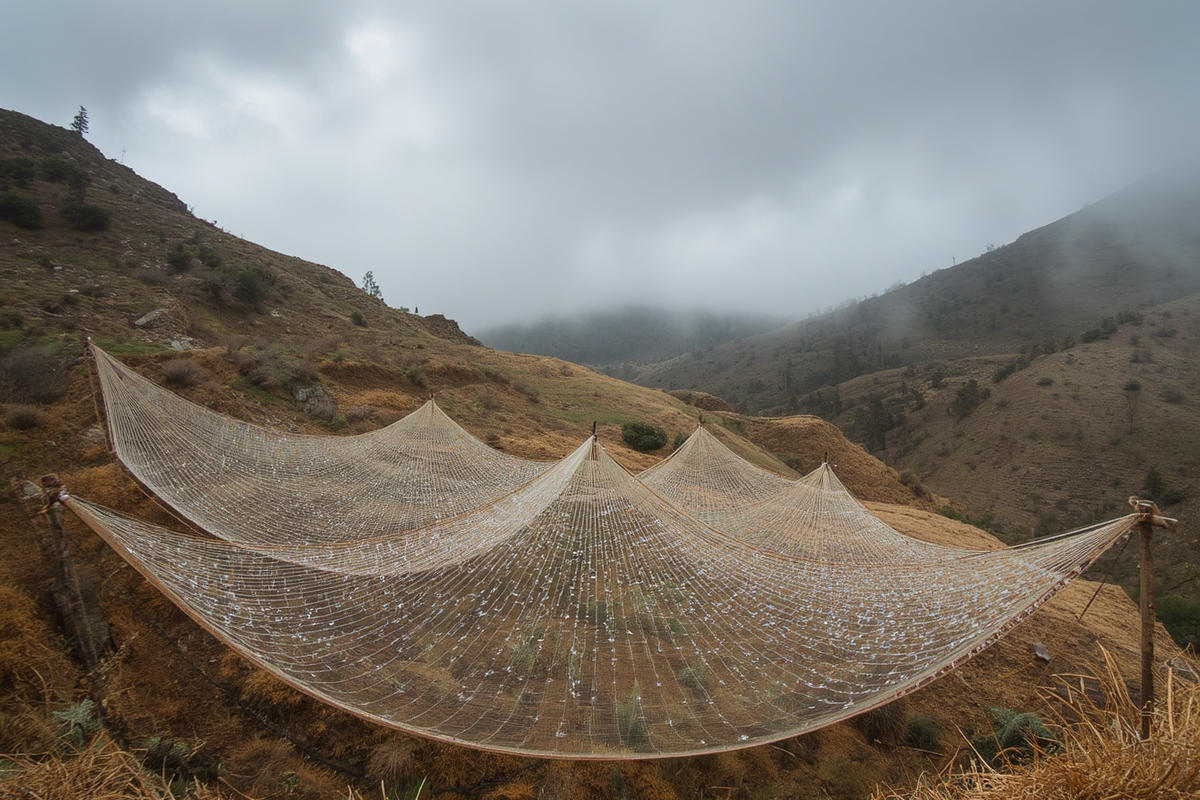
Water scarcity is becoming one of agriculture’s biggest challenges. While many countries depend on rivers, groundwater, or rainfall, farmers in northern Chile are experimenting with a completely different source of irrigation—fog.
In parts of the Atacama Desert, one of the driest places on Earth, researchers and farming communities are installing large mesh panels that capture tiny droplets from coastal fog. As the droplets collect on the mesh, they flow into storage tanks and are later used to irrigate crops, raise tree seedlings, and support small farms. Scientists say fog harvesting could become an important supplementary water source for agriculture in other water-stressed regions with similar climatic conditions.
Fog collectors consist of specially designed vertical mesh nets stretched between support poles.
When moist air passes through the mesh, tiny water droplets stick to the fibres, combine into larger drops, and trickle into collection channels. The collected water is stored in tanks before being used for irrigation or other agricultural purposes.
Researchers have improved mesh materials over the years to increase water collection efficiency under different weather conditions.
Although fog harvesting cannot replace large irrigation systems, it provides a dependable supplementary water source for high-value crops, nurseries, and community gardens.
In several Chilean communities, the collected water is used to grow vegetables, herbs, and native plants while reducing dependence on expensive transported water.
Scientists believe the approach is particularly valuable in coastal deserts where fog occurs regularly despite very low rainfall.
Low Energy, Low Operating Cost
Unlike desalination plants or groundwater pumping systems, fog collectors require no electricity to produce water.
Once installed, the structures rely entirely on natural wind and fog movement. Maintenance mainly involves cleaning the mesh and checking support structures.
Researchers say this makes fog harvesting an environmentally friendly option for regions with limited infrastructure.
Countries including Peru, Morocco, South Africa, and parts of the Canary Islands are also evaluating fog harvesting for agriculture and rural water supply.
Engineers are testing stronger mesh materials and improved collector designs that can increase water yields under different climatic conditions.
Climate experts believe unconventional water-harvesting technologies will become increasingly important as droughts become more frequent.
Chile’s experience shows that even environments with almost no rainfall can support agriculture when local natural resources are used creatively.
As freshwater resources come under increasing pressure worldwide, harvesting water directly from the air may become an important tool for sustaining agriculture in some of the world’s driest farming regions.
Also Read: Punarnava Jal – The world’s first organic fertilizer! Know how it is beneficial for farmers?
Contact us – If farmers want to share any valuable information or experiences related to farming, they can connect with us via phone or whatsapp at 9599273766 or you can write to us at “kisanofindia.mail@gmail.com”. Through Kisan of India, we will convey your message to the people, because we believe that if the farmers are advanced then the country is happy.
You can connect with Kisan of India on Facebook, Twitter, and Whatsapp and Subscribe to our YouTube channel.