


New ₹119 Crore ICAR Facilities in Ranchi: Can NEXTGEN Breeding Research Help Farmers Get Better Seeds?

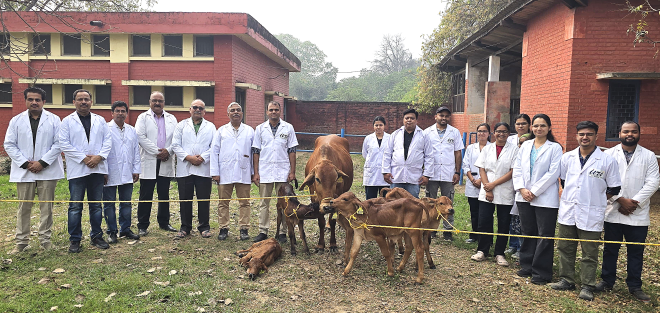
The Indian Council of Agricultural Research has opened a NEXTGEN Breeding Facility at the ICAR-Indian Institute of Agricultural Biotechnology in Garhkhatanga, Ranchi. Union Agriculture Minister Shivraj Singh Chouhan inaugurated the facility on 8 October, alongside other campus buildings and facilities. The projects were valued at ₹119 crore.
The new facilities include an administrative and school building, Birsa Munda Multipurpose Hall and Jaipal Singh Munda Sports Complex. The minister also laid the foundation stone for a guest house. The announcement places crop breeding research among the institute’s priorities, although officials have not announced specific new varieties from this facility.
What Is a NEXTGEN Breeding Facility?
Crop breeding involves developing plants with useful characteristics, such as higher yields, shorter maturity periods, resistance to particular pests and diseases, or improved tolerance to drought and other stresses. Researchers select and test plants across generations before deciding whether a candidate variety is suitable for farmers.
A breeding facility can support this work by providing research infrastructure and scientific capacity. The actual benefits depend on the research undertaken, the crops selected, the performance of candidate varieties in field trials and whether those varieties eventually receive approval for release.
The inauguration announcement did not specify which crops the new facility will prioritise or provide a timeline for new seed releases. Farmers should therefore view it as a research development, rather than evidence that new seeds are already available for purchase. <Cite refs={[“turn695432view0”]} />
Why Improved Seeds Matter to Farmers
Seed choice affects crop establishment, maturity, yield potential and how well plants perform under local conditions. A variety developed for one region may not perform equally well elsewhere because rainfall, temperature, soil type, irrigation access and pest pressure differ between farming areas.
For Jharkhand, farmers need crop varieties suited to their local growing conditions and available water resources. The agriculture minister emphasised scientific farming, improved seeds, balanced fertiliser use and technologies suited to local conditions during the Ranchi event.
A variety described as high-yielding does not guarantee higher income on every farm. Actual returns depend on seed quality, planting time, soil fertility, crop management, weather, market prices and production costs. Farmers should compare a new variety’s performance with locally recommended options before switching.
What Farmers Should Check Before Buying New Seeds
Farmers should purchase seeds through authorised dealers or recognised agricultural institutions and check the variety name, lot number, germination information, packaging date and expiry or validity details. They should keep the purchase receipt and follow the recommended sowing rate and planting window for their region.
Before adopting an unfamiliar variety, farmers can ask their local Krishi Vigyan Kendra or agriculture department whether it is recommended for their district. They should also ask about maturity duration, irrigation needs, fertiliser recommendations, disease resistance and expected performance under rainfed or irrigated conditions.
Field demonstrations and local trials can help farmers compare varieties under conditions closer to their own farms. Where possible, they should avoid replacing their entire crop with an untested seed in the first season. Testing a small area can limit financial risk while providing useful information.
Research Must Reach Farmers’ Fields
At the event, Chouhan called for stronger links between agricultural research and farmers, including timely access to improved seeds and field-level extension services. Around 1,500 farmers from Ranchi, Khunti, Gumla and Ramgarh districts had attended a separate pre-Rabi farmers’ programme organised by ICAR-IIAB.
The next measure of success will be whether research produces suitable varieties, whether they undergo proper testing and whether farmers can access reliable seed in time for sowing. Information about recommended varieties must also reach smallholders through local extension workers, demonstrations and accessible guidance.
For farmers, the opening of the NEXTGEN Breeding Facility is an investment in research capacity, not an immediate change in farm productivity. Its value will become clearer as research priorities, field-trial results and future seed releases emerge.
Also Read: Punarnava Jal – The world’s first organic fertilizer! Know how it is beneficial for farmers?
Contact us – If farmers want to share any valuable information or experiences related to farming, they can connect with us via phone or whatsapp at 9599273766 or you can write to us at “kisanofindia.mail@gmail.com”. Through Kisan of India, we will convey your message to the people, because we believe that if the farmers are advanced then the country is happy.
You can connect with Kisan of India on Facebook, Twitter, and Whatsapp and Subscribe to our YouTube channel.