


Ghan-Jeevamrit Discs: Can Farmers Turn Cow Dung Into a Storable Natural Farming Input?

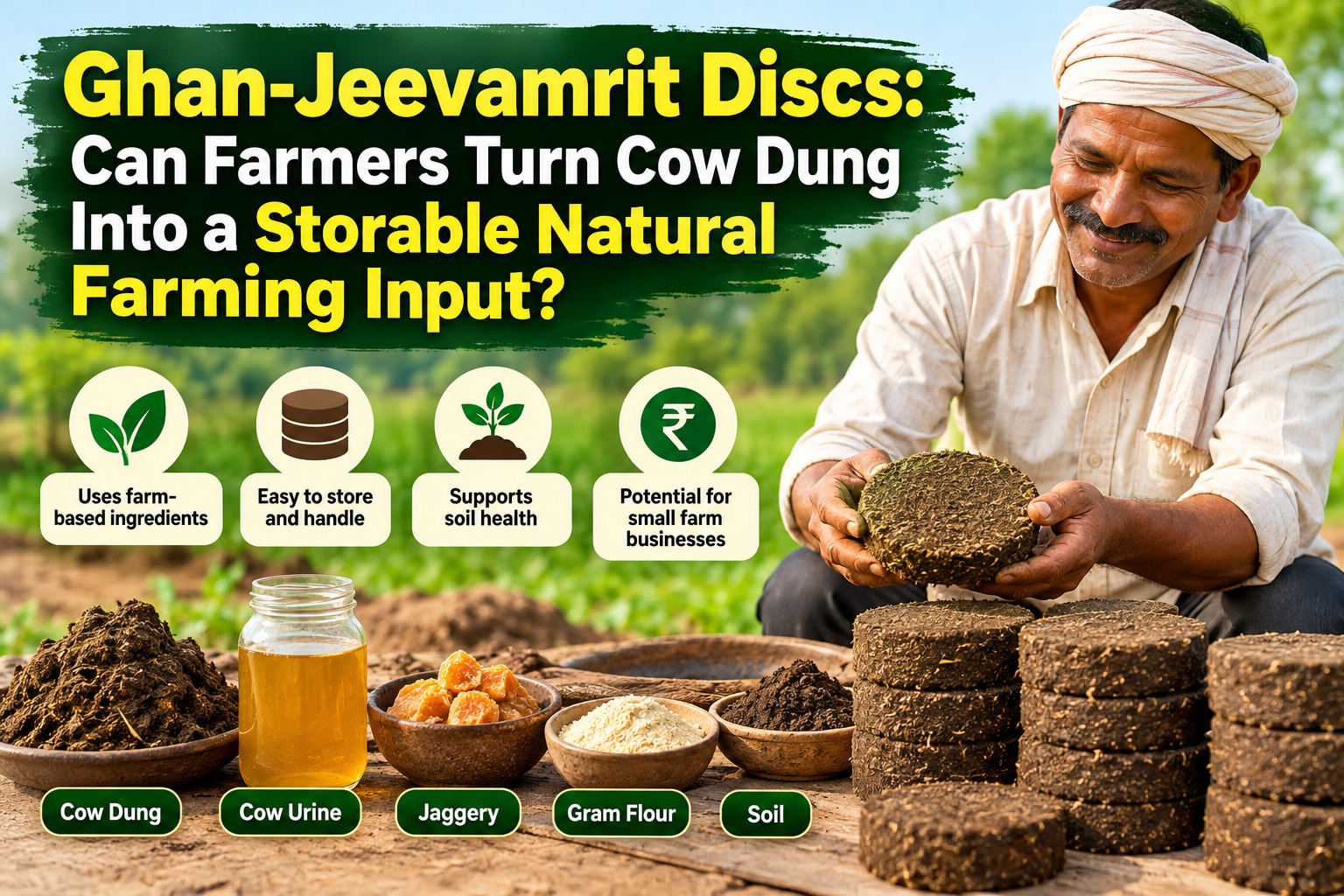
Farmers practising natural farming often prepare liquid formulations using locally available materials such as cow dung, cow urine and jaggery. These preparations can require frequent mixing and careful storage. A solid alternative called Ghan-Jeevamrit discs offers another way to prepare and store a farm-made input.
An article published in ICAR’s journal Indian Farming in June 2026 describes a method for preparing these discs using cow dung, cow urine, jaggery, gram flour and a handful of soil. The researchers present the approach as a way to use farm resources and explore small-scale rural income opportunities.
The main attraction is convenience. A solid product may be easier to handle, transport and store than a liquid formulation. Its usefulness on a particular farm still depends on preparation quality, storage conditions, crop requirements and evidence of performance under local conditions.
What Goes Into Ghan-Jeevamrit?
The preparation described by the researchers uses five basic ingredients: cow dung, cow urine, jaggery, gram flour and a small quantity of soil. The ingredients form the base of the preparation, with the aim of supporting microbial activity associated with natural farming inputs.
Cow dung supplies organic material, while jaggery and gram flour provide materials that can support microbial activity during preparation. Soil may introduce microorganisms, although the microbial composition will vary with its source. These ingredients alone do not guarantee a consistent nutrient content or a specific effect on crop yield.
Farmers should follow the preparation method published by the researchers rather than improvising quantities or assuming that all locally made mixtures are equivalent. A product’s quality can vary with ingredient quality, moisture, hygiene and handling. Reliable preparation and appropriate storage are important when making inputs for repeated use.
How Farmers Can Approach Preparation
1. Use Clean, Suitable Materials
Farmers should collect dung and other ingredients from reliable sources and use clean equipment. Materials contaminated with chemicals or other unwanted substances should not be used. Clean handling helps reduce avoidable contamination during preparation and storage.
2. Follow a Tested Recipe
The ingredients need to be combined in the quantities and sequence recommended by the published method. Farmers should not assume that adding more jaggery, gram flour or cow urine will make the preparation more effective. Changes in proportions can affect consistency and the conditions under which microorganisms develop.
3. Prepare and Store Carefully
The preparation needs appropriate handling and storage to retain its intended characteristics. Farmers should keep finished discs protected from rain, excessive moisture and contamination. They should also label batches with preparation dates so that they can monitor storage duration and avoid mixing older material with newly prepared batches.
The ICAR article describes the potential advantages of a solid form, including easier storage and application. Farmers should consult the full research article for the exact preparation procedure and any conditions specified by its authors.
How Should Farmers Use the Discs?
Farmers should first establish whether Ghan-Jeevamrit is recommended for their crop and farming system. Application quantity and timing should follow a tested protocol or guidance from a qualified agricultural adviser. A method suitable for one crop or soil may not produce the same results in another setting.
Farmers can begin with a small trial plot and compare it with a similar plot managed using their usual nutrient practices. They should record the quantity applied, crop growth, labour and other input costs. Comparing yields and expenses over a season can help determine whether the preparation offers a practical benefit.
The discs should not automatically replace farmyard manure, compost, soil-test-based fertilisers or other recommended nutrient inputs. Their nutrient contribution and effect on crops need to be understood before farmers adjust an existing nutrient plan. Farmers transitioning to natural farming should seek advice on maintaining crop nutrition throughout the transition.
Can This Become a Small Farm Business?
Producing Ghan-Jeevamrit discs could interest farmers who already have access to suitable ingredients and want to explore local sales. A small enterprise would need to assess demand from nearby farmers, production time, packaging, storage, transport and the cost of obtaining ingredients.
Before selling the product, producers should check applicable rules for marketing agricultural inputs and avoid making unsupported claims about yields, disease control or guaranteed savings. They should also ensure that buyers receive clear information about preparation, intended use and storage.
The business case depends on whether customers are willing to pay enough to cover production and distribution costs. Farmers should calculate net returns rather than treating the value of ingredients available on the farm as zero. Small trial batches and feedback from local growers can help assess demand before production expands.
A Useful Option, Not a Guaranteed Solution
Ghan-Jeevamrit discs offer a way to explore solid, farm-made inputs using materials available in many rural households. The ICAR-published research makes the method worth examining, particularly for farmers interested in natural farming and small-scale rural enterprises.
Farmers should still verify the preparation method, test the product on a limited area and track results before relying on it across their holdings. The practical value will depend on consistent preparation, suitable application and measurable benefits for crop growth or farm costs.
Also Read: Punarnava Jal – The world’s first organic fertilizer! Know how it is beneficial for farmers?
Contact us – If farmers want to share any valuable information or experiences related to farming, they can connect with us via phone or whatsapp at 9599273766 or you can write to us at “kisanofindia.mail@gmail.com”. Through Kisan of India, we will convey your message to the people, because we believe that if the farmers are advanced then the country is happy.
You can connect with Kisan of India on Facebook, Twitter, and Whatsapp and Subscribe to our YouTube channel.