



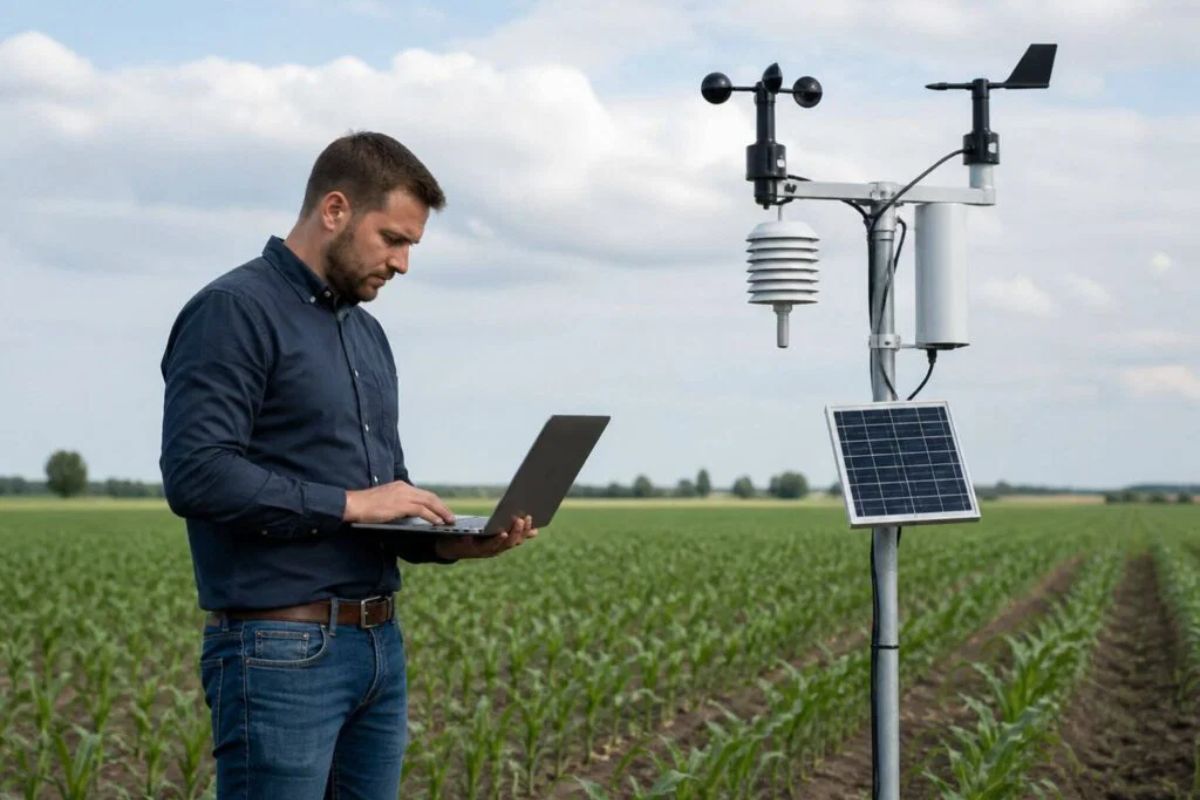
Indian farmers are facing weather conditions that no longer follow old seasonal patterns. Heatwaves are arriving earlier, rainfall is becoming irregular, and sudden storms are damaging crops during harvesting periods. Farmers who once depended heavily on experience and seasonal memory now struggle to predict weather conditions accurately. Agriculture experts say climate instability is becoming one of the biggest risks in Indian farming because even small weather changes can sharply affect yields and farmer income.
This is why hyperlocal AI weather stations are gaining attention across India. These systems provide village-level weather forecasting instead of broad district-level updates that often fail to match actual farm conditions. Agriculture experts believe hyperlocal forecasting may become one of the most important technologies in climate-resilient farming during the next decade.
IIT Ropar Is Expanding AI Farming Systems
One of the biggest recent developments came from Punjab, where IIT Ropar’s ANNAM.AI initiative announced the deployment of 100 AI-based weather stations designed for agriculture. The project aims to provide farmers with real-time weather intelligence related to sowing, irrigation, pest management, and harvesting decisions. The system is expected to expand into states such as Haryana, Uttar Pradesh, Bihar, Maharashtra, and Jammu and Kashmir during later phases.
Researchers involved in the programme say Indian agriculture generates large amounts of climate and crop data, but only a small percentage of farmers currently receive useful digital advisories from these systems. The new AI platform aims to convert weather data into practical recommendations farmers can actually use in daily farming decisions.
Agriculture experts say district-level forecasts are often too broad for real farming conditions. Weather can vary sharply even between nearby villages. One village may receive heavy rainfall while another remains dry. This becomes important during pesticide spraying, irrigation scheduling, or crop harvesting when timing matters heavily.
AI weather stations monitor rainfall, humidity, wind speed, temperature, and soil moisture continuously. Farmers receive alerts through mobile applications and digital advisory systems. Researchers say these systems may help reduce crop losses caused by sudden rainfall or heat stress events.
Some AI platforms are also beginning to provide multilingual support because language barriers limited earlier digital farming systems. Experts say voice-based local language alerts may improve adoption among rural farmers.
Water Management Is Becoming More Scientific
Groundwater depletion is forcing farmers to manage irrigation more carefully. Agriculture experts say many farmers still irrigate crops based on habit instead of actual soil moisture conditions. AI weather systems combined with soil sensors can now recommend exactly when irrigation is necessary.
Researchers say hyperlocal forecasting may help reduce unnecessary water use, especially in water-stressed regions such as Punjab and Haryana where groundwater levels continue falling rapidly. IIT Ropar’s ANNAM.AI programme estimates that AI forecasting systems could reduce irrigation water usage significantly in some farming regions.
Experts believe precision irrigation may become critical because climate pressure and groundwater depletion are increasing together across several agricultural states.
Artificial intelligence is now entering multiple areas of Indian agriculture. Farmers increasingly use AI systems for:
- Weather forecasting
- Pest detection
- Soil monitoring
- Crop disease identification
- Yield estimation
- Precision spraying
Several agri-tech companies and startups are building AI farming tools designed specifically for Indian conditions. Agriculture experts say India may become one of the world’s largest testing grounds for small-farm AI agriculture because most Indian farmers operate on fragmented landholdings.
Researchers believe future farming systems may depend heavily on real-time data because climate conditions are becoming too unpredictable for traditional forecasting methods alone.
Experts Also Warn About Risks
Despite growing excitement around AI agriculture, some researchers are raising concerns. A recent report discussed fears that expensive digital farming systems could increase farmer debt and widen inequality between large and small farmers. Critics argue that advanced technologies may remain accessible mainly to wealthier farmers unless low-cost public systems expand widely.
Researchers also say India still faces major challenges related to agricultural data infrastructure. Many farming datasets remain fragmented and difficult to integrate into large-scale AI systems.
Agriculture experts believe technology alone cannot solve farming problems unless rural infrastructure, training, and affordable access improve simultaneously.
Still, AI weather systems are expanding quickly because farmers increasingly need faster and more accurate climate information. Agriculture experts say future farming decisions may depend heavily on hyperlocal forecasting, satellite monitoring, and predictive climate systems.
What once sounded futuristic is slowly becoming normal inside Indian villages. Farmers now receive rainfall alerts on smartphones, monitor irrigation through sensors, and use AI advisories for crop management.
For Indian agriculture, the next major farming shift may not begin with new seeds or fertilizers.
It may begin with weather data arriving directly into a farmer’s hand.
Also Read: Punarnava Jal – The world’s first organic fertilizer! Know how it is beneficial for farmers?
Contact us – If farmers want to share any valuable information or experiences related to farming, they can connect with us via phone or whatsapp at 9599273766 or you can write to us at “kisanofindia.mail@gmail.com”. Through Kisan of India, we will convey your message to the people, because we believe that if the farmers are advanced then the country is happy.
You can connect with Kisan of India on Facebook, Twitter, and Whatsapp and Subscribe to our YouTube channel.