



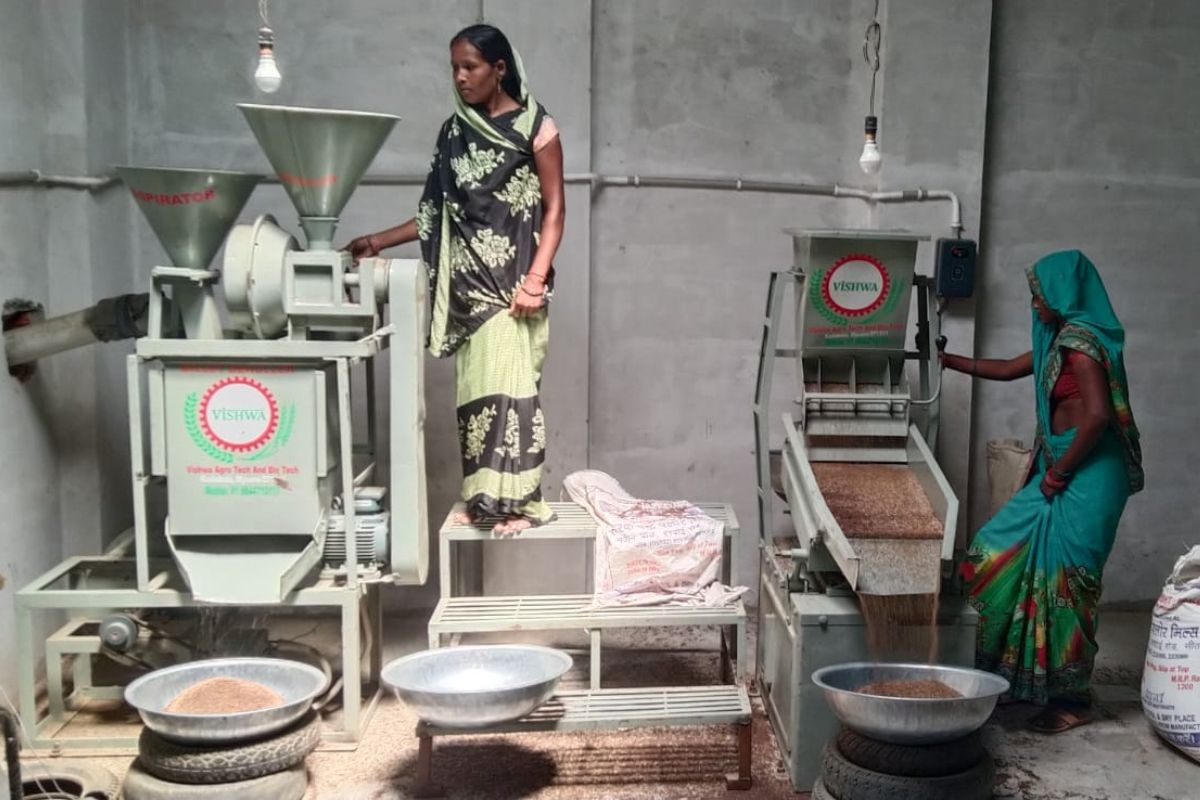
Many farmers sell crops immediately after harvest because they lack storage, drying or processing facilities. This can leave them dependent on local prices at a time when supplies are highest. Small-scale agro-processing can offer another option by allowing farmers to store, process or package part of their produce before selling.
ICAR-Central Institute of Agricultural Engineering in Bhopal has established an on-farm technology park where farmers and entrepreneurs can see post-harvest technologies in practical conditions. The facility includes storage systems, solar dryers, grain storage equipment, onion storage and other technologies designed for farm-level use.
The idea is simple. Instead of treating harvesting as the end of farming, farmers can look at what happens after the crop leaves the field. Better storage, drying, grading and processing can reduce losses and create products that have a longer shelf life or higher market value.
A farmer selling raw wheat receives the market price for grain. A small processor can turn part of that wheat into flour. Similarly, mustard can be processed into oil, fruits can become dried products and millets can be converted into ready-to-cook foods.
Value addition does not automatically mean higher profit. Processing brings costs for machinery, labour, electricity, packaging and marketing. Farmers need to calculate these expenses before investing. The business works only when the additional value created is greater than the extra cost of processing.
Post-harvest losses are another reason to consider processing. ICAR notes that losses across agricultural commodities remain a significant challenge, while its Bhopal centre has developed technologies covering cereals, pulses, oilseeds, fruits, vegetables and millets.
Storage can be the first step
Farmers do not necessarily need to start with a large processing plant. Better storage can itself create a business advantage by giving them more control over when they sell.
The ICAR-CIAE technology park includes a one-tonne hybrid evaporative cooling storage system for horticultural produce. Under tested conditions, the system extended the shelf life of commodities such as cucumber, mango and tomato compared with ambient storage.
Onion is another crop where storage can influence returns. The technology park demonstrates an all-side ventilated onion storage structure designed to reduce losses during storage. Such systems can help farmers avoid selling the entire crop immediately after harvest when prices may be weak.
Drying is one of the simplest ways to extend the usable life of agricultural produce. Farmers can process products such as chillies, maize, fruits and other commodities into dried forms that can be stored and sold later.
ICAR-CIAE has demonstrated a one-tonne IoT-based solar drying system. Its sensors monitor temperature and humidity, while an aeration system helps maintain drying conditions. Green chilli and maize reportedly took three to four days in the system compared with six to seven days under open-sun drying.
A smaller solar dryer with auxiliary heating can also operate when sunlight is limited. The system uses biomass or electricity for additional heating and has a 200-kilogram capacity. This can make drying more predictable during periods when weather conditions are unsuitable for open-air drying.
Farmers can start collectively
A processing unit may be difficult for one small farmer to operate alone. An FPO, cooperative or group of farmers can spread the investment across several members and keep the equipment in regular use.
The group can collect produce from members, process it together and sell a standardised product. This can also make packaging, transport, testing and marketing easier than if every farmer works separately.
The model is already being used in different parts of India. ICAR reports that technology-enabled FPOs have used processing equipment to create value-added products and improve market returns for members.
One common mistake is buying equipment first and searching for a market later. Farmers should reverse this process.
They should identify what buyers want, how much they are willing to pay and how much raw material is available locally. Only then should they calculate the machinery capacity required. A smaller machine running regularly can be more useful than a larger machine that remains idle for most of the year.
Packaging also matters. A processed product needs suitable packaging, labelling and storage. If farmers plan to sell beyond their local market, they may also need food safety registration and other applicable approvals.
Processing machinery requires more than technical knowledge. Entrepreneurs need to understand quality control, costing, maintenance and marketing.
ICAR-CIAE’s facilities are also used for training and practical demonstrations. The institute says its agro-processing work has supported entrepreneurship development and that several entrepreneurs established food-processing businesses after receiving training and technical support.
Farmers interested in starting such businesses should therefore look for training opportunities before investing. Agricultural universities, KVKs, ICAR institutes and food-processing programmes can provide technical guidance on suitable equipment and processes.
What farmers should calculate first
Before starting a processing business, farmers should calculate five basic things: raw material availability, equipment cost, processing cost, expected selling price and likely demand.
They should also calculate how much produce can be processed each month. Electricity, labour, packaging, transport, maintenance and wastage should be included in the calculation. A product may appear profitable until these costs are added.
Farmers should also consider whether processing will be seasonal. A machine used only for two months may need to process enough produce during that period to justify its purchase. Shared ownership or custom processing can sometimes make more sense.
A village-level processing unit can create work beyond farming. It may require people for cleaning, grading, processing, packaging, transportation and sales.
This can be especially useful where farmers already produce enough of one commodity locally. Instead of sending all raw produce outside the village, some value can be created closer to the farm.
The larger opportunity is not simply selling a processed product. It is building a local business around an existing agricultural supply chain. Farmers can become producers as well as processors, depending on their skills and available capital.
Farmers interested in agro-processing should avoid trying to manufacture several products immediately. One crop or product is easier to test, market and improve.
A small pilot can reveal whether buyers return, whether production costs are manageable and whether quality remains consistent. Once the business proves viable, farmers can add another product using the same equipment or supply chain.
The goal should be a regular business rather than a one-time processing activity. Equipment needs to remain productive, and the final product needs repeat customers.
The opportunity is bigger than selling raw crops
Agro-processing will not replace traditional farming, but it can give farmers another way to earn from the same crop. Storage can delay sales, drying can extend shelf life and processing can create products with additional market value.
The ICAR-CIAE technology park shows that these technologies are already being demonstrated under practical conditions. For farmers and FPOs, the next step is to assess which technology fits their crop, investment capacity and local market.
Also Read: Punarnava Jal – The world’s first organic fertilizer! Know how it is beneficial for farmers?
Contact us – If farmers want to share any valuable information or experiences related to farming, they can connect with us via phone or whatsapp at 9599273766 or you can write to us at “kisanofindia.mail@gmail.com”. Through Kisan of India, we will convey your message to the people, because we believe that if the farmers are advanced then the country is happy.
You can connect with Kisan of India on Facebook, Twitter, and Whatsapp and Subscribe to our YouTube channel.