


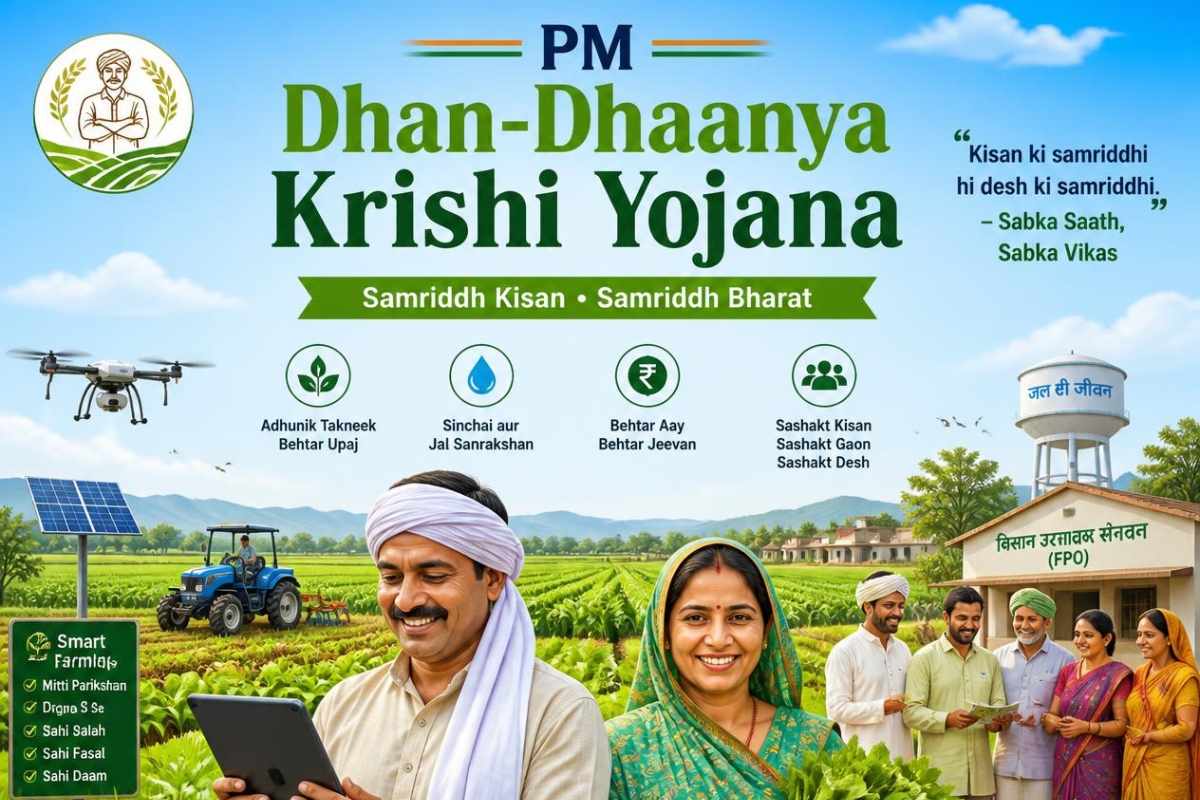
Farmers in 100 districts across India are the focus of the PM Dhan-Dhaanya Krishi Yojana, a government programme designed to address low productivity, inadequate irrigation, limited credit and weak post-harvest infrastructure. The scheme aims to coordinate existing programmes around district-specific agricultural needs.
The scheme was approved by the Union Cabinet in July 2025 and formally launched in October that year. It will run for six years and focuses on districts identified as Aspirational Agricultural Districts, where targeted interventions are intended to improve productivity, diversify farming and strengthen rural livelihoods.
Why District-Level Planning Matters
Agricultural problems differ widely between districts. Some areas struggle with irrigation, while others face low yields, inadequate storage or limited access to institutional credit. PMDDKY uses district-level planning to identify these gaps and direct attention towards the constraints that affect local farmers most.
The programme is built around convergence with existing government schemes rather than creating a completely separate support system. Agriculture, allied sectors, irrigation, credit, storage and other interventions can be aligned through district action plans based on local requirements.
For farmers, this means the benefits will depend on the priorities identified in their district. A farmer in a water-stressed area may see greater emphasis on irrigation, while another district could prioritise storage, crop diversification, livestock or access to markets.
Limited irrigation can restrict both crop choices and yields. PMDDKY identifies irrigation improvement as one of the key areas for intervention. Better water access can allow farmers to grow more than one crop and reduce dependence on uncertain rainfall.
The scheme also encourages improved agricultural productivity. Farmers can benefit when district plans connect them with better crop varieties, scientific farming practices, extension services and suitable technologies. These measures can be more useful when recommendations are based on local soil, water and weather conditions.
Crop diversification is another area covered by the programme. Farmers heavily dependent on one crop can face greater income risk when prices fall or weather damages production. Introducing pulses, oilseeds, horticulture or allied activities can spread that risk where markets and resources allow.
Storage Can Reduce Post-Harvest Losses
Producing a good crop does not always guarantee better income. Farmers may be forced to sell immediately after harvest if they lack storage or access to nearby markets. Better post-harvest infrastructure can give farmers more options over when and where they sell their produce.
The government has linked PMDDKY with efforts to strengthen post-harvest infrastructure in selected districts. Storage, processing and market-related facilities can help retain more value within farming communities, particularly when local production is high during the same harvest period.
Credit access is another important part of the programme. Farmers need working capital for seeds, fertilisers, machinery, irrigation, livestock and other farm operations. District-level planning can help identify gaps in formal credit access and connect farmers with existing financial support systems.
The success of PMDDKY will depend partly on how well district plans reach individual farmers. Farmers should follow announcements from their district agriculture department, Krishi Vigyan Kendra, Panchayati Raj bodies and other local agencies involved in agricultural programmes.
Farmer Producer Organisations can also play a role. Groups can help farmers access inputs, machinery, storage, processing and markets at a larger scale. Where PMDDKY interventions involve collective infrastructure, organised farmer groups may be better placed to use and manage those facilities.
The government says the programme seeks to address district-specific gaps rather than apply one identical model across the country. This approach is important because agricultural productivity depends on local soil, rainfall, irrigation, markets, infrastructure and cropping patterns.
Climate Risk Also Matters
District agricultural plans need to account for changing weather conditions. Erratic rainfall, heat stress, drought and extreme rainfall can affect yields and farm income. Water conservation, crop diversification, improved varieties and climate-resilient farming practices can help reduce these risks.
ICAR is separately developing location-specific climate-resilience action plans under NICRA-TDC. The approach focuses on matching farming interventions with local climate and agricultural conditions, which can complement district-level planning under PMDDKY.
For farmers, the value of PMDDKY will ultimately depend on what happens on the ground. Better irrigation, storage, credit and productivity support can make a difference only when farmers can access them. Local awareness, transparent selection and regular monitoring will therefore be important.
The scheme gives selected districts a framework to address several agricultural problems together instead of treating each issue separately. Farmers should keep track of district-level announcements and use KVKs and agriculture offices to understand which PMDDKY-linked facilities, training programmes and support measures are available locally.
Also Read: Punarnava Jal – The world’s first organic fertilizer! Know how it is beneficial for farmers?
Contact us – If farmers want to share any valuable information or experiences related to farming, they can connect with us via phone or whatsapp at 9599273766 or you can write to us at “kisanofindia.mail@gmail.com”. Through Kisan of India, we will convey your message to the people, because we believe that if the farmers are advanced then the country is happy.
You can connect with Kisan of India on Facebook, Twitter, and Whatsapp and Subscribe to our YouTube channel.