


Can One Tomato Variety Handle Manipur’s Cold Rabi Season? This Farmer’s Results Offer a Clue

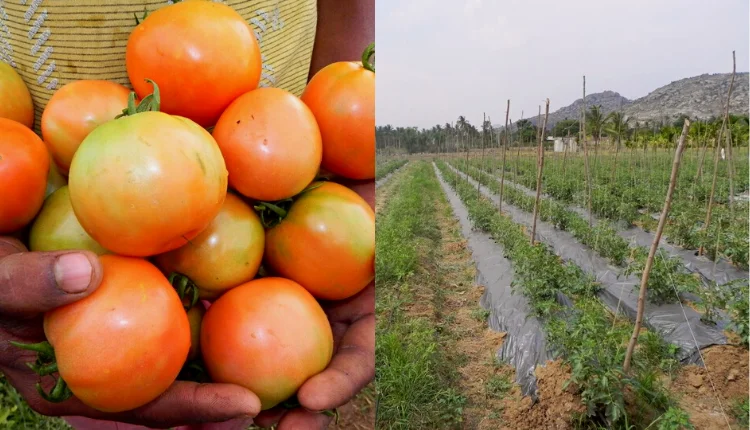
Tomato is an important commercial crop for farmers in Bishnupur district of Manipur. But growing it during the Rabi season can be difficult. Falling temperatures and frost can affect crop growth and productivity, while farmers may also face high costs when using commercial F1 hybrid seeds.
To address this challenge, Krishi Vigyan Kendra Bishnupur introduced farmers to Arka Abhed, an F1 hybrid developed by ICAR-Indian Institute of Horticultural Research in Bengaluru. The aim was to test the variety under actual Rabi-season conditions and allow farmers to assess its performance in their own fields.
Why is Rabi tomato farming difficult?
Bishnupur has about 281 hectares under tomato cultivation, producing around 6,144 tonnes annually, according to ICAR. The crop generally performs well at temperatures of about 20–25°C, but Rabi cultivation becomes more difficult when temperatures fall and frost occurs.
Farmers therefore need varieties that can perform under local conditions. Seed cost is another concern. Depending on the hybrid, purchasing commercial F1 seed can add significantly to the cost of cultivation.
The KVK demonstration aimed to give farmers another option. Rather than relying only on information about a variety, farmers could observe its growth, fruit quality and performance during the season.
How was Arka Abhed tested?
The demonstration began after a seed distribution and capacity-building programme organised by KVK Bishnupur in August 2025, in collaboration with ICAR-IIHR under the North Eastern Hill component.
Seeds were distributed to 10 selected farmers from different villages of Bishnupur district. These included Langpok, Kabowakching, Bishnupur Ward No. 11, Khoijuman and Kumbi.
The farmers then cultivated the variety under local field conditions. This allowed them to assess the crop directly rather than depending only on information provided during a training programme.
The demonstration also created an opportunity for neighbouring farmers to observe the crop. ICAR reported that farmers showed interest in adopting Arka Abhed and other suitable Arka varieties along with recommended cultivation practices.
What did the farmers harvest?
The economic results were notable. Under the demonstration, an average yield of 67.1 quintals was recorded from 625 square metres.
The reported cultivation cost was about ₹27,800. The gross return reached around ₹2,62,400, resulting in a reported net return of ₹2,34,600.
ICAR said market prices during the period ranged from ₹35 to ₹50 per kilogram. The crop was grown over approximately five months, providing an opportunity to produce tomatoes during the Rabi season.
These figures come from the reported demonstration and should not be treated as a guaranteed income for farmers elsewhere. Yield, market prices, cultivation costs and weather conditions can vary between farms.
What did one farmer experience?
Ch. Khogendro Singh from Khoijuman village was among the farmers who took interest in the variety. He has around 25 years of farming experience and had previously grown several improved horticultural varieties.
His experience includes Arka Mangala yard-long bean, Arka Rakshak and Arka Samrat tomato hybrids, along with Arka Meghana and Arka Khyati chilli hybrids.
After participating in the KVK programme, he cultivated Arka Abhed during the Rabi season. ICAR reported that he obtained high yields and substantial net returns while observing the variety under frost-prone conditions.
The farmer particularly noted the hybrid’s frost tolerance, disease resistance and thick-skinned fruits. He is now planning year-round cultivation of suitable Arka tomato varieties along with crop rotation and diversification.
Why does a field demonstration matter?
Farmers often need to see how a variety performs under their own climate and soil conditions before changing what they grow. A variety that performs well in one location may not produce the same results everywhere.
The Bishnupur demonstration brought together improved seed, farmer training and recommended crop-management practices. Farmers could observe the crop through its growing period and assess its performance directly.
This farmer-to-farmer learning can also help spread information. Neighbouring farmers who saw the crop could examine its growth and fruit quality before deciding whether they wanted to try the variety.
Can other farmers adopt Arka Abhed?
Farmers should first check whether the variety is suitable for their location and growing season. Seed availability is also important because farmers need access to quality planting material.
ICAR reported that farmers in Bishnupur expressed interest in expanding Arka tomato cultivation and exploring suitable Arka hybrids as alternatives to high-cost commercial F1 hybrids.
The reported performance provides useful evidence from Bishnupur, but wider adoption needs more demonstrations across locations and seasons. Continued testing can help establish how consistently the variety performs under different weather and field conditions.
Farmers should also follow local recommendations on planting time, spacing, fertilisation, irrigation, pest management and other cultivation practices.
What can farmers learn from the trial?
The main lesson is not simply that one tomato variety produced high returns. The demonstration shows how farmers can evaluate a new variety before adopting it across a larger area.
Farmers can start with a small portion of their land, compare the new variety with the variety they already grow and record yield, input costs, crop duration and market price.
They should also observe how the crop responds to local problems such as frost, disease, water stress and temperature changes.
This approach can reduce the risk of changing varieties based only on claims about yield or profitability. Field performance and local market conditions remain important.
The Arka Abhed experience in Bishnupur shows how a scientific variety can move from a research programme to a farmer’s field. The reported results also show why local demonstrations matter when farmers are considering a new crop variety.
For farmers facing cold Rabi conditions, the question is not only which tomato variety promises higher yield. It is whether the variety can perform under their own weather, soil and market conditions.
The next step is wider testing. More field demonstrations across different locations and seasons can show whether the performance seen in Bishnupur can be repeated elsewhere.
Also Read: Punarnava Jal – The world’s first organic fertilizer! Know how it is beneficial for farmers?
Contact us – If farmers want to share any valuable information or experiences related to farming, they can connect with us via phone or whatsapp at 9599273766 or you can write to us at “kisanofindia.mail@gmail.com”. Through Kisan of India, we will convey your message to the people, because we believe that if the farmers are advanced then the country is happy.
You can connect with Kisan of India on Facebook, Twitter, and Whatsapp and Subscribe to our YouTube channel.