



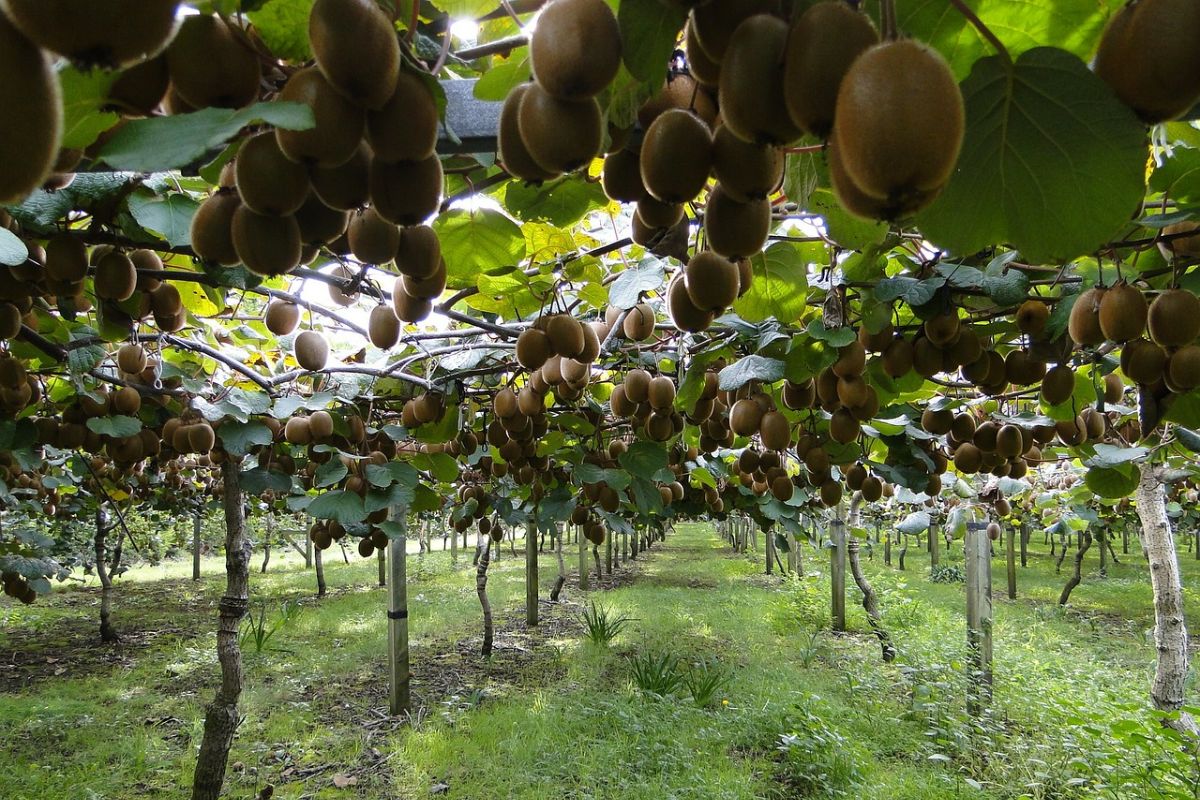
A kiwi orchard in Nagaland has improved its productivity after adopting a T-Bar trellis system, according to a new success story highlighted by the Indian Council of Agricultural Research. The technology has helped address a common problem in kiwi cultivation where overcrowded vines can reduce sunlight penetration, affect airflow and make orchard management difficult.
Kiwi is an important high-value fruit crop for the hill regions of the Northeast. The crop can provide farmers with good returns, but orchard productivity depends heavily on proper training, pruning and canopy management. The experience from Nagaland shows how changing the way vines are supported can improve the use of available orchard space.
From Congested Vines to Better Canopy Management
Kiwi vines are vigorous growers and require a strong support structure. When vines become crowded, leaves and fruiting branches compete for sunlight and space. This can create dense canopies that make pruning, spraying and harvesting more difficult.
The T-Bar trellis system provides a structured framework for training the vines. Instead of allowing branches to spread randomly, the system guides them along designated support wires. This creates a more organised canopy and allows farmers to manage the plants more systematically.
Better canopy arrangement can also improve light distribution and airflow within the orchard. These factors are important for maintaining plant health and supporting fruit development.
The ICAR success story describes the technology as a way of moving from congested vines towards higher yields through improved orchard management.
Technology Makes Orchard Work Easier
Orchard management becomes more demanding as kiwi plants mature. Farmers need to carry out regular pruning, training and other operations to maintain productive branches and control excessive vegetative growth.
A properly designed trellis gives farmers better access to the vines. This can make important operations easier and allow growers to identify problems within the canopy at an earlier stage.
The system can also help organise fruiting branches across the available space. When vines are trained properly, farmers can manage the orchard with greater consistency rather than allowing individual plants to develop uncontrolled growth.
For hill farmers, this type of structural improvement can be important because land is often limited and expanding orchard area may not be practical. Improving productivity from existing land can offer a more realistic route to increasing farm income.
The Nagaland example shows that agricultural technology does not always require complex machinery or expensive digital systems. A change in orchard design can also make a measurable difference when it is suited to the crop and local farming conditions.
Lessons for India’s Kiwi Growers
Kiwi cultivation is concentrated mainly in India’s Himalayan and Northeast regions, where suitable temperatures and elevation provide favourable conditions for the crop. Nagaland is among the states with growing interest in commercial kiwi production.
The experience with T-Bar trellising offers a practical lesson for other growers. Before expanding an orchard, farmers can examine whether existing plants are using available space efficiently. Better vine training, planned pruning and suitable support structures can help farmers improve orchard performance without necessarily increasing the cultivated area.
The approach can also help extension workers demonstrate improved orchard management techniques to growers. Farmers can compare conventional vine training with structured systems and assess the benefits based on yield, labour requirements and fruit quality.
ICAR’s latest success story places the Nagaland orchard among examples of how scientific interventions can address practical problems faced by farmers.
For kiwi growers, the focus is not only on planting more vines. The quality of orchard management determines how effectively each plant uses sunlight, space and nutrients. A well-managed canopy can make harvesting and crop protection easier while creating better conditions for fruit development.
The Nagaland experience highlights a simple point for high-value fruit farmers: improving the structure of an existing orchard can sometimes be as important as expanding its size. As more farmers adopt improved training systems and scientific pruning practices, technologies such as T-Bar trellising could help strengthen commercial kiwi cultivation in India’s hill regions.
Also Read: Punarnava Jal – The world’s first organic fertilizer! Know how it is beneficial for farmers?
Contact us – If farmers want to share any valuable information or experiences related to farming, they can connect with us via phone or whatsapp at 9599273766 or you can write to us at “kisanofindia.mail@gmail.com”. Through Kisan of India, we will convey your message to the people, because we believe that if the farmers are advanced then the country is happy.
You can connect with Kisan of India on Facebook, Twitter, and Whatsapp and Subscribe to our YouTube channel.