



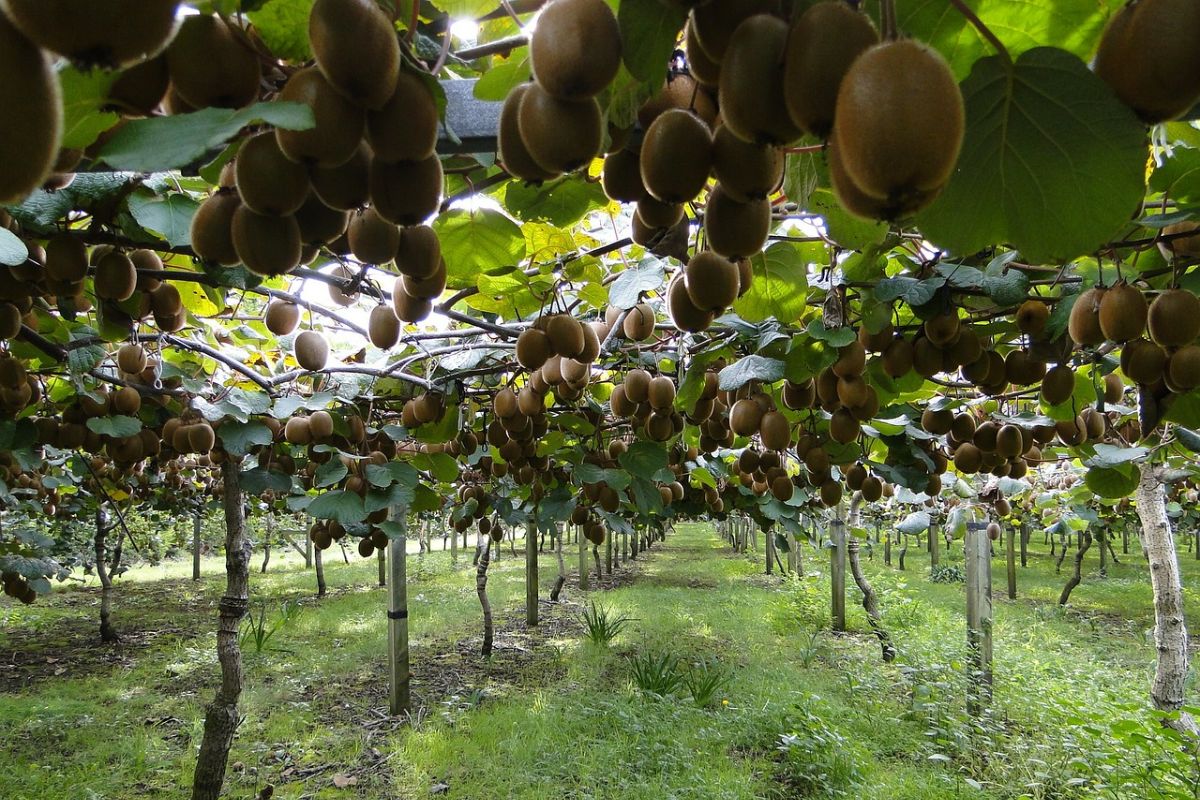
A kiwi farmer in Nagaland has improved orchard management by adopting T-bar trellis technology, a system that helps spread kiwi vines across a structured support instead of allowing them to grow in a congested canopy.
The case was highlighted by the Indian Council of Agricultural Research as an example of how a change in orchard management can improve crop growth and productivity. The technology was used in a kiwi orchard in Nagaland and featured by ICAR among its recent farmer success stories.
Congested vines created a problem
Kiwi is a climbing fruit crop that needs a strong support structure. When vines become crowded, leaves and fruiting branches can overlap, making it harder for sunlight to reach the canopy.
Poor canopy management can also make pruning, spraying and harvesting more difficult.
The T-bar system provides horizontal support for the vines. Instead of allowing the plant to develop into a dense mass, farmers can guide the branches along the support structure.
This gives the farmer greater control over the arrangement of the canopy and helps create space between fruiting branches.
T-bar system improves orchard management
The technology is particularly relevant to hill farmers growing kiwi because orchard land can be limited and labour-intensive operations can add to production costs.
A properly managed trellis can make several farm activities easier. Farmers can reach fruiting branches more easily during pruning and harvesting. Better exposure of the canopy can also support more uniform growth.
ICAR has highlighted the Nagaland case under its success stories, where the T-bar trellis was used to address the problem of congested vines and improve orchard performance.
The system is not simply a replacement for traditional support. Farmers also need to manage pruning, training, nutrition and plant health according to the crop’s growth stage.
Kiwi is an important crop for hill farmers
Kiwi cultivation has expanded in parts of Northeast India because the region has suitable highland areas for the crop.
Nagaland’s terrain and climate allow farmers to grow horticultural crops that can provide an alternative to conventional field crops.
For such farmers, orchard productivity matters because perennial fruit crops require investment over several years. Improving the use of available space and maintaining healthy plants can help farmers get better returns from established orchards.
The T-bar example shows that farm gains do not always require a new crop or expensive machinery. Changes in the way an existing crop is trained and managed can also affect productivity.
Better canopy management can reduce labour problems
Kiwi orchards require regular pruning and training. When vines become tangled, these operations can take more time and may damage branches.
A structured trellis gives farmers a clearer framework for managing the plants.
It can also make it easier to identify fruiting branches and remove unwanted growth. Better access to the canopy can be useful during harvesting as well.
For small orchard owners, such changes can matter because labour is often one of the major recurring costs.
The Nagaland case is useful for other kiwi growers because it focuses on a practical farm-level problem rather than simply promoting a new variety.
Farmers need to match trellis systems to local orchards
A T-bar trellis will not automatically increase production in every orchard. The result depends on factors such as plant age, spacing, pruning, soil conditions, nutrition, water availability and disease management.
Farmers considering the system need to assess the cost of installing the support structure against the expected improvement in orchard management and returns.
The Nagaland example shows one possible approach. By reorganising the kiwi canopy, the farmer was able to address vine congestion and work towards better orchard productivity. ICAR has included the case among its recent examples of technologies reaching farmers.
For kiwi growers in the Northeast, the lesson is practical. Before planting more trees or expanding the orchard, improving the management of the existing plants may offer another route to higher productivity.
Also Read: Punarnava Jal – The world’s first organic fertilizer! Know how it is beneficial for farmers?
Contact us – If farmers want to share any valuable information or experiences related to farming, they can connect with us via phone or whatsapp at 9599273766 or you can write to us at “kisanofindia.mail@gmail.com”. Through Kisan of India, we will convey your message to the people, because we believe that if the farmers are advanced then the country is happy.
You can connect with Kisan of India on Facebook, Twitter, and Whatsapp and Subscribe to our YouTube channel.