

Can a Laser Land Leveller Save Irrigation Water? What Farmers Should Know Before Renting One

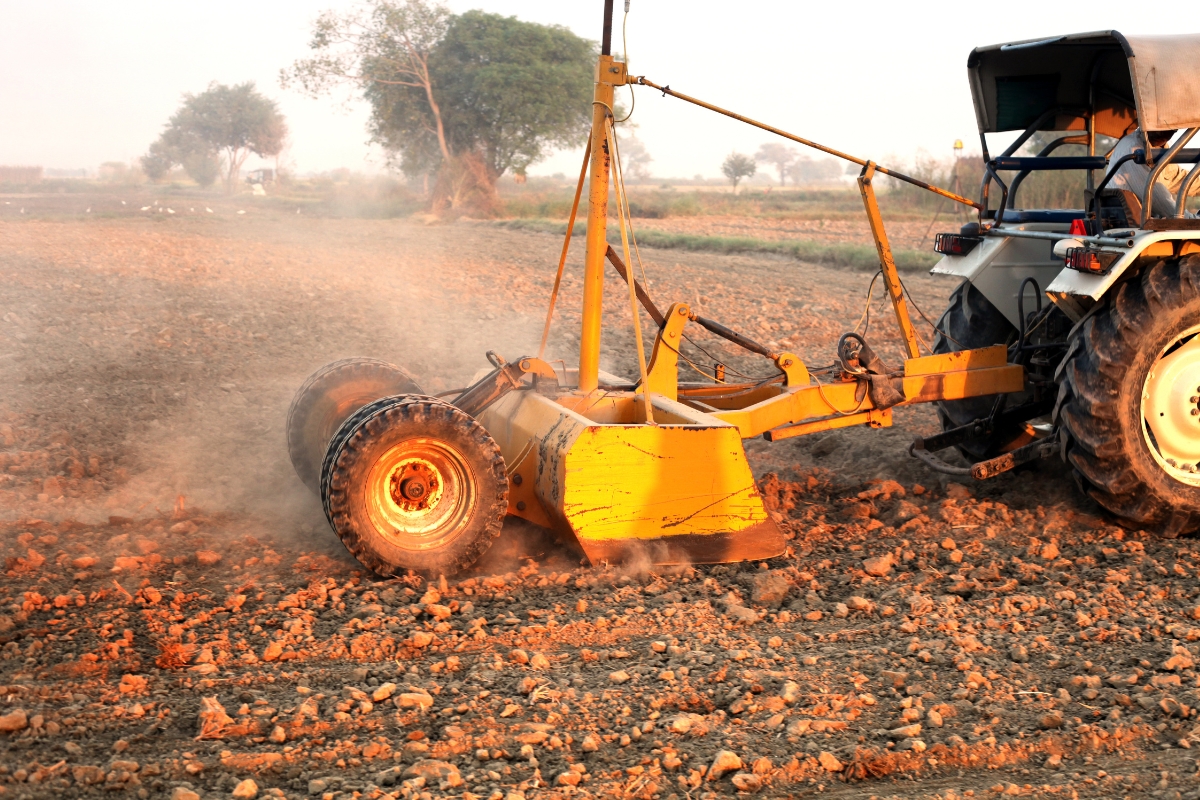
An uneven field can make irrigation difficult. Water collects in lower patches while higher areas may remain dry. Laser land levelling uses a laser-guided system to create a more uniform field surface, allowing irrigation water to spread more evenly. ICAR lists laser levelling among technologies developed to save water, labour and energy.
The machine uses a laser transmitter, receiver, control box, hydraulic system, tractor and levelling bucket. The laser system guides the bucket while soil is cut from higher areas and moved into lower sections. ICAR describes precision levelling as maintaining the field surface within about two centimetres of the required level.
For farmers, the main benefit is not the machine itself. It is the more uniform field that results from its use. Better levelling can improve irrigation distribution, crop establishment and water productivity, particularly in irrigated cropping systems.
How does laser land levelling save water?
When a field has depressions and high patches, farmers may apply more water to ensure that dry areas receive enough moisture. This can leave lower parts waterlogged while increasing overall irrigation requirements.
ICAR research has found that precision levelling can reduce total water use. A five-year study covering wheat-based cropping systems reported water savings of 83 to 184 mm compared with traditional levelling, along with higher water productivity.
Another ICAR source notes that uneven fields can contribute to water losses and that precision levelling improves the distribution of irrigation water. The technology is especially relevant where farmers face limited irrigation supplies or declining groundwater availability.
The exact saving will differ from farm to farm. Soil type, crop, field slope, irrigation method and existing field condition all affect the result. Farmers should not assume that every field will achieve the same percentage reduction.
A separate ICAR study in Central India found that laser levelling reduced variations in standing water in paddy and resulted in 16.67% water savings per irrigation compared with conventional levelling.
The technology can also help reduce irrigation time. When water moves more uniformly across the field, farmers may spend less time waiting for distant parts of the plot to receive sufficient water.
Can it increase crop yield?
Better water distribution can improve crop establishment and reduce areas where plants receive either too much or too little water. This can lead to more uniform crop growth.
A 2023 study published through the Indian Council of Agricultural Research found that precision laser levelling increased rainy-season crop yields by 6.3% to 12.7% and wheat yields by 7% to 12% compared with traditional levelling.
A new 2026 study based on a survey of 885 farmers across 12 districts of Punjab also examined laser land levelling in paddy systems. It found that adoption was associated with an increase of 2.64 quintals per acre in paddy yield and about 3% higher technical efficiency.
The Punjab study is useful because it used farmer-level data rather than a small experimental plot. The researchers compared 527 adopters with 358 non-adopters and used statistical methods to account for differences between the two groups.
The researchers also found that adoption was influenced by factors including landholding size, education and ownership of tractors and pumpsets. This shows that access to machinery can affect whether farmers are able to use the technology.
Should farmers buy or rent the machine?
Buying a laser land leveller may not make sense for a farmer who needs the equipment only once or twice a year. The machinery requires a suitable tractor and trained operation, while the initial investment can be significant.
Custom hiring can provide another option. ICAR research from Haryana found that farmers accessed laser levelling through private service providers, cooperatives and custom hiring centres.
The Haryana study reported that some farmers used a custom hiring centre where a laser leveller, tractor and operator were available at a nominal daily rate. Cooperatives also offered the service on an area basis.
This model can make the technology more accessible to farmers who do not own tractors or specialised equipment. Before hiring, farmers should ask whether the operator has experience with laser levelling and whether the field is suitable.
Farmers should also compare the hiring charge with the expected savings in water, fuel and labour. The calculation should cover several seasons because the benefits of accurate levelling can continue after the machine leaves the field.
What fields are suitable?
Laser land levelling is generally suited to relatively flat or gently sloping agricultural land. ICRISAT describes the technology as particularly useful in irrigated areas, including rice-wheat systems and regions facing water scarcity.
Farmers should first assess field slope, soil condition, existing irrigation arrangements and the amount of soil that needs to be moved. Excessive soil cutting can remove fertile topsoil from high areas if levelling is poorly planned.
The objective is not simply to make a field completely flat. Precision levelling creates the required surface grade so that water can move uniformly. The correct grade depends on the field and irrigation system.
ICAR describes laser land levelling as a resource-conservation technology that can save water, nutrients, labour and energy. It is also used alongside other practices such as zero tillage and improved planting methods.
Farmers should therefore view levelling as one part of farm management rather than a replacement for good irrigation practices. Efficient water application still depends on irrigation scheduling and crop requirements.
Why does it matter as climate changes?
Climate change is making water management more important for farmers facing irregular rainfall, heat and pressure on groundwater. Saving irrigation water during each crop cycle can help reduce pressure on limited supplies.
A recent ICAR review of climate-resilient agriculture also highlighted laser land levelling as a technology that can improve irrigation efficiency, reduce water losses and support more uniform crop establishment.
The connection with climate change is practical. A farmer cannot control when rainfall arrives, but can improve how efficiently available water is used. Better field preparation can help farmers get more value from each irrigation.
This becomes especially relevant in groundwater-stressed rice-growing areas. The 2026 Punjab study described laser levelling as a water-saving technology that can support climate adaptation in water-intensive rice systems.
Still, laser levelling cannot solve groundwater depletion on its own. Farmers also need suitable crops, efficient irrigation methods and decisions based on actual water availability.
What should farmers check before hiring?
Farmers should ask for a field survey before levelling begins. The operator should identify high and low points and determine how much soil needs to be moved.
Check whether the service includes the tractor, operator and laser equipment. Ask for the total cost per acre and whether additional charges apply for difficult fields.
Farmers should also compare the service with the expected benefits. Water savings, reduced irrigation time, better crop establishment and possible yield gains should be considered over more than one season.
Laser land levelling is not a new machine, but research continues to show where it can provide value. Recent evidence from Punjab adds to earlier ICAR findings that accurate levelling can improve water use and crop performance.
For farmers facing rising irrigation costs or limited water, the practical question is whether the field currently loses water because of unevenness. If it does, hiring a laser land leveller may be worth comparing with conventional levelling based on the farm’s actual costs and water use.
Also Read: Punarnava Jal – The world’s first organic fertilizer! Know how it is beneficial for farmers?
Contact us – If farmers want to share any valuable information or experiences related to farming, they can connect with us via phone or whatsapp at 9599273766 or you can write to us at “kisanofindia.mail@gmail.com”. Through Kisan of India, we will convey your message to the people, because we believe that if the farmers are advanced then the country is happy.
You can connect with Kisan of India on Facebook, Twitter, and Whatsapp and Subscribe to our YouTube channel.