



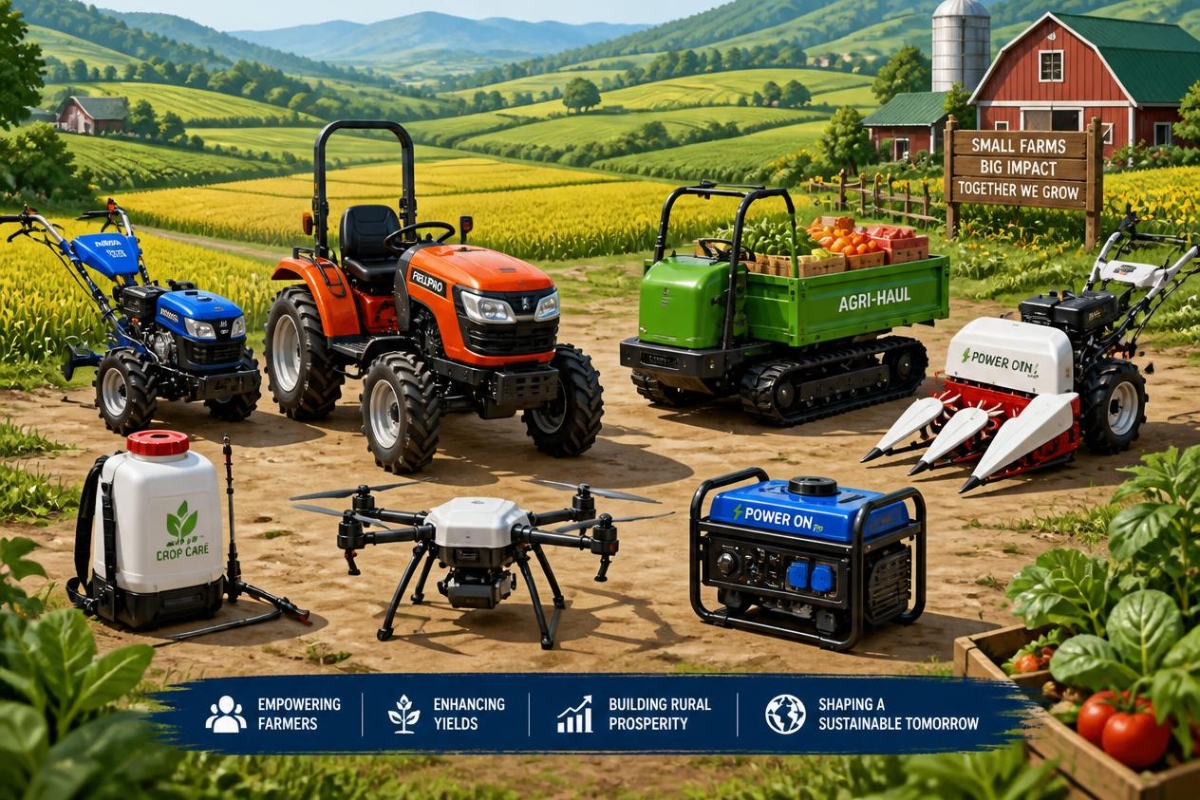
Buying a tractor, seeder, harvester or other farm machine can be expensive, especially for small and marginal farmers who use the equipment for only a few days each season. Custom Hiring Centres offer another option. Farmers can rent machines when they need them instead of paying the full cost of ownership.
The idea is to make farm machinery available on a shared basis. A centre keeps different machines and implements that farmers can hire for specific operations. This can help farmers access equipment for sowing, planting, harvesting, residue management and other activities without having to purchase every machine themselves.
What Is a Custom Hiring Centre?
A Custom Hiring Centre, or CHC, is a facility where agricultural machines and equipment are made available to farmers on a rental basis. The government promotes CHCs under the Sub-Mission on Agricultural Mechanization, which aims to improve access to machinery for small and marginal farmers.
The machines available depend on the centre and local farming needs. Equipment can include seed drills, rotavators, harvesters, mulchers, planters and other implements. Some centres also provide access to newer technologies and specialised machinery that individual farmers may not otherwise be able to afford.
The government says 27,554 Custom Hiring Centres had been established under the farm mechanisation programme between 2014-15 and 2025-26. During the same period, the programme supported 21.61 lakh machines for individual farmers with central assistance of ₹9,404.47 crore.
The model can be particularly useful where a machine has a high purchase price but is needed only for a short period. Instead of keeping capital tied up in equipment, farmers can pay for the hours or acreage for which they actually use the machine.
Farm machinery can reduce labour requirements and help complete operations within the right agricultural window. But ownership can bring other costs, including maintenance, fuel, repairs, storage and depreciation. These expenses can make a machine costly when annual use is limited.
Custom hiring changes this calculation. A farmer pays for the service rather than purchasing the equipment. This can make mechanisation accessible even when the farmer has a small holding or cannot justify buying a machine for occasional use.
An ICAR paper on custom hiring notes that the model can reduce the capital burden on farmers, improve machine use and reduce the cost of individual ownership. It also says timely access to machinery can be important for rainfed farming, where agricultural operations often depend on short weather windows.
The benefit also depends on availability. A machine is useful only if it reaches the farmer when the field operation needs to be completed. Farmers should therefore check booking arrangements and availability before the sowing or harvesting period begins.
Government Support Is Available
The government supports Custom Hiring Centres through the Sub-Mission on Agricultural Mechanization. Under the current framework, financial assistance of 40% of the project cost is available for establishing CHCs for projects costing up to ₹250 lakh.
Farm Machinery Banks receive higher support. The government provides 80% financial assistance for projects costing up to ₹30 lakh. For the North Eastern states, the assistance for Farm Machinery Banks can reach 95% of the project cost.
The scheme also supports individual farmers who want to purchase machinery. Financial assistance of 40–50% of the machine cost is available under the stated scheme provisions. This means farmers have two broad routes: purchase equipment with government support or access machinery through a shared hiring facility.
The exact assistance and application process can depend on the state and category of applicant. Farmers should check the current rules with their state agriculture department before making a purchase or setting up a hiring centre.
The Department of Agriculture and Farmers Welfare operates the FARMS, or Farm Machinery Solutions, platform. It connects farmers with Custom Hiring Centres, Farm Machinery Banks and Hi-Tech Hubs that provide machinery on rent. The platform also allows machinery owners to offer equipment for hiring.
The system is designed for multiple languages and allows farmers to look for available farm machinery without needing to own a computer. Farmers can also use the platform to explore the sale and purchase of used agricultural machinery.
The government machinery portal also provides a facility to find registered dealers and machinery information. Farmers can check available equipment, dealer details and machine specifications through the official system before making a purchase decision.
For farmers, digital access can make hiring easier, but local availability remains important. A machine listed online may not necessarily be available on the exact day a farmer needs it. Farmers should confirm the booking, rental rate, operator charges and transport costs before finalising the service.
Farmer Groups Can Also Run Hiring Centres
Custom Hiring Centres are not limited to private entrepreneurs. Farmer Producer Organisations, societies and other eligible groups can apply for establishing centres through the government mechanisation system. The official portal provides separate application processes for societies, self-help groups, FPOs and entrepreneurs.
An ICAR-Indian Institute of Millets Research initiative in Telangana provides one example. In February 2026, ICAR-IIMR inaugurated a Custom Hiring Centre at the Tekmal Mandal Farmers Producer Cooperative Society. The centre was designed to give small and marginal farmers collective access to machinery they may not be able to purchase individually.
ICAR expected the initiative to initially benefit around 500–700 member farmers, with the possibility of expanding to surrounding villages. Such models can allow farmer groups to share access to machines while spreading the cost across a larger number of users.
Farmers should first check the machine’s hourly or per-acre rental rate. They should also ask whether fuel, transportation and the operator’s charges are included. These costs can change the final price of hiring a machine.
Farmers should also check the machine’s condition and suitability for their crop and field. A machine that works well in one soil type or crop may not be suitable for another. If possible, farmers should compare rates from more than one nearby centre before booking.
Timing is just as important as price. During sowing and harvesting seasons, demand can rise sharply. Farmers should book important machinery early and confirm the date and time of delivery. Delayed access can reduce the benefit of mechanisation if the crop operation misses its suitable window.
Machinery Access Can Reduce the Cost of Farming
Custom Hiring Centres give farmers another way to use modern farm machinery without carrying the full cost of ownership. The model can be especially useful for small holdings where purchasing expensive equipment may not make financial sense.
For farmers, the practical step is to calculate the cost of hiring against the cost of owning a machine. Include fuel, repairs, maintenance and depreciation when comparing the two options.
If hiring is cheaper and the machine is available when needed, a Custom Hiring Centre can provide a practical way to mechanise farm operations without a large upfront investment.
Also Read: Punarnava Jal – The world’s first organic fertilizer! Know how it is beneficial for farmers?
Contact us – If farmers want to share any valuable information or experiences related to farming, they can connect with us via phone or whatsapp at 9599273766 or you can write to us at “kisanofindia.mail@gmail.com”. Through Kisan of India, we will convey your message to the people, because we believe that if the farmers are advanced then the country is happy.
You can connect with Kisan of India on Facebook, Twitter, and Whatsapp and Subscribe to our YouTube channel.