



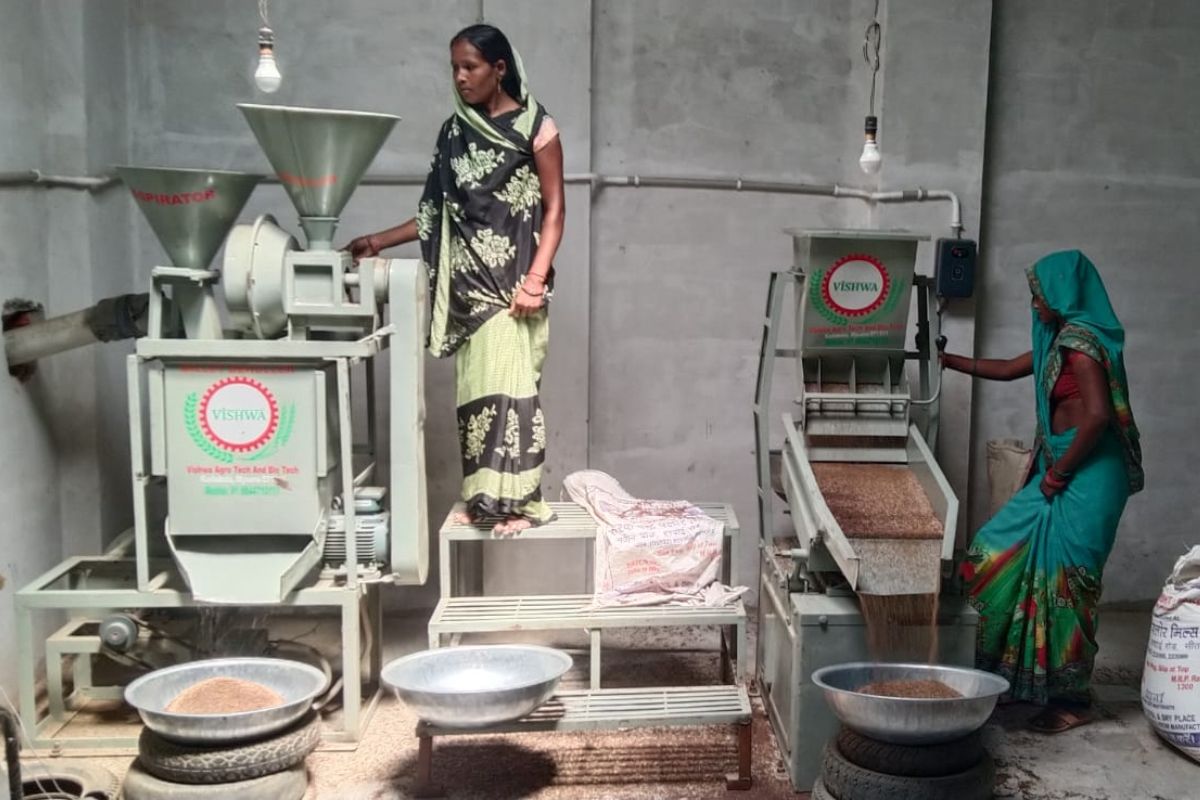
For years, millet farmers in Karnataka faced a common problem after harvest. Growing the crop was only half the challenge. Processing it was often far more difficult.
Traditional millets such as ragi, foxtail millet, little millet, barnyard millet, and kodo millet require cleaning, grading, dehulling, and polishing before they can reach consumers. Most farmers depended on distant processing centres, increasing transportation costs and reducing profits.
Today, small-scale millet processing units are changing that equation.
Across districts such as Chitradurga, Tumakuru, Ballari, Vijayapura, and Raichur, farmer groups and rural entrepreneurs are installing compact processing machines that allow millets to be processed close to production areas.
The technology is helping farmers capture more value from crops that are increasingly attracting national attention. Millets have gained popularity because of their nutritional value and climate resilience. Yet processing remained a major challenge.
Unlike rice and wheat, many millet varieties have hard outer husks that must be removed carefully before consumption. Traditional methods are labour-intensive and time-consuming.
For small farmers, sending grain to large commercial processors often reduced earnings because transportation, handling, and commission charges added extra costs.
Many growers sold raw grain instead of processed products, leaving much of the profit to traders and processors.
The result was a value chain where farmers produced the crop but earned only a small share of the final market value.
Compact Machines Are Reaching Villages
Mini processing units are designed specifically for small-scale operations.
Most systems can clean, grade, dehull, and package grain within a relatively small space. Some units are operated by self-help groups, farmer producer organisations, and village entrepreneurs.
The machines require lower investment compared with large industrial facilities.
This makes them practical for rural communities where production volumes may not justify major infrastructure projects.
Farmers can process smaller quantities while maintaining product quality. The approach allows villages to move beyond raw grain sales and enter the growing market for packaged millet products.
Many of the successful processing centres are managed by women’s self-help groups. Across Karnataka, these groups have established enterprises producing millet flour, ready-to-cook mixes, breakfast products, snacks, and traditional foods.
Processing adds value at every stage.
A farmer selling raw millet may earn a modest return. Once the grain is cleaned, packaged, branded, and marketed, its value increases significantly.
Women’s groups are increasingly capturing part of that value while creating employment opportunities within rural communities.
The model is helping transform millet farming from a production activity into a broader rural business ecosystem.
Consumer interest in millets has expanded rapidly over the past few years. Health-conscious buyers, urban households, fitness enthusiasts, and food companies are driving demand for traditional grains. Restaurants and food startups are also incorporating millets into modern menus.
The International Year of Millets in 2023 further increased awareness about these crops. Karnataka, one of India’s leading millet-producing states, has benefited significantly from this trend. Farmers who once struggled to find buyers are now seeing stronger demand for both grain and processed products.
Processing infrastructure helps them take advantage of these opportunities.
Climate Change Is Strengthening the Millet Economy
Millets are often described as climate-resilient crops because they require less water than many conventional cereals and can tolerate dry conditions more effectively.
This has increased their importance in regions facing water stress and erratic rainfall.
Karnataka’s dryland farmers have cultivated millets for generations because the crops perform well under challenging conditions.
As climate risks increase, policymakers are encouraging greater millet cultivation across several states. Processing facilities ensure that increased production translates into stronger incomes rather than market bottlenecks. Without local processing, many farmers would struggle to benefit fully from rising demand.
The spread of mini processing units is creating opportunities beyond farming.
Young entrepreneurs are entering businesses related to packaging, branding, logistics, and direct marketing. Some enterprises sell products through online platforms while others focus on local retail networks. The shift reflects a broader change in Indian agriculture. Success increasingly depends not only on growing crops but also on processing and marketing them effectively.
Farmers who participate in these activities earn a larger share of consumer spending.
The millet revival is often discussed in terms of nutrition and climate resilience. Equally important is what happens after harvest. Without processing, even the best crops struggle to reach consumers efficiently.
Mini millet processing units are helping bridge that gap.
By bringing technology closer to villages, they allow farmers to retain more value, create local employment, and build stronger rural enterprises.
Across Karnataka, these machines are proving that sometimes the most important agricultural innovation is not in the field.
It is what happens after the crop leaves it.
Also Read: Punarnava Jal – The world’s first organic fertilizer! Know how it is beneficial for farmers?
Contact us – If farmers want to share any valuable information or experiences related to farming, they can connect with us via phone or whatsapp at 9599273766 or you can write to us at “kisanofindia.mail@gmail.com”. Through Kisan of India, we will convey your message to the people, because we believe that if the farmers are advanced then the country is happy.
You can connect with Kisan of India on Facebook, Twitter, and Whatsapp and Subscribe to our YouTube channel.