



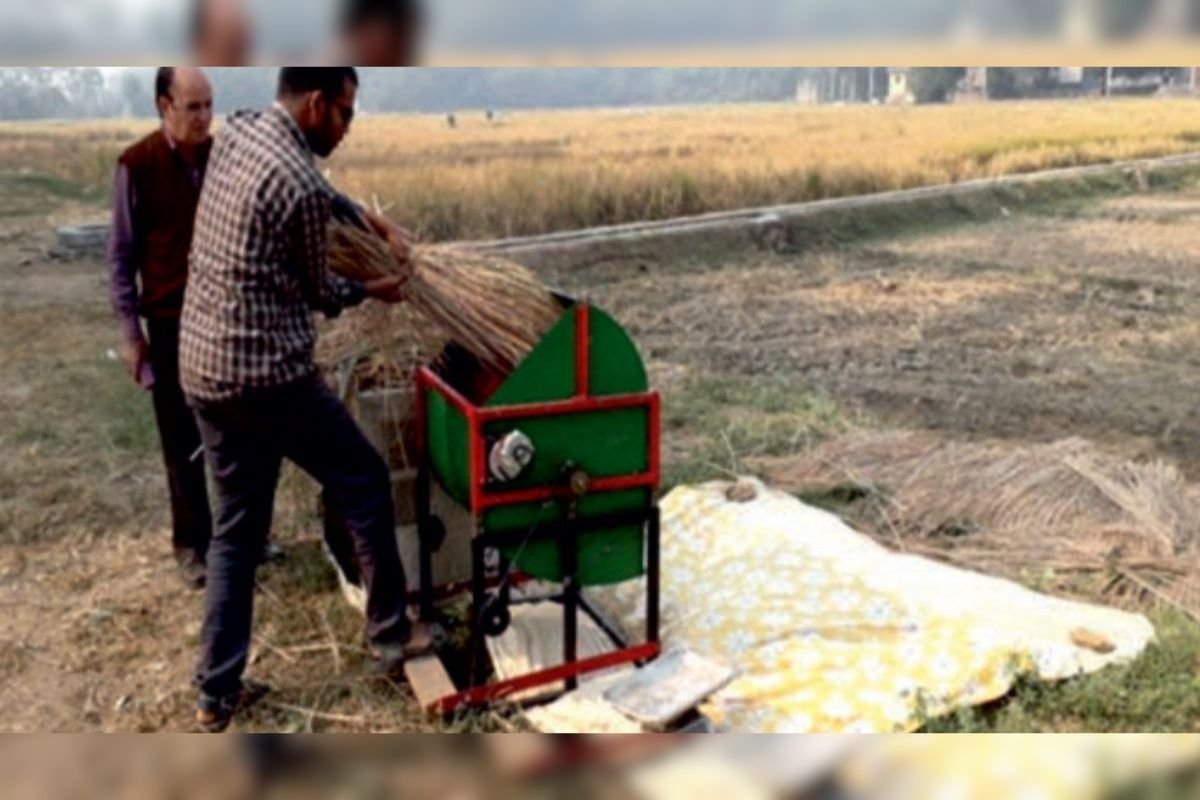
Paddy harvesting leaves large amounts of straw in fields, and farmers have limited time before preparing land for the next crop. Crop residue management machines can help farmers handle this material without burning it. The government has set a 2026 target of distributing more than 46,000 such machines.
The right machine depends on what a farmer wants to do with the residue. Some machines chop and spread straw, others incorporate it into soil, while some allow farmers to sow the next crop without removing the residue. Understanding these differences can help farmers avoid buying unsuitable equipment.
A farmer should first check how much straw the harvesting operation leaves behind. Combine harvesters can leave considerable residue across the field, creating difficulties when the next crop needs to be planted quickly.
The amount and distribution of straw can influence which machine works best. Farmers should discuss field conditions with machinery operators or local agriculture officials before selecting equipment, especially if they are considering a machine for the first time.
Straw management starts with chopping
A straw chopper or shredder can cut standing or scattered residue into smaller pieces. Smaller pieces can spread more evenly across the field and decompose more easily than large bundles left after harvesting.
This type of equipment can be useful when farmers want to retain residue in the field. The machine does not solve every residue-management problem, but it can make subsequent operations easier and improve the distribution of straw.
The Happy Seeder is designed to plant wheat into fields where rice residue remains on the surface. It cuts and lifts the straw while placing wheat seed into the soil, then deposits the residue over the field.
This can save farmers from completely removing paddy straw before sowing wheat. Keeping residue on the surface can also protect soil from direct exposure and help retain moisture, although machine performance depends on field conditions and proper operation.
A Super Seeder performs residue management and wheat sowing in a combined operation. It cuts and incorporates paddy residue while placing seed into the soil.
For farmers who need to move quickly from paddy harvesting to wheat sowing, combining operations can save time. But the machine is heavier and generally requires suitable tractor power, so farmers should check tractor compatibility before arranging one.
Mulchers cut crop residue into smaller pieces and distribute it across the field. They can be useful when farmers want to manage straw before another tillage or sowing operation.
Farmers should check whether the machine is suitable for their crop and residue quantity. A machine that works well in one field may perform poorly where straw is wet, heavily packed or unevenly distributed.
Baler machines offer another option
Instead of incorporating straw into the soil, farmers can collect it into bales. A baler compresses loose crop residue into manageable bundles that can be transported and stored.
Baled straw can potentially move to livestock farms, biomass plants, compressed biogas units or other users. This approach can create another use for residue, but farmers need a reliable buyer before investing in baling operations.
Buying specialised machinery may not make financial sense for a farmer who uses it only for a few days each year. Custom Hiring Centres allow farmers to access machinery without purchasing the entire machine.
The government promotes Custom Hiring Centres under the Sub-Mission on Agricultural Mechanization. The scheme provides financial assistance for establishing such centres, helping improve access to machinery for small and marginal farmers.
Farmers should not select a machine based only on its purchase price. Tractor horsepower, implement weight, field size and soil condition can affect performance.
A machine requiring more tractor power than available can increase fuel use, reduce work quality or create mechanical problems. Farmers should check the manufacturer’s recommended tractor specifications before hiring or purchasing equipment.
Residue management becomes more difficult when farmers delay field operations. Wet straw can be harder to handle, while a short gap before wheat sowing can increase pressure on farmers.
Farmers should therefore arrange machinery before harvesting begins. Booking a machine early can reduce last-minute delays, especially in areas where many farmers need the same equipment during a narrow sowing window.
Government support is expanding
The Sub-Mission on Agricultural Mechanization has supported machinery access across India. From 2014-15 to 2025-26, the government reports that ₹9,404.47 crore in central assistance supported 21.61 lakh machines for individual farmers, along with thousands of Custom Hiring Centres and Farm Machinery Banks.
Financial assistance varies according to the type of machinery, farmer group and scheme component. Farmers should therefore check current state-level rules rather than assuming that every machine receives the same subsidy.
Before purchasing equipment, farmers should calculate purchase price, tractor use, fuel, maintenance, labour and annual utilisation. A machine used for only a few days may have a high cost per acre.
Hiring can be more suitable when local machinery services are available. Ownership may make more sense when a farmer has enough land, regular demand or a plan to provide services to neighbouring farms.
Crop residue does not always have to remain a waste product. Government programmes are also supporting supply chains that move paddy straw towards biomass power, compressed biogas, ethanol and pellet production.
For farmers, this creates another possibility. Instead of burning residue, they may be able to sell or supply it to an organised collection system if such a market exists locally.
What should farmers do before harvest?
Farmers should identify the amount of residue expected, decide whether they want to incorporate, retain or remove it, and check which machines are available nearby. They should also compare hiring charges with the cost of owning equipment.
The most suitable machine is not necessarily the largest or newest one. It is the machine that matches the farm’s crop, tractor, soil, residue level and sowing schedule. Crop-residue machinery can help farmers manage the short gap between paddy harvesting and the next crop. The choice should be based on what happens to the straw after the machine completes its work.
For small farmers, access may matter more than ownership. Custom Hiring Centres, Farm Machinery Banks and farmer groups can help spread machinery costs across more users. With better planning, farmers can manage residue without losing valuable time before the next crop.
Also Read: Punarnava Jal – The world’s first organic fertilizer! Know how it is beneficial for farmers?
Contact us – If farmers want to share any valuable information or experiences related to farming, they can connect with us via phone or whatsapp at 9599273766 or you can write to us at “kisanofindia.mail@gmail.com”. Through Kisan of India, we will convey your message to the people, because we believe that if the farmers are advanced then the country is happy.
You can connect with Kisan of India on Facebook, Twitter, and Whatsapp and Subscribe to our YouTube channel.