



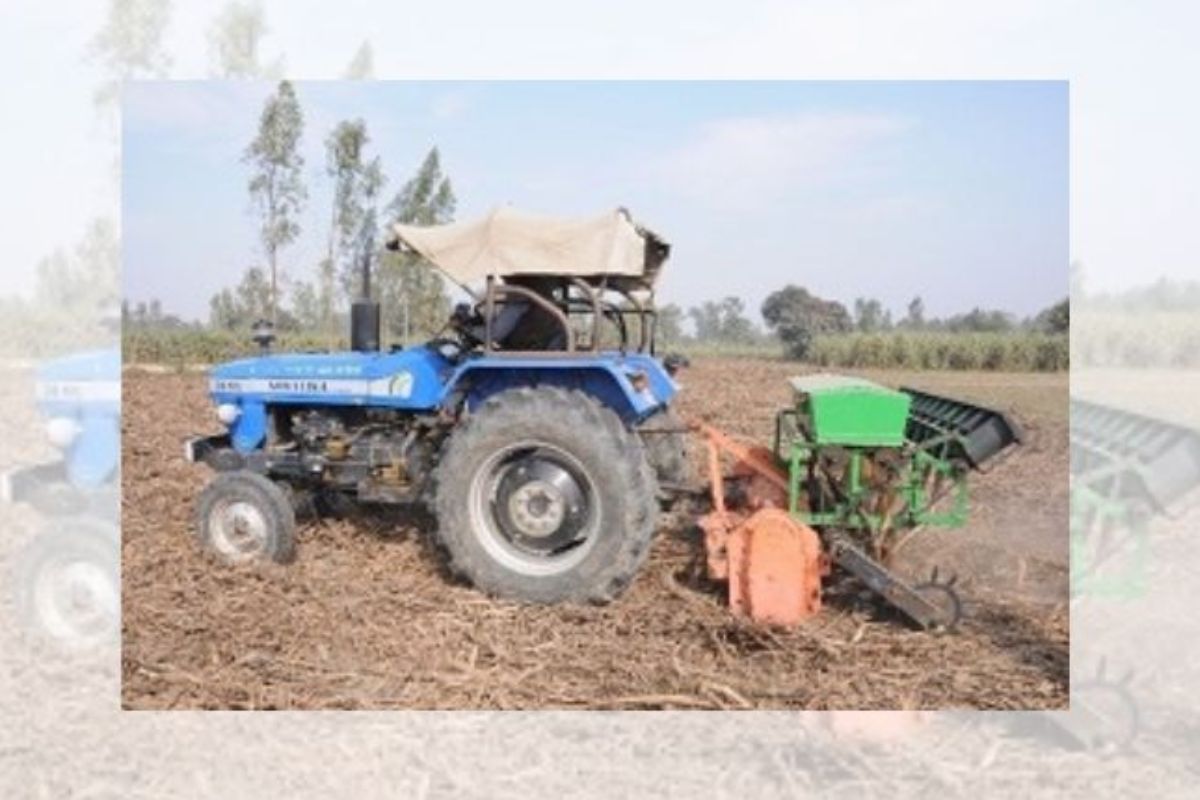
Farmers growing wheat after rice often have a narrow window between harvesting the paddy and sowing the next crop. Conventional field preparation can require several operations before wheat is planted. A zero-till seed-cum-fertilizer drill allows wheat to be sown directly into untilled soil.
What is a zero-till drill?
A zero-till seed-cum-fertilizer drill places seed and fertilizer into narrow openings made in the soil without conventional ploughing and seedbed preparation. ICAR describes tractor-operated models with seed and fertilizer boxes, metering mechanisms, depth-control wheels and furrow openers.
The machine is particularly useful for direct sowing of wheat after rice. ICAR reports that a tractor-operated zero-till drill can achieve a field capacity of about 0.3 to 0.4 hectares per hour under suitable field conditions.
1. Reduce repeated field preparation
Conventional wheat establishment after rice can involve several field operations. Each operation takes time, consumes fuel and requires machinery or labour. Zero-till sowing removes much of this seedbed preparation.
ICAR has reported that direct wheat sowing with a zero-till drill can save about 50–60% of sowing time compared with conventional seedbed preparation and sowing. The actual saving depends on soil, residue and field conditions.
2. Save fuel and operating costs
Reducing the number of tractor passes can lower diesel consumption and machinery operating costs. ICAR research has documented cost savings from zero-tillage compared with conventional wheat establishment.
Farmers should calculate savings using their own diesel price, tractor fuel consumption, labour costs and field size. A machine that reduces several operations may provide greater benefits on larger areas or where custom-hiring services are available.
3. Sow wheat soon after rice
Delayed wheat sowing can affect crop establishment and yield potential. Zero-till drilling can allow farmers to prepare less and move quickly from rice harvesting to wheat sowing.
ICAR has reported that zero-tillage can advance wheat sowing by several days compared with conventional practices. Farmers should still follow local agricultural university recommendations for sowing dates, soil moisture and suitable wheat varieties.
4. Place seed and fertilizer accurately
The drill is designed to meter seed and fertilizer rather than broadcasting both materials across the field. Proper calibration is important because incorrect settings can produce uneven seed placement or excessive fertilizer use.
Farmers should check the seed rate, fertilizer rate, row spacing and sowing depth before starting. The metering system should also be checked whenever seed or fertilizer type changes.
5. Check soil moisture before operation
Zero-till equipment works best when field conditions are suitable. ICAR specifies soil moisture of about 24–27% for the particular tractor-operated drill described in its machinery information, while previous crop residue and soil conditions also affect machine performance.
Farmers should avoid operating machinery in unsuitable wet conditions because soil may stick to openers and wheels. Very dry or hard soil can also affect penetration and seed placement. Local technical advice should guide machine settings.
6. Manage crop residue properly
Rice residue does not automatically prevent zero-till sowing, but heavy or poorly distributed residue can interfere with machine operation. Farmers should select machinery and residue-management practices according to the amount and condition of straw remaining in the field.
The government’s crop-residue-management programme includes zero-till seed-cum-fertilizer drills among machinery eligible for assistance under specified conditions. The listed maximum subsidy varies with machine configuration. Farmers should verify current state-level rules before purchasing equipment.
7. Consider custom hiring before buying
A zero-till drill may not be economical for every small farmer to purchase individually. Farmers with limited acreage can consider hiring the machine from a Custom Hiring Centre, farmer group or local machinery service provider.
The government’s farm-mechanisation platform provides information on agricultural machinery and assistance programmes. Farmers can also check locally available machinery through state agriculture departments and custom-hiring networks.
Which farmers can benefit most?
Zero-till drilling is especially relevant to farmers following rice with wheat, where the time between harvesting one crop and establishing the next can be short. It can also reduce the number of tractor operations required before sowing.
ICAR research has found that zero-tillage can maintain comparable wheat yields while reducing cultivation costs in suitable rice-wheat systems. The technology is not a universal replacement for tillage, so field conditions and local recommendations should be considered before adoption.
Farmers should compare the number of rows, tractor power requirement, seed and fertilizer capacity, furrow-opener design, depth-control system and availability of spare parts. They should also ask for a field demonstration before purchasing.
The government’s farm-mechanisation platform notes that machinery performance testing is carried out through designated Farm Machinery Training and Testing Institutes, State Agricultural Universities and ICAR institutions.
A zero-till seed-cum-fertilizer drill can help farmers establish wheat quickly after rice while reducing field preparation, fuel use and sowing costs. Its benefits depend on soil moisture, residue conditions, machine calibration and timely operation. Farmers should compare purchase and hiring costs before deciding which option suits their farm.
Also Read: Punarnava Jal – The world’s first organic fertilizer! Know how it is beneficial for farmers?
Contact us – If farmers want to share any valuable information or experiences related to farming, they can connect with us via phone or whatsapp at 9599273766 or you can write to us at “kisanofindia.mail@gmail.com”. Through Kisan of India, we will convey your message to the people, because we believe that if the farmers are advanced then the country is happy.
You can connect with Kisan of India on Facebook, Twitter, and Whatsapp and Subscribe to our YouTube channel.