


Have you ever considered what a remote sensing satellite hovering hundreds of kilometers in the exosphere has to do with the moisture of the soil in a small farm, or the exact moment a farmer decides to sow their seeds? For decades, agriculture was viewed as a strictly terrestrial endeavour, dependent on looking up at the clouds and relying on generational intuition. Today, the fundamental architecture of farming is undergoing a radical, borderless transformation.
Far from the immediate geopolitical headlines of currency swaps and diplomatic summits, the BRICS nations (Brazil, Russia, India, China, and South Africa, now expanding into BRICS+) have been quietly building a closed-loop agricultural ecosystem. This is not a temporary policy shift; it is a permanent technological infrastructure designed to feed nearly half the planet’s population. By linking space technology, biological laboratories, and digital public infrastructure, the Global South is creating an independent agricultural framework.
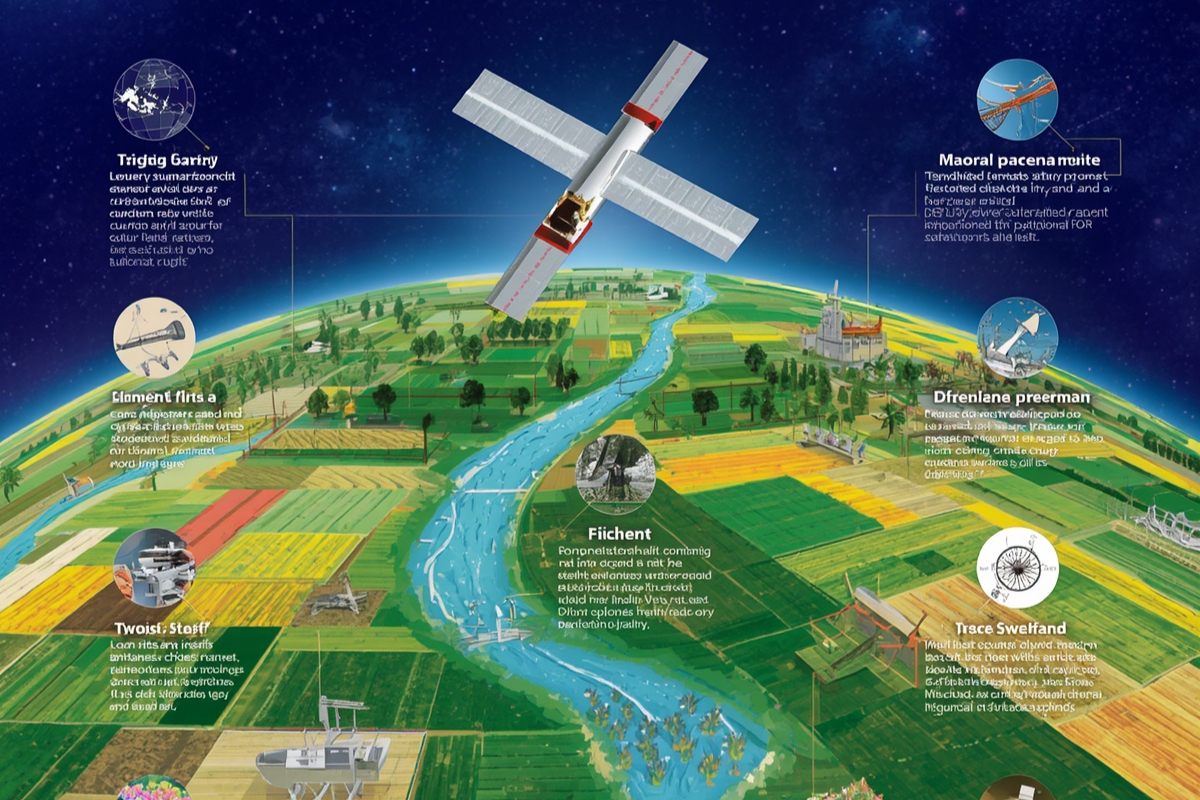
To understand how this massive, multi-continental operation functions on the ground, we can decode it through three critical phases of technological integration: Orbital Observation, Biological Innovation, and Digital Application. This approach explains how raw data from space is transformed into genetic resilience in the lab, and ultimately, into actionable economic decisions for the farmer in the field.
Phase 1: Orbital Observation (The Sovereign Space Grid)
The foundation of modern agricultural security is data, and the ultimate vantage point for global agricultural data is space. Historically, developing nations relied heavily on Western space agencies and commercial satellite operators to provide critical earth-observation data regarding weather patterns, soil health, and impending natural disasters. The BRICS ecosystem fundamentally changes this power dynamic through the BRICS Remote Sensing Satellite Constellation, an agreement formalized in 2021.
This is where the ecosystem begins. The constellation is not a single, newly launched mega-satellite; rather, it is an intelligent, integrated virtual network of existing sovereign satellites. It brings together India’s Resourcesat series, China’s Gaofen and Ziyuan satellites, Russia’s Kanopus-V, and the jointly developed Sino-Brazilian CBERS satellites.
Why does a joint constellation matter for agriculture? The answer lies in planetary physics and revisit times. A single satellite orbiting the Earth might pass over a specific farming region in India or Brazil only once every few days. If a critical weather event—like a sudden cloudburst or a rapid pest migration—occurs in between those passes, the data is lost. By pooling their satellite networks, BRICS nations have drastically reduced the revisit time. The ground stations in these countries now share real-time, high-resolution optical and radar imagery.
For the agricultural sector, this constant stream of telemetry is revolutionary. Hyperspectral sensors on these satellites can read the exact chemical composition of the crops below. They can detect the early thermal signatures of a drought weeks before the soil visibly cracks. They can map groundwater depletion, track the movement of locust swarms across continents, and measure the exact nitrogen levels in vast tracts of farmland.
The constellation ensures that the Global South is no longer flying blind or waiting for third-party reports. The observation grid is uninterrupted, sovereign, and incredibly precise. However, raw data from space is merely a diagnostic tool. To secure food supplies, that data must be interpreted and transformed into biological solutions.
Phase 2: Biological Innovation (The Open-Source Seed Banks)
If the satellite provides the raw data of a changing planet, the laboratories provide the deep scientific innovation required to adapt to it. When the space grid indicates that average temperatures in a specific agricultural belt are rising by a degree, or that rainfall patterns are becoming dangerously erratic due to El Niño, what is the systemic response?
This is where the BRICS Agricultural Research Platform (BRICS-ARP), operationalized with institutions like the Indian Council of Agricultural Research (ICAR) acting as pivotal nodes, steps in. This phase is all about genetic decryption, germplasm exchange, and climate-smart biology.
The agricultural profiles of BRICS nations are highly diverse but complementary. Brazil is a powerhouse in large-scale, mechanized agriculture and has mastered the art of tropicalizing crops through its state agency, EMBRAPA. China possesses advanced capabilities in genomic sequencing and high-yield hybrid technologies through the CAAS (Chinese Academy of Agricultural Sciences). India, with its vast network of smallholder farmers, leads in biodiversity, traditional drought-resistant crops like millets, and highly adaptable agricultural extension programs. Russia contributes unparalleled expertise in soil sciences and vast arable landmass capabilities.
Under the BRICS framework, these nations are moving beyond isolated research and establishing a massive, open-source biological repository for the Global South. When scientists from these countries collaborate, they combine their genetic libraries. For instance, if Brazilian scientists have successfully isolated a specific gene sequence that makes soybeans highly resistant to prolonged dry spells in the Cerrado region, that genomic understanding can be shared with Indian researchers aiming to fortify local oilseed crops against erratic monsoons.
This phase of innovation is heavily focused on anticipating the future. As climate change accelerates, traditional staple crops like wheat and rice are becoming increasingly vulnerable to heat stress and water scarcity. The BRICS research network is heavily investing in the genetic mapping of resilient alternative crops. By studying the DNA of forgotten, climate-hardy crops and utilizing modern biotechnology, scientists are breeding seeds that can withstand the harsh realities projected by satellite data.
This is not a theoretical exercise; it is an urgent biological arms race against climate change. The seed banks and research platforms of BRICS are working to ensure that the crops planted a decade from now will have the built-in genetic memory to survive extreme weather. The data from space has been synthesized into the very DNA of the seed.
Phase 3: Digital Application (The Farmer’s Agri-Stack)
The most advanced satellite constellation and the most resilient, genetically fortified seed mean absolutely nothing if they do not reach the hands of the individual farmer. The final, and arguably most critical, phase of this ecosystem is the application on the ground.
Historically, there has been a massive disconnect between macro-level agricultural science and micro-level farm operations. The BRICS framework, heavily influenced by India’s aggressive push for Digital Public Infrastructure (DPI), is bridging this gap through what is broadly termed the ‘Agri-Stack’.
How does the farmer utilize this massive scientific undertaking? By receiving the distilled essence of space signals and laboratory innovation directly on their mobile device. The Agri-Stack architecture utilizes national digital identities, digital land records, and localized weather APIs to create a hyper-personalized advisory system for the farmer.
Imagine a smallholder farmer preparing for the sowing season. Instead of relying on a generalized regional weather forecast, the farmer receives an alert on their phone. This alert is powered by the combined intelligence of the BRICS satellite network, which has detected anomalous moisture patterns indicating a delayed monsoon. Simultaneously, the digital advisory system, drawing on the biological data from agricultural research platforms, suggests delaying the sowing of traditional seeds by ten days, or alternatively, recommends switching to a specific, newly developed short-duration, drought-resistant crop variety that requires 30% less water.
The application extends beyond just sowing. It dictates the precise use of resources. Using satellite-mapped soil health cards, the farmer knows exactly which quadrant of their two-acre plot requires nitrogen and which quadrant is deficient in phosphorus. This precision agriculture, previously available only to massive corporate farms in the West, is being democratised for the smallholder farmer through low-cost digital tools, IoT sensors, and drone-based spraying technologies championed within the BRICS digital agriculture working groups.
Furthermore, this infrastructure empowers the economics of the harvest. By integrating global crop yield data and regional demand metrics, digital platforms can advise farmers on the optimal time to harvest and sell. As BRICS moves toward systems like the proposed BRICS Grain Exchange, the goal is to protect local farmers from localized market gluts and the wild price swings of Western commodity markets, offering a more stable economic environment. The farmer is no longer a passive participant reacting to nature; they are an active, data-empowered decision-maker operating at the terminal end of a highly sophisticated technological supply chain.
The Geopolitics of Food Security and the Evergreen Reality
Understanding this Seed-to-Satellite framework reveals why the BRICS agricultural agenda is far more significant than any single diplomatic summit or annual joint declaration. It is about fundamentally rewiring the geopolitics of food.
For centuries, the Global South has been disproportionately vulnerable to external shocks. Whether it is a fluctuation in global fertilizer prices dictated by regional conflicts, a sudden change in commodity prices driven by speculators in Chicago, or technology export bans by Western nations, developing countries have often paid the highest price.
The integrated ecosystem of Orbital Observation, Biological Innovation, and Digital Application acts as a strategic shield against these vulnerabilities. By building their own remote sensing capabilities, these nations are breaking the monopoly on planetary data. By pooling their biological research, they are ensuring that the intellectual property of future food security belongs to the developing world. And by deploying digital public infrastructure, they are guaranteeing that this technological wealth is distributed down to the most marginalized farmers.
The expansion into BRICS+ adds even more gravity to this ecosystem. With the inclusion of nations like Egypt (one of the world’s largest grain importers), Ethiopia (an agrarian-heavy economy), and the UAE (possessing massive capital for agri-tech investments), the network of data, biology, and capital is becoming deeply intertwined. The ecosystem is designed to be self-sustaining, capable of absorbing climate shocks and economic embargoes alike.
The Ultimate Takeaway for the Farmer
For the agricultural community, the narrative is clear and evergreen: farming is no longer merely the physical act of tilling soil. It is applied space science, advanced genomics, and data analytics operating in real-time.
The traditional image of the farmer as someone isolated from the cutting edge of technology is obsolete. Within the emerging BRICS agri-ecosystem, the farmer is the central node of a vast, invisible network. When a farmer stands in their field today, looking at their digital advisory application, they are standing at the intersection of orbital physics and molecular biology.
They are utilizing the observation data from the exosphere, planting the innovations forged in the leading laboratories of the Global South, and executing agricultural strategies that not only secure their own livelihood but collectively ensure the food security of billions. This closed-loop system is the new reality of global agriculture, an enduring infrastructure that will outlast political cycles and redefine how human civilization sustains itself in the 21st century.
Also Read: Punarnava Jal – The world’s first organic fertilizer! Know how it is beneficial for farmers?
Contact us – If farmers want to share any valuable information or experiences related to farming, they can connect with us via phone or whatsapp at 9599273766 or you can write to us at “kisanofindia.mail@gmail.com”. Through Kisan of India, we will convey your message to the people, because we believe that if the farmers are advanced then the country is happy.
You can connect with Kisan of India on Facebook, Twitter, and Whatsapp and Subscribe to our YouTube channel.
