



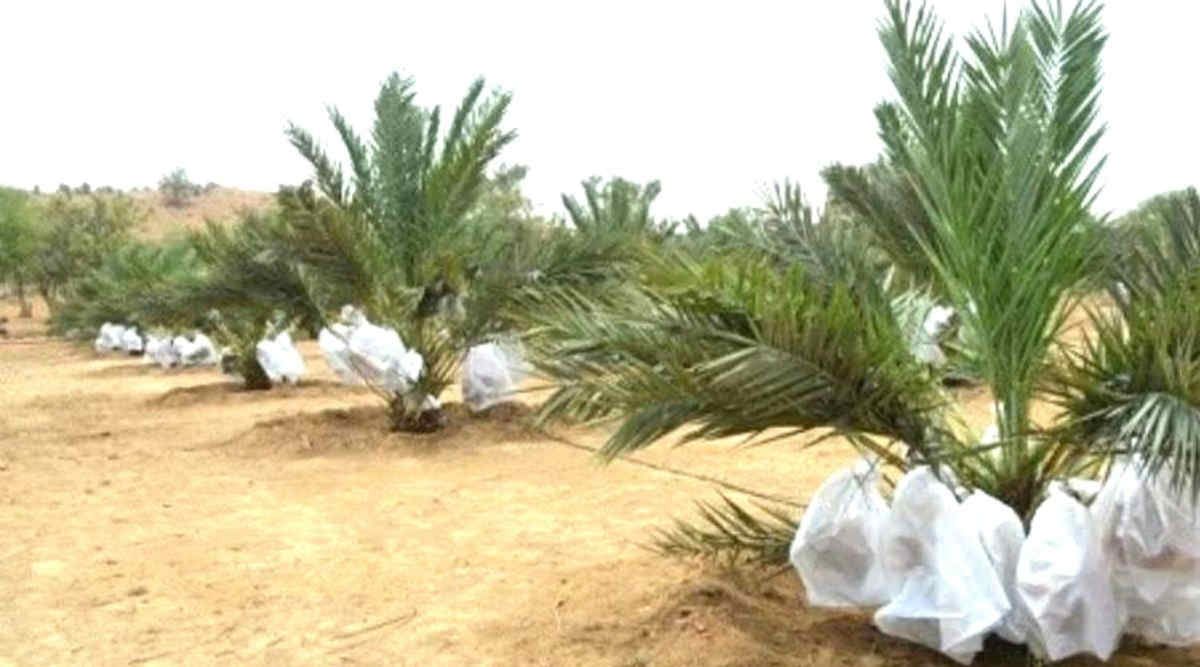
India is stepping up efforts to expand date palm cultivation across arid and semi-arid regions as part of a broader strategy to reduce dependence on imported dates. States such as Rajasthan, Gujarat, and parts of Haryana are emerging as important centres for commercial date palm production, supported by improved planting material and specialised cultivation techniques.
The initiative comes as domestic demand for dates continues to grow. India remains one of the world’s largest importers of the fruit, creating a significant opportunity for local production. Agricultural planners believe that suitable desert regions can support much larger cultivation areas in the coming years.
For farmers operating in water-scarce environments, date palm offers an alternative to traditional crops that often struggle under harsh climatic conditions.
The crop is increasingly being viewed as a long-term investment in desert agriculture.
Dates are consumed across India throughout the year and witness especially strong demand during festive and religious seasons.
Despite this large market, domestic production remains far below consumption levels. Imports account for the majority of supplies available in wholesale and retail markets.
This gap has attracted policy attention.
Agricultural departments see an opportunity to strengthen local production while reducing import dependence. Expanding cultivation could also improve farmer incomes in regions where crop choices remain limited.
The economic potential is substantial.
Demand already exists.
Desert Conditions Suit the Crop
Date palms are naturally adapted to hot and dry environments.
Unlike many fruit crops, they can perform well under high temperatures and limited rainfall conditions. This makes them particularly suitable for desert regions where conventional horticulture faces constraints.
Researchers have identified several areas with climatic conditions favourable for commercial cultivation.
Modern irrigation systems have further improved the viability of date palm farming in challenging environments. Farmers can now maintain orchards with greater efficiency than was previously possible.
Adaptation to arid conditions remains the crop’s greatest strength.
One of the major developments supporting expansion is the availability of tissue-culture planting material. Traditional propagation methods often resulted in uneven orchards and variable productivity. Tissue-culture plants provide greater uniformity and allow farmers to establish high-quality plantations.
Agricultural experts believe this improvement has significantly increased commercial interest.
Better planting material contributes to higher yields, improved fruit quality, and more predictable production outcomes.
Technology is helping transform a traditionally niche crop into a larger commercial enterprise.
The sector is becoming increasingly organised.
Date palm cultivation creates opportunities beyond farming itself. Processing, packaging, grading, storage, and value-added product manufacturing all contribute to the industry’s economic potential. Products such as date syrup, date powder, and processed snacks are attracting growing consumer interest.
Entrepreneurs are beginning to invest in these segments as production expands.
The development of local value chains can help ensure that more economic benefits remain within producing regions.
Agricultural economists view processing as a critical component of long-term sector growth.
Production alone is not enough.
Market development must follow.
Farmers Diversify Income Sources
Several farmers adopting date palm cultivation are integrating it into broader horticultural systems.
The crop provides an additional income stream while reducing dependence on traditional field crops. Because orchards remain productive for many years, growers often view them as long-term assets.
Diversification is becoming increasingly important in regions facing climatic uncertainty.
Perennial crops can provide greater stability compared with seasonal production systems. Date palms are therefore attracting attention from farmers looking to strengthen resilience.
The trend is gaining momentum.
For decades, desert agriculture was largely associated with limitations. Today, improved technology, irrigation systems, and crop selection are changing that perception. Date palm cultivation is becoming one of the most visible examples of this transformation.
The crop aligns well with the environmental realities of arid regions while serving a market that already exists at scale. Farmers gain access to a high-value horticultural enterprise, and the country benefits from increased domestic production.
As plantations continue expanding, date palms may become a more familiar feature of India’s agricultural landscape.
In the deserts of western India, a crop once considered specialised is steadily moving into the mainstream.
Contact us: If farmers want to share information or experiences related to farming with us, then they can do this by calling us on the phone number 9599273766 or by writing an email to kisanofindia.mail@gmail.com or by sending your recording. Through Kisan of India, we will convey your message to the people, because we believe that if the farmers are advanced then the country is happy.